
Translated material
The Russian missile "Soyuz" successfully started with two Galileo satellites from the Cosmodrome Kuru
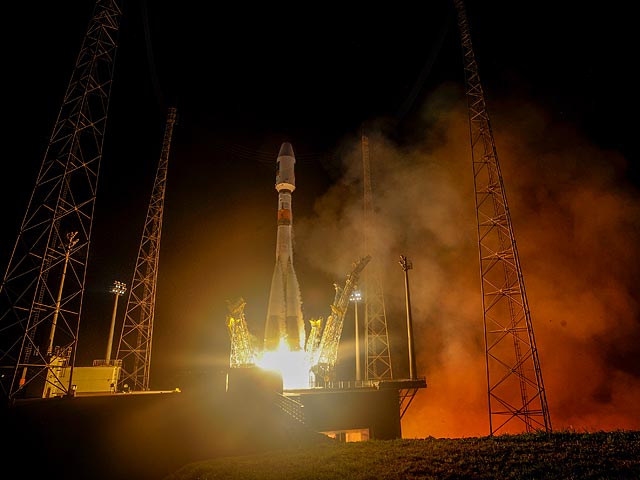
The Russian Soyuz-ST launch vehicle with two European satellites of the Galileo navigation system started on Friday night from the Cosmodrome Kuru in French Guiana. The satellites have successfully reached the intermediate orbit in the estimated time, according to the website of Roscosmos.
"On September 11, at 05 hours 08 minutes Moscow time from the Guiana Space Center (GCC, French Guiana), the joint calculations of Russian and European experts completed the Soyuz-ST launch vehicle with the Fregat-MT and two European spacecraft Galileo FOC M3," the space department said.
According to Roscosmos, in the calculated time (at 05:17) the head block as part of the Frigat-MT acceleration unit and the two spacecraft Galileo FOC M3 separated from the third stage of the launch vehicle and continued the flight.
The department of spacecraft from the accelerated unit is scheduled for 08:56 in Moscow. Further withdrawal of satellites to target orbit will occur due to two inclusions of the accelerated unit engine, an agency representative told Interfax .
Satellites will become, respectively, the ninth and tenth in a row taken to orbit as part of the Galileo project, RIA Novosti notes.
The total cost of the Galileo navigation project is about seven billion euros. Each of the system satellites cost about 40 million euros. The launch of the Russian Soyuz-ST from the Cosmodrome Kuru in French Guiana costs 65-70 million euros.
It is planned that by 2020, 30 Galileo satellites should be brought to orbit. Galileo developers say that their system will be more accurate than GPS, and will provide Europeans with independence from the American GPS, Russian GLONASS and Chinese Compass. The commissioning of the system was originally planned for 2008, but then repeatedly postponed.
The Union project in the Guiana Space Center is implemented on the basis of an intergovernmental agreement between Russia and France, signed in November 2003. Roscosmos is responsible for the implementation of the program from the Russian side and coordinates work with domestic enterprises of the rocket and space industry involved in the program (FSUE "Tsenka", OJSC "RCC" Progress ", NPO n. A. Lavochkin).
The Soyuz-ST launch vehicle Production of OJSC RCC Progress (Samara) was developed on the basis of the Soyuz-2 missile to ensure the launch of spacecraft from the Kuru cosmodrome. It is adapted to the requirements of the Guian of the Space Center in terms of safety, the system of telecommunications and operating conditions.
The Acupress of Fregat-MT is developed by NPO named after S.A. Lavochkin for the removal of spacecraft for various purposes as part of the Soyuz type missiles.