
Translated material
Dance so far young
The record-label for eight years has been deleting a video with a baby dancing under the prince
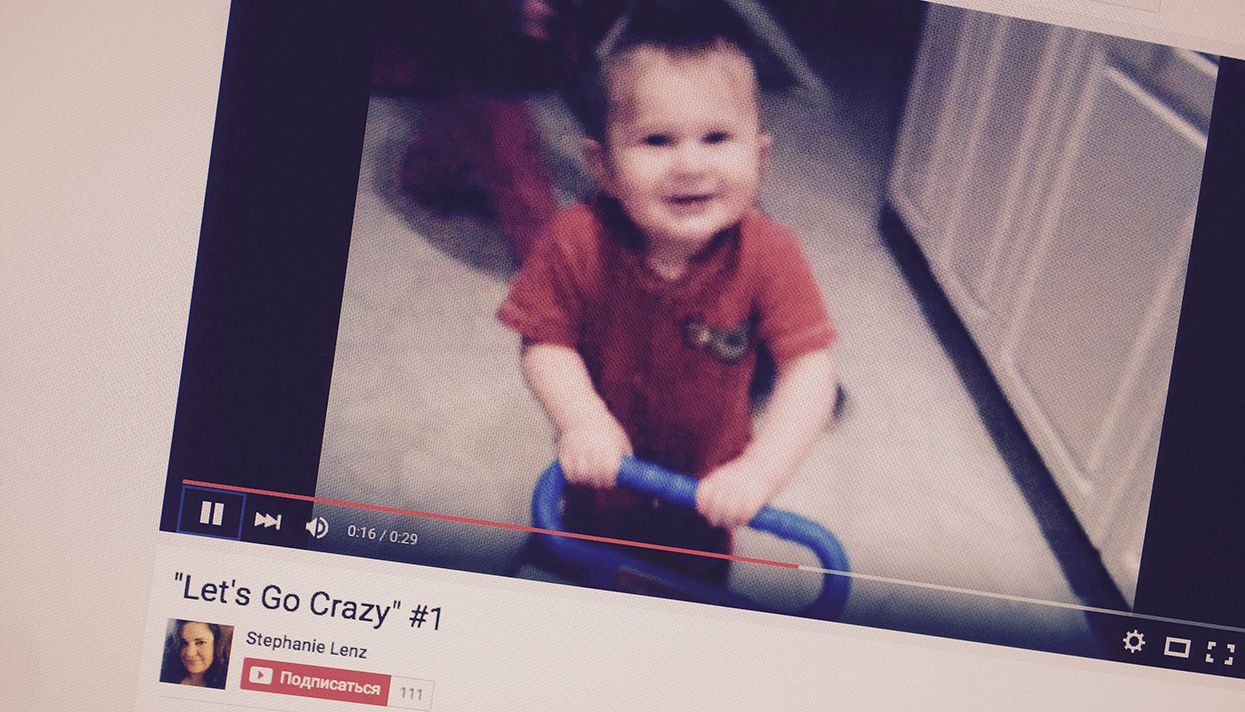
On September 14, an important court decision was made - the US Court of Appeal determined that the copyright holders must decide whether their property is in good faith or not before complaining. It sounds difficult, but if you look at the case by which such a decision was made, everything becomes extremely clear. Universal has been suing the simple American Stefani Lenz for eight years, which in 2007 laid out on YouTube 29-second video of its child, dancing the prince “Letʼs Go Crazy” under the song, and the song in the video can be distinguished with great difficulty. "Medusa" tells how ordinary home video has become a symbol of the struggle against the copy.
In February 2007, Stefani Lenz laid out a short video on which her child, who had not yet learned how to walk, dance to the music. Having listened, you can identify the composition of the prince “Letʼs Go Crazy” in the song, but it is not easy to do it-the song sounds somewhere in the background, and the video and sound of the roller do not differ in high quality. Universal records in combating violation of the Rights of the Laubla record-label found a video and turned to the YouTube administration with an ordinary request to delete it for a violation of copyright. Such appeals of YouTube or any other such service within the framework of the American law on copyright in the digital era are received - and satisfied - constantly. In most cases, no one complains.
Lenz was not one of those who are ready to forget about the remote video and, with the support of the Electronic Frontier Foundation, filed a court to Universal. In her opinion, the copyright holders often throw YouTube with the requirements for removing content even in cases where there was no copyright violation, and this contradicts all Americans to freedom of speech. In American legislation, there is a concept of conscientious use of other people's content - in the news, for parodies, research and other goals; According to Lenz, this is exactly what was the case in its case. In Universal, they insisted that the prince’s songs should not be used in home videos - and promised to achieve removal of any such videos.
The prince generally has a strange relationship with Internet services-many of his songs are not on YouTube and in popular striming services. These relations turned out to be strange in the case of a video with a dancing child. The fact is that in 2006, Universal signed an agreement with YouTube, which allows the video service users to include label songs in their videos - whether it is a video review of new albums or a funny video with a baby or a cat. Only a video with the music of those artists who did not like such a scheme are deleted. There was only one among thousands of artists Universal: Prince. Everyone else, including superconsciousness, had nothing against their songs in videos with babies.
After filing a lawsuit, the video returned to YouTube (and scored 1.3 million views, which is incredibly a lot for a rather boring home video), and the court litigation dragged on for many years. The Lenz Court with Universal has become one of the most famous cases of the absurdity of copyright and a symbol of the struggle for the free distribution of information. Lenz herself, with the support of EFF lawyers, gave dozens of interviews and gained public sympathy. The publicity was also given publicity by the fact that this court concerned everyone who has ever flooded their home shootings on YouTube.
Universal did not recede to the end. In 2010, the label even tried to prove the failure of the case Lenz because she publicly talked about her negotiations with lawyers, but she managed to defend the claim. In the end, the label was found guilty of abuse by law, but the musical giant appealed.
The lawsuit is already eight and a half years old, a child who has become the main character of the video had to go to school for a long time, and the decisions have not yet been made. On September 14, the case was considered in the Court of Appeal of the Ninth District of the United States - but this court did not make a final decision, but only approved the right to consider the case and established a recommendation for it. She says that owners of copyright should take into account the very conscientious use - that is, to complain about violations not stupidly, but with meaning. Defenders of freedom of speech already call this victory and believe that a loud precedent will warn abuses by copyright holders.
Pavel Borisov
Riga