
Translated material
Yuan ruble not a comrade
The situation in the Chinese economy remains complicated, the exchange of Shanghai and the Schinjhenia fever, the stock market has lost the amount equal to two GDP of Russia, the world is full of rumors about the broken “Chinese dream”. Meanwhile, not only the price of oil depends on China, but also the volume of the promised Celestial Investments in the Russian economy. What to wait - the New Times sorted out
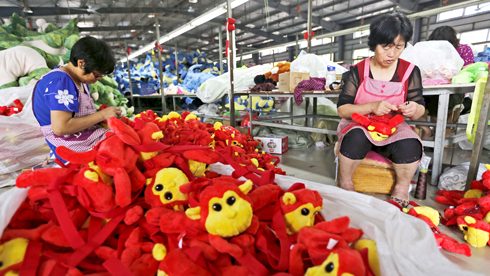
At a factory of soft toys in Lianungan (Jiangsu province), the products of which are exported to the USA and the EU, September 2015, as it should be ancient, distant, huge and also confessing oriental religion, China is doubled in the eyes of an outside observer, introducing themselves as one or its other face.
You can see the Celestial Continent Star: the growth rate of its GDP as a percentage of 2.5 times higher than the growth rate of the whole world, and the GDP itself exceeded $ 10 trillion - the third place after the EU and the USA. Gold exchange reserves - more than $ 3.77 trillion, that is, 32 % of global. The country is the largest trading partner in the United States and the EU with a turnover of more than $ 1.3 trillion (almost GDP of Russia in 2015), while its total turnover with the outside world is more than $ 4.5 trillion.
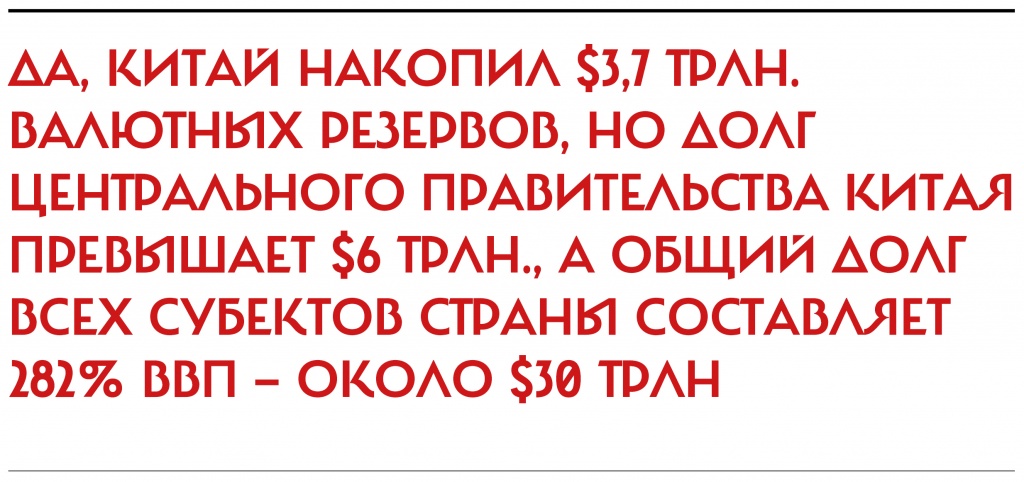
But you can see something completely different. Despite the efforts made since the reforms of Dan Xiao Pina, it remains a country with a low level of per capita GDP - about $ 7.5 thousand per person per year, occupying a 79th line in the list of countries of the world - worse than Belarus and Azerbaijan, along with Botswana. Even a high percentage of the growth rate of per capita GDP in dollars is modest and has not grown for several years - a little more than $ 500 per person per year, the United States has this figure 2 times higher. Half of the population of China still lives on income less than $ 4 per day - in Russia there are less than 5 %. Although China economically exceeds Russia by 8 times, in per capita calculation - still poorer by 1.5 times. Yes, China has accumulated $ 3.7 trillion of foreign exchange reserves, but the debt of the Central Government of China exceeds $ 6 trillion, and the total debt of all subjects of the country is 282 % of GDP - about $ 30 trillion.
Both views are faithful and adequately describe the country that, due to the reforms of the 1980s, managed to competently use the presence of a huge amount of very cheap labor, rush forward from the “low base” and grow as much as possible with such powerful limiters as non-investigated sources of external income, centralized planning and administrative management of the economy.
Records with questions once a modest invention of an American engineer-a system of fasteners for marine containers-allowed China due to a sharp reduction in sea and rail transportation to become a global production platform, primarily in the production of cheap clothes and shoes (the United States to this day buys from China for tens of billions of dollars a year). The policy of centralized stimulation of new industries and entrepreneurship made it possible to expand exports: today the same United States purchases many times more machines, equipment and electronics in China than clothing, and the US trade deficit in operations with the PRC amounted to $ 382 billion (20 % more than in 2008).
However, from the very beginning for the Chinese leadership, the internal inconsistency of such an economic model was obvious. The main competitive advantage of China - cheap labor - as export volumes increased, it became more expensive, leveling other competitive advantages and allowing neighbors - India, Thailand, Vietnam, Malaysia and others - to take away its market share from China. Therefore, the priority of economic policy was to restrain the growth of labor cost with the simultaneous redistribution of income received from the export of the country's industries and regions (until recently all export production were located in the coastal strip along the East China Sea). In case of failure, they came up with an alternative option - to activate the development of the domestic market, so that the growing incomes of the population are reinvested in production for domestic consumption, making China less dependent on external economic relations.
All these years, China has retained the rigid structure of economics management: the largest companies still belong to the state, the four largest state-owned banks control all large lending, the share of borrowed funds in business balance sheets is significantly higher than the mid-INSTRURE, so the joint-stock capital is not too important. Such control allowed the authorities to manipulate the economy.
Nevertheless, China could not effectively influence the cost of the Communist Party of the Communist Party of China: from 5 thousand yuan in 1995, the average salary in China rose to almost 57 thousand in 2014. Economic policy was reduced to a comprehensive stimulation of production, which gradually became less profitable, and the accelerated creation of infrastructure, designed not only to accelerate operations and reduce cost, but also to activate the domestic market due to the redistribution of export revenues (no more than 30 % of labor resources were occupied in exported business) between hundreds of millions of PRC citizens.
A year after year, China set records for the volume of investment in the construction and infrastructure, holding their level in the region of 50 % of GDP. The success of the country in the modernization of the road network, communications, energy complexes, urbanization and creation of production clusters are well described. But it’s not enough where you can find the answer (at least in the form of calculations) to another question: how effective and profitable are new objects? On the contrary, in many cases, their profitability and even potential use are very doubtful.
Chinese bubbles nevertheless have not yet been able to disperse the domestic market China: the Chinese are economical. As a result, all more savings accumulate in households, which are practically nowhere to invest. The banking system, responding to an excess supply of money, pays interest on deposits a little less than the inflation rate, collecting money for cheap loans to state -owned companies. Private trusts and funds are more generous, but the collected money is used in opaque schemes with high risks.
Therefore, recently, the Chinese stock market has become one of the areas of investment (and redistribution levers). Cut off the restrictions on the movement of capital (Chinese cannot buy more than $ 50 thousand per year; everyone, except for the inhabitants of Venzhou, cannot be invested abroad) and the mainly state -owned company, the traded share in which is relatively small (about 40 %), the stock market has become a kind of megakazino - first of all, for owners of hundreds of millions of accounts discovered by citizens, opened by citizens. PRC, as well as an arena for manipulations in the scale unheard of for the rest of the world - what is the sensational story of Luan, who had earned stocks on manipulations for several years in a row using 14 thousand brokerage accounts
* * Lu Liang, aka Mr. K - a financial columnist popular in China. In the late 1990s-early 2000, he controlled, together with a group of ten people, almost 14 thousand brokerage “accumulations” opened to dummies: Lou agents went into the rural hinterland and rewrote the passport data of the peasants for a modest reward. Lu Lyan dispersed the capitalization of companies in which his group had a significant package, and then at once dropped shares. In 2001, he was sentenced to a long time. .
Another lever was the residential real estate market: investors received money there, which led to pouting a bubble, the growth of which the state is trying to restrain - for example, in 2013, an empty apartments were introduced in the country to stop increasing prices for investment housing.
In 2014, the turn of the stock bubble came. Local investors, among which two -thirds did not even graduate from school, raised the market by 150 %, although GDP increased only 7 %for the same time. At the same time, unlike the real estate market, the stock market, even such as in China, is difficult to regulate: the authorities did not just miss the saturation levels, but on the contrary, through a decrease in lending rates and official assurances in the reliability of growth, in every possible way contributed to puffing the bubble. As a result, in June 2015, the third large-scale collapse on the exchange began the third over 10 years. The stock market eventually lost the amount equivalent to the two GDP of Russia (
In early July, losses were estimated at $ 2.3 trillion, which is 10 Greece Generals. - NT ), and after correction did not even reach the levels of the beginning of 2014. Of course, the Chinese stock market is not directly connected with the economy, and its collapse in itself does not say anything about the state of affairs in China. Nevertheless, this is serious: the reasons for slipping into a corkscrew were brewing for a long time, and the reaction of the authorities raises many questions.
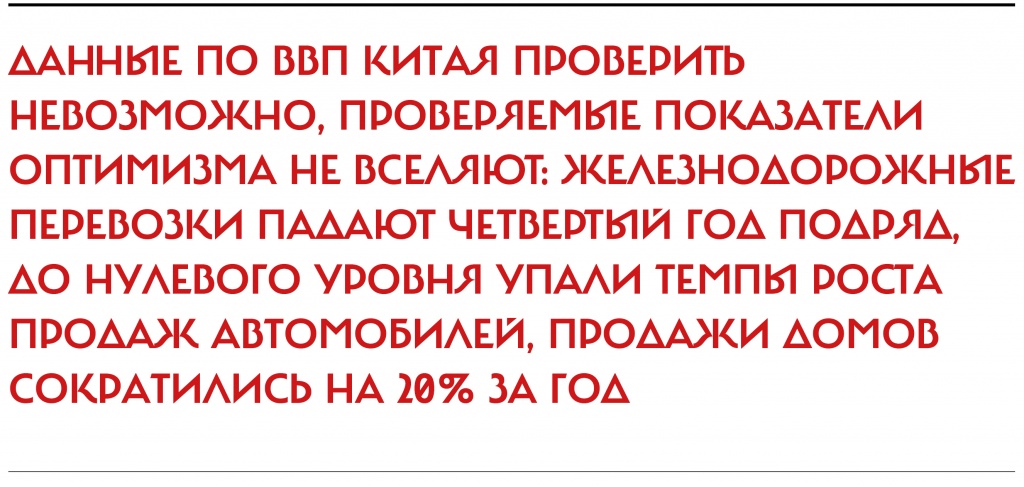
Two reality of the problems that China has successfully masked for many years, begin to break out. Their main ones are steadily falling efficiency of the economy. The costness of exports is growing, on the other hand, stimulation measures taken to support it are no longer enough. As a result, the fall in 2014 of exports to all countries except the United States and the EU (in 2015, the fall is also expected in these areas). The turnover with Russia for the first half of 2015 fell by 29 % - to $ 30.6 billion. GDP growth reached the ceiling - $ 500–550 per person per year - and it fails to break through, although the authorities stubbornly report on the further GDP growth: in 2015, the expected growth of 6.9 %. And there are also large international analysts, as the newspaper The Financial Times writes, it came to the conclusion: the published data on Chinese GDP is actually impossible to verify, while the verified indicators of the Chinese economy do not instill optimism: railway transportation falls fourth in a row, the volume of electricity generation almost did not grow up, the production of cement drops for the second year under the row, the second year under the row, the second year in the row, the second year in the row, the second year in the long time. As well as imports - in 2015 it has already fallen by 15 %. To the zero level, the growth rate of car sales fell, sales of houses were reduced by 20 % per year.
The figures are shown: with official data on the growth rates of China's GDP, something is wrong. More suspicions give rise to the actions of the authorities: for example, the recent decision on the devaluation of the yuan, covered by the “transition to market pricing” (in reality, the market is controlled by the Central Bank of China and State Banks) - this is a direct attack on the growing cost of production. No one argues, the measure is significant. Only now, it is unlikely that the comrades from the State Council of the PRC would have gone to her if they had seen the real GDP growth - at least from the fears of the market overheating.
Add to this the problems associated with corruption - both large -scale theft and the fight against it - who made officials more passive and sharply slowed down the implementation of the package of measures taken in 2013 - in fact, the reforms did not move off the dead point; The concentration of power in the hands of the chairman of the CPC SI: the prime minister, in fact, is a technical figure, and the ministers are waiting for the first -person command, and as a result, the country misses the challenges - from the revolution of umbrellas in Hong Kong to the bubbles on the market; Excessive administration and monopolization - all this to us, of course, is well familiar to us, but from this relationship with the new main partner of Russia (and in the absence of an alternative, which was the Western economy) do not become easier. Comrade SI, meanwhile, at the end of the month he flies to the USA-first will stop on the west coast, in Seattle, where his meetings with Bill Gates and the leaders of other Internet giants are planned (apparently, Google returns to China, from where he left, protesting against censorship restrictions from the Chinese authorities), and then he will fly to New York, where in the fields of the General. The Assembly of the UN will meet with Obama, who is still evading from a meeting with Putin. (
According to
The White House clearly made it clear to the Kremlin that the meeting of the presidents makes sense only if there were specific proposals in the hands of Putin - in the Crimea and Ukraine, first of all. ) In other words, the leadership of the PRC understands that the previous growth potential is almost exhausted (China's per capita GDP is 1.5 times lower than that of South Korea), the Chinese “order economy” requires modernization, the latest Western technologies can not be taken out (and this is a serious problem in the relations of China and the USA, about Obama about to talk with SI in New York Bloomberg agency), rich in hydrocarbons and other minerals of the country - that Russia, that Africa, will not be taken out by the Chinese economy. Relations with the West become more important than China than ever, and this Russia sitting behind a sanctions fence will have to be considered.
Here is such a partner now, if not to say - an older brother.
Photo: Reuters/Stringer China Out