
Translated material
The monologue of the scarecrow of the crocodile
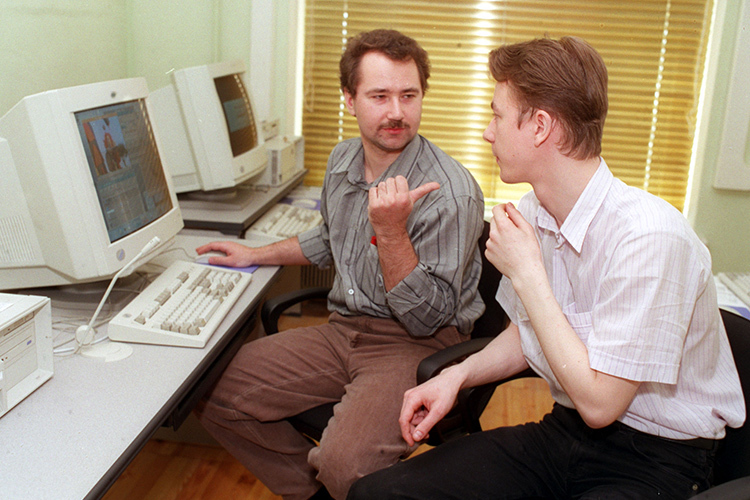
On the eve of the festival "Island of the 90s", Colta.ru publishes materials about this interesting time.
Come to our festival! The entrance is free. The program is here
This note should not be written to me, but to some silent witness, all the nineties secretly following the sunrise and the fall of the so-called network literature. I have a quiet spying of growth and wilting her, who observed from Fryazin or from Frisco skeptical and kindly behind a boil of foam. Or just a historian who was not related to events. But not to me, who worked in this zoo with a crocodile. There is nothing more stupid than suddenly talking museum exhibit. It remains to rely on the weakness of memory, which, as you know, greatly contributes to the objectivity of the description.
Let's try to turn it off and turn on the smoothing again. The nineties in general - quite vague in its borders and uneven region inside. In a good way, they need to be described by a way, especially in such an area as the Internet. We will proceed from the trivial idea that the nineties begin in 1991, when the USSR ceases to be, and end in 2000, when Putin begins to be. A detailed and consistent description is a matter of future historians, but now I am now interested in the general outline of the story about how the nineties have turned into two thousandths in one individual cultural field.
At the start, in 1990-1992, we have this: no Internet inside, weak signs of Russian life outside. At this first stage, when the USSR collapsed and the first signals from Moscow to Barnaul, from Tallinn to Helsinki, flew only the formation of the Russian choir. The baritones and soprano from the conditioned Haifa and Houston sound with the gradual connection of altas and tenors from the approximate Obninsk and Akademgorodok. Black screens, green letters, text interfaces.
A modern person can easily explain what Russian Internet model is 1993-1994.
Imagine a large city library in the regional center, in which dozens of specialists came to install computers. And then suddenly - well, I don’t know what ... For example, the plague, cholera, Ebola and typhus. Quarantine, in general. The library was closed, ITSHNI and librarians inside begin to live their lives. Slowly pull the wires, install programs. They read books, exchange impressions. Separate favorite books from the library fund are scanned - just to look at how it all works. So the first electronic libraries are formed. Library of Evgenia Peskina (1992) - a project is purely individual, the library of Maxim Moshkov (1993) - the project is fundamentally collaborative. (Both still exist.) However, the main life boils in the smoking room. Here they exchange sharpnesses, flirt, argue to aches in languages and, of course, tell jokes. The role of the smoking room in our case is performed by the USENET television conferences (no one has ever called them that, they said simply: Newsgroups), that is, collective email newsletters with constantly available open archives. It is from here that the first virtual personalities ripen in these nicotine incubators later, in these nicotine incubators, among which there are simply scandalists, but writers also come across. In order to give the reader an idea of that completely frivolous friendly literary environment (I remind you, I remind you, and they are terribly far from the people), you should call my beloved writer from this smoking room-Misha Fliggenko, the author, for example, the immortal “Swede Council”:
Seamstress! You are sewing and from sewing
You get tired, clothes.
To make your fingers to be?
Go a little cover.
(See on the website of the “Russian Journal” the excellent material of A. Burstein , dedicated to this unfairly forgotten poet.)
The more time people spend in the smoking room, the more often it occurred to them to organize their games in a separate space, somewhere in the back room or on the stairs. That is how the first Russian literary Internet sites are born. The gradual expansion of the audience, the widespread stretching of the WWW web and the introduction of increasingly wider communication channels are marked by the launch of several projects at once, characterizing the physiognomy of the early Russian literary Internet and to some extent determining its further development.
First of all, this is the “Bourim” of Dmitry Manin, a Muscovite, who has settled in the United States. A purely frivolous, game project, in my opinion, is the most significant thing that was done in this area in the nineties. The environment invented by Manin works (still!) According to the principles of perfectly thought -out feedback, for me it is an example of cultural engineering on the network, economical, rational and productive. At the entrance there are new rhyme pairs from the players, at the exit - new poems competing with each other in wit or touching, a violent social life around and the new gaming projects of various authors ( "Sonnetnik" , a hypertext prose "Roman" ). As for the Burim themselves, the frivolity of the game does not interfere with their depth and piercing: see my beloved from the early period (composition of Alexei Khubrov):
Here is Apollo in all its glory
But Abram, a humpbacked lizard.
But the first is marble, in dew,
And this one is in a hat, speaking!
I am proud that I later had to cooperate with the creator of “Burim”: together with D. Manin, we came up with and launched the now deceased project “Pinocchio”, where the poems were proposed to be composed based on photographs accidentally selected from the bank. This case ended with a scandal: very evil (and very stupid, in my opinion) came from photographers and forbade us to compose signatures for our photos. Our other joint with Manin, launched in 1997, shows weak signs of life and now - this is a "garden of diverging hoca."
Then, in 1995, Astrophysicist Dmitry Werner opens a very important and at one time superpopular site of jokes from Russia . Anecdotes and other post -folklore genres collected here are an indispensable material for folklorists, ethnographers, sociologists and historians.
Another project of 1995, as well as the “jokes” of Werner, which was saved from usenet , was not a game, but quite serious. This was an attempt to create the first literary magazine for the works of amateur authors selected from Newsgroups-a kind of proto- “Poems.ru” and proto- “Prose.ru”. The author of this project, Leonid Delitsyn, was also called the magazine Delitzyne, its archives are partially available in copies at this address (if Roskomnadzor has not yet forbidden, as he was going, the web archive; however, this note can be freely applied to any link in the text). A short -lived life was destined for this magazine, but it was of great historical significance: this was the first serious attempt to organize the literary process within the Russian network.
The heir to this heroic attempt was the competition of the network literature “Teneta”, which stretched for several years in a row and accompanied by lethargic scandals and funny ceremonies. (In the process of searching for materials, for example, I stumbled upon such news: “The Organizing Committee of the Tenet-Rinet'2000 contest satisfied M.I. Mukhin’s petition for a resignation from the contest president’s post, expressed gratitude to him and elected Leonid Delitsy President.” Being, according to Wikipedia, the secretary of M.I. Mukhin, I don’t remember anything about this plot. As a historian, as a historian, as a historian, as a historian. He suggested that the parody of the Yeltsin New Year's Rokirovka would be mistaken: Mukhin’s resignation took place four months before.
In my opinion, the nineties begin to end with the “tenet” with their spirit of creative game, skeptical freedom, the Libertine expansion of horizons, free work and the revision of the old hierarchies.
If at the early stage of development the Russian Internet was presented to the public, in the expression of some of the then nearby publicist, a “fashionable toy for American morons”, then starting from the mid-90s, as the audience expands, increase the number of accessible resources, the distribution of personal computers with the human interface ( Windows 95 and later versions), the process of hybridization of traditional ones has not yet completed to this day. forms of literary life and Internet space.
An exceptional role was played in this process by the deceased A.N. Zhitinsky (1941–2012), who acted as an organizer, network publicist, pioneer attempts to combine the traditional “paper” book publishing and new forms of literature, as well as the head of the Lito name Stern , around which literary life was in full swing. The appearance at first “journal.ru” (1996), and then - “Russian magazine” (1997) marks the beginning of professional network journalism with a strong literary component (at first both editions had “paper” versions now). A little later, the art projects of Marat Gelman will start, among which it should be called especially “modern Russian literature with Vyacheslav Kuritsyn” ( Kuritsynweekly , 1998-2002). The Ural classic of the postmodern letter of Kuritsyn, who migrated from the “paper” editions of the early 90s to the network, later, alas, moved away from active journalistic activity (although it did not disappear from the very successful department of the Russian journal Boris Kuzminsky at all at the turn of the century).
Another important milestone in the beginning of this hybridization was the opening of the “Journal Hall” in 1996 (later and still under the “Russian Journal”). For twenty years, this resource, representing fresh numbers of literary magazines, has turned from an additional form of presentation of “paper” publications into the main channel for the distribution of their publications (this, of course, could not but cause shifts of the format of traditional magazines, returning to the practice of publishing short options for novels and/or reorientation to small genres).
One way or another, now, in the second half of the nineties, the early projects, which were discussed at the beginning of the notes, gradually fade into the background. The era more or less accidentally filling the vacant cells of characters (Divine Parker! Witty Lebedev! Outstanding nose!) Is replaced by a mass regular cycle of consumption and production. The Shutovsky "Internet Academy" turn into trade unions of managers of different links. Meaningless web views disappear, their authors are lost somewhere, and paper magazines about network life are scattered to dust. At the turn of the millennia, the block architecture of blogs replaces the bizarre buildings of red brick. On the way cells and honeycombs of social networks.
What are the names of the poets and prose writers of the early Russian Internet, who first entered the literature through these gates, are relevant today for the general public? I can recall only one thing (see the list in the application to the note).
... The quarantine is removed, the library is filled with readers, the smoking room is empty, the ITSHNIOVER diverge home and turn on computers. Black screens, green letters, text interfaces.
From the completely marginal project Gay.ru (Roskomnadzor, this link is not the propaganda of fun among minors!) In 2000, the completely mainstream site of Stihi.ru is symbolically bombarded, which will be destined to determine the face of the new literary Internet. Here at random from the last verses from there. Spelling and punctuation of the author’s features are preserved, expressed in pycetically.
Kuda there Misha Fliggenko!
Song about the homeland
Irina Krymova
You are great, you are my holy Rus',
You will overshadow the white article,
You are a golden gold soul,
And you will welcome in a word, and forgive.
The path for centuries is difficult to be difficult.
I encroached on the lands of the enemy more than once,
But your sword is sharp and invariably
They punished them sternly at a formidable hour.
Again, clouds obscure the sun -
The enemy revived again behind the hillock
And the barrel guesses aimed.
Again, trouble lurks behind the hill.
On the alert of your sons, Russia!
We will not retreat either to the span of the Earth.
We are open with all our souls for the world,
But we blow the enemies that came to us.
Chorus:
Homeland! We are dear to us forever!
Homeland! You captured your heart!
Homeland! You are driving a person
Let your earth bloom for centuries!
PS incomplete list not mentioned in the note on the oversight of the author of the names
Alexey Andreev
Mikhail Verbitsky
Roma Voronezh
Linor Goralik
Evgeny Gorny
Dmitry Gorchev
Dmitry Gusev
George Zherdev
Dmitry Itskovich
Dmitry Kovalenin
Psa Korolenko
Sergey Kostyko
Sergey Kuznetsov
Dmitry Kuzmin
Alexander Levin
Max Nemtsov
Gleb Pavlovsky
Vladimir Strochkov
Julia Friedman
Alexey Tsvetkov (not "Younger")
Bayan Shiryanov
Enrique Schmidt
The festival "Island of the 90s" will take place. The entrance is free. The forecast is good.
Direct broadcast of the festival from all social networks - here
Our hashtag #island90
"Island of the 90s" on Facebook
"Island of the 90s" in VKontakte
The project is carried out with the support of the Foundation "Presidential Center B.N. Yeltsin ”(Yeltsin Center) , the educational portal“ Your History ” and the Museon Art Park .