
Translated material
Hard time

On the eve of the festival "Island of the 90s", Colta.ru publishes materials about this interesting time.
Come to our festival! The entrance is free. The program is here
The 90s are considered to be a time of "one hundred colors." The time of wild, but pretty, when the prohibitions collapsed in one hour freed the living space for amazing cultural chimeras, for desperately daring experiments not only with form, but also with methods of cultural production. But for Russian cinema, the 90s were also a strange time without a spectator. Rather, without a moviegoer. Cinemas were massively re-profiled into furniture and car dealerships, to the casino and sales points of the second-hand. The main channel of the film destruction in the 90s was either television or video distribution-and a significant part of the films of the decade is now available only in faded copies recorded from the TV. The State Film Fund will not help: many of the hits of that time (for example, the MMM “gongofer”, or “mother, do not grieve”, or the early films Renata Litvinova) do not have a rental certificate and, therefore, are prohibited for any show, except for the festival. And perhaps the most precious diamond of Russian cinema of the 90s, Anna Karamazoff, and is completely languishing in the safe of the French since the time of his Cannes premiere and was never released on the screens-neither ours nor European.
So, completely imperceptibly, the cinema of the 90s, which always, as it seemed, was even more than necessary, turned into Atlantis. Reading the reviews of contemporaries, sometimes you are amazed at the extreme hostility that these films caused in critics, year after year, stubbornly turned away from the miracle that worked in front of their nose. Now, cleansed of the husk of the momentary conjuncture, from inappropriate picky comparisons with Hollywood, “Indivud” and the Cannes Class, the film of the 90s amazes incredible freedom, recklessness and-which no one could foresee in those years-modernity. The modernity of our current agenda, artistic and political. Not only cooperative extravagans of category “B”, not only forgotten masterpieces of the author’s cinema-but also universally recognized (and still often left without spectators!), Stage, so to speak, paintings with careful reading can tell about us today more interesting than most modern films about Russian life. The spirit of time is always caught only with a certain historical distance. Surprisingly, in the case of Russia, sometimes this path can be made against the sentry.
Here, for example, the “breakthrough” of the captive, one of the first swallows (or better say-pancakes) of Russian-European co-products. The film of a strange fate (and the other in the 90s did not have films or people), a film that did not even try to overcome, but simply ignored the naive dual consciousness of the post-perestroika era. It didn’t work out - the “breakthrough” with its May sun with the ampir buildings of Stalin Moscow, with its jazz, the theme of impossible love and totalitarian, Viscontiev longing failed between two equally close contexts for it: the European restrained interest in the wilds and wonders of strange Russia and the then Russian anti -Soviet.
This is a black and white, unexpectedly modernist consciousness of the country, which had just completely dealt with one utopia, in order to immediately and unconditionally believe in another, generally spoiled the nerves of many Russian directors. But for the "break" is especially insulting. At first, the enlightened Europeans at the first opportunity threw a captive, already during the filming contrary to all the agreements by increasing the Russian share of financial participation (Goskino came to the rescue - is this conceivable today?). Then came the turn of Russian criticism, literally taken aback from such an unbridled baroque, sincerely (but not recklessly) sung by the world ... not real Stalinist socialism, but his luxurious media resolution. The “rod” space is, of course, not the real Moscow of the 30s (one of the obvious anachronisms of the picture is the abbreviation “VDNH” instead of the “VSH”), but that heavenly Jerusalem, which was so carefully erected by the authors of socialist realism and almost materialized-if not in reality, then, in collective memory.
Contemporaries compared the “breakthrough” with the films of Alexandrov and Fassbinder, but today it is clear that the Dykhovichny felt the demonic charm of socialist realism much thinner than his critics. Not unbridled Aleksandrov, but the living corpse of Ermler with his stillborn pseudoic chamber drama of the late 50s. It is the Hermler, similar to the crypts of the apartments of houses with excesses, namely aniline sunsets and as if sanitized streets of the "unfinished story" - a clear referent of the Moscow, invented (of course, by real events) of Moscow. The Camera of the Great Yusov paints with delicate light the horizon, the domes of the Kremlin churches, pavilions and fountains of the agricultural exhibition, which shine even more than the domes. This blush was mistakenly accepted by contemporaries for the girl, although he was obviously an unhealthy, senile harbinger of an apoplexy blow. The audience was waiting for Kolyma stories, received a model of “deaths of the gods” and took it for the postmodern version of the “Kuban Cossacks”, and failed to consider the most obvious rhyme of the large style with greater terror.
The festival reigning in the decorations of the “breakthrough” is a masquerade of optimism, the final of which is already known to us: all the heroes of the film, non -casual men in blue caps, carry on their faces a seal of not only perversion, but also doom. Heroes are drawn past us without representation, without personal history, without explanation - the sentenced to death does not need all these Bauls of psychologism. The then president of the Cannes festival, Gilles Zhakob wrote to Dykhovichny that his film was ahead of time for twenty years. Unfortunately, these words turned out to be not just a formula for a polite refusal: after the due time, the heroes of the “rod” returned to real Moscow to buy apartments in the house on the embankment, suffer from longing in offices and from existential loneliness - behind the Kremlin wall, speak at the congresses, write denunciations in the newspaper and glue the butacher's mare, but to the Russian itself, but to the Russian itself statehood.
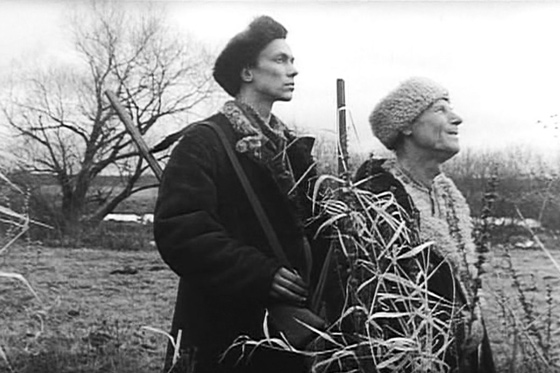 Frame from the movie "Outskirts"
Approximately the same story happened with the “outskirts” of Lutsik (and Samorova), a masterpiece, so no one, except criticism, is not seen, hidden. The horror, who declared the very criticism from the social question asked by the authors, even surpassed panic in front of the Balaban “brother”: here he is, “Rashen, is terrible for himself.” In addition, the left discourse was desperately unpopular not only among the authors who wrote to Kommersant and the Russian Telegraph, but also among the people, whose rebellion was so terribly and funny painted “outskirts”. A long blood -pouring the road of Russian peasants to Moscow for the truth (and beauty) scared not only the obvious approval of the “direct action”, but also the resuscitation of the epic Soviet style - and the resuscitation carried out with the self -irony necessary for real revitalization. It seems that this irony has become the last straw - the question "are they seriously or are mocking?" It was set in almost every note about the film. Brecht, Godar, removal - then all this is Russian criticism, who believes in the bright future of capital, was not very interesting. Before the “touch of sin” Jia Zhanka, like Lucica, mixed social realism, folklore motives, history of revenge and subtle irony, there were still 15 years and almost the same-until the “tired of the sun-2”, which were circulating Russian htn and death, dubious soldier's humor and fabulous miracles on a cheerful psychedelic carousel.
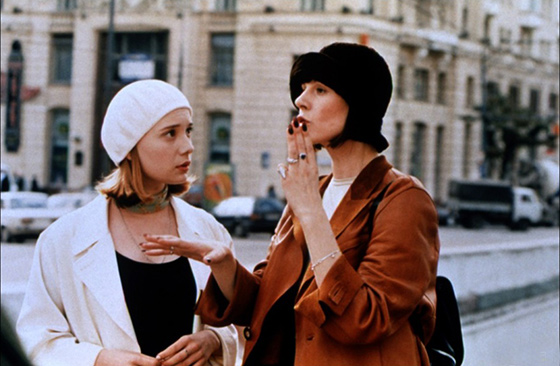 Frame from the film "Country of the Deaf"
But the movie, so rooted in his time that his viewing even causes some nostalgic awkwardness. The “outskirts” who took one year, took all possible prizes, making the stars of Chulpan Khamatov and Dina Korzun “Country of the Deaf” Todorovsky. Low -budget and, according to contemporaries, devoid of all vices (which now, however, seem to the virtues) of post -perestroika cinema, this picture seemed Russian “bad blood” (or even “lovers from the new bridge”). To the best of the baroque and at the same time paradoxically minimalistic, as if gnawed to the skeleton, history. Shoots without the sound of shots, neon lights of a floating casino, Moscow as Peter (the action takes place for the most part on granite embankments, the city is generally unrecognizable, it is just a city with a river). Dina Korzun, in the role of Renata Litvinova (“Country” was filmed based on the Litvin novel “possess and belong” and develops an important theme of the deaf -mute for the Litvin theme - she arose in a strange and also ahead of the film “Leningrad, November”). And, most importantly, money as the central driving power of the plot and this world in general. How typical for the 90s! However, from today it is not very clearly visible that the presence of a topic, and especially such an explicit, was generally a sick cinema of the 90s. Make a movie - but what? Both the directors and critics asked this damned question. It was possible to catch the present units. The “Country of the Deaf” is not quite such paintings: in search of the life of her heroines, they hang around the Moscow streets, but they don’t find anything. However, the time itself is its very damp, but very symptomatic material: the Todorovsky film openly and shamelessly shot in the aesthetics of glossy magazine photography. And what better expresses the spirit of its time than the page of a fashion magazine?
The end of all these throwings between the West and the East, Stalin and Cannes, Tarantino and Alexandrov puts “Moscow” Zeldovich and Sorokin. The film, it seems, for the first time in Russian cinema, set the goal of analyzing and capturing the CEATGAST (in the script of Moscow, Vladimir Sorokin directly headed for realism, in addition to the filming process, the group of reflexively studied the criticism of the script published in the art of cinema back in 1998), really acquired properties, rather archival photography than a movie. Reviewing “Moscow” now, you experience an amazing feeling - the rotation of the DVD does not revive the face of the past, as it would happen to any other film. No, the life of these funny dressed people, on the contrary, fades at a speed of 24 frames per second, as time is fading on an old photograph. The time of the film is not an eternal cinema Present Tense , but an unconditional past. All the heroes of the film are dead and irrevocably, it is impossible to reanimate even a simple stunt of movement on the screen. The decadence was an important element of the culture of the 90s-but Zeldovich had funny wake on the hated past suddenly turn into the funeral of the present. Moscow turns out to be necropolis inhabited not by people, but by products of consumption. With the Warholsky enthusiasm, the camera constantly gives close-ups of all kinds of cans and packages, and in the very Sorokinsky stage, Bracaley serves as an instrument of excellent-nuclear, in the spirit of Bunuel, murder.
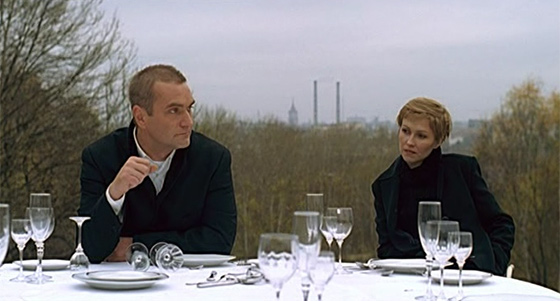 Frame from the movie "Moscow"
At the same time, Moscow obviously seeks to distance himself from formal, external signs of time; There is no time at all that stopped. Typical postmodern time. Her heroes have little in common with their supposedly prototypes. And the scenery turn out to be the harbingers of the movie "New Russian Interior", which will reign all the 2000s. The central point of the Moscow space is a minimalist club on the Vorobyevs in its sterile, ultra -bourgeois deadliness as far from the “Hermitage”, from which he was allegedly written off (not to mention the radical dissimilarity of the heroine of Kolyakanova with the mistress of “Hermitage” Svetlana Vickers). In this smooth new world, there is no longer good or evil, all the same to himself and everything else - as there is no difference between Pepsi and Roos, which the blessed heroine shimmers from the can to the jar.
One of the heroes compares the society of the late 90s with a clot of semi-digested dumplings, but the director here is clearly a supporter of another model-eternal ice, which fetters people and the country. They still hope that it is worth poke somewhere to the center of this iceberg-and everything will "fall off like vomiting." But no one except the camera, with the sadness of panoramic, empty, as if the Moscow landscapes grunted from the cold, is guessed that this cold is only frosts, and a real cold is still ahead.
The festival "Island of the 90s" will take place. The entrance is free. The forecast is good.
Direct broadcast of the festival from all social networks - here
Our hashtag #island90
"Island of the 90s" on Facebook
"Island of the 90s" in VKontakte
We thank our partners - the Foundation "Presidential Center B.N. Yeltsin ”(Yeltsin Center) and the educational portal“ Your History ” , as well as our organizational partner - the Museon Art Park , which made this story possible.