
Translated material
Poetics of mobilization
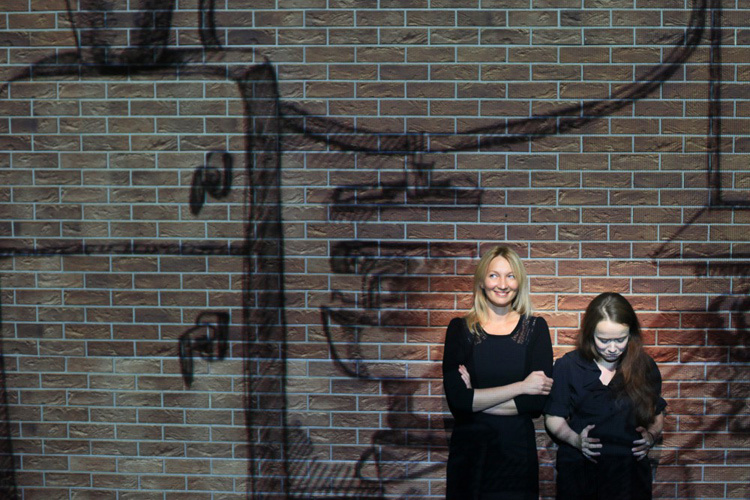
The metropolitan center named after Meyerhold opened the season with the premiere of Viktor Ryzhakov “Sasha, take out the garbage” based on the play by Natalia Vorozhbit. About the play - Alena Karas.
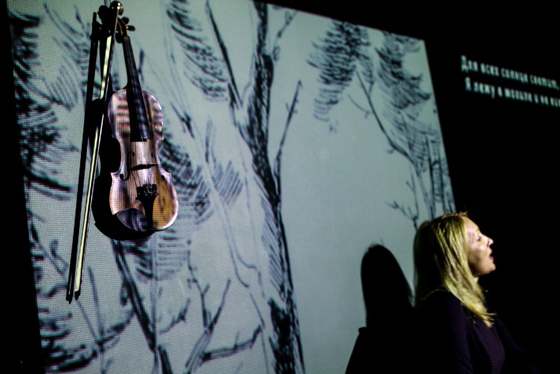
It is difficult to say that it starts the work of fantasy, explodes the imagination, triggers a pain mechanism. It is almost impossible to write about the small performance of Viktor Ryzhakov based on the play of the Kyiv playwright Natalya Vorozhbit. It lasts fifty minutes, two actresses and one actor participate in it, consider it that there are no scenery - only a deaf brick wall and short segments of the artist Olga Nikitina. Closer to the final, the song of the SCORPIONS group “Wind of Changes” sounds, sagging at the Potsdamer-Plaz, a year after the fall of the Berlin Wall. The flashes of the salute, and perhaps, explosions of bombs with projections on a brick flat wall - the performance ends on this.
Fifty minutes in Tsim - the gap, the failure of the times, the injury with a length of a quarter century, from the destruction of one wall to the construction of new ones - those that are separated today by the once inseparable world.
Restrained applause ... Work of sorrow, insensibility, stubborn ignoring the war, for the second year blazing in the east of Ukraine. It must be understood what Natalya Vorozhbit does: it testifies when evidence is impossible. In a situation of almost complete impulsive of historical injuries in the Russian and Ukrainian theater, she tries to speak on behalf of the document. Eight years ago by order Royal Shakespeare Company Vorozhbit wrote the play "Holodomor". Then there were "Diaries of the Maidan" , whose reading took place in the "Theater. DOC »A year ago. Now here is the new text - “Sasha, make garbage”, written for the Scottish Traverse Theater. He is about the last war.
 © Meyerhold Center
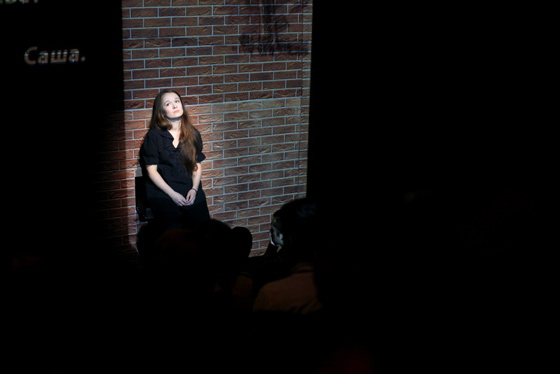
Quiet. A small amphitheater descends to the platform and rests against the brick wall. On a narrow strip there are two actresses closely pressed against the wall. On the wall - shadows, video projection from the kitchen, where a memorial meal is being prepared on the occasion of the death of the owner. The shadows wander around the faces, not allowing them to consider. The dialogue of women is simple and wiped, as if merged with a wall. Katya (Svetlana Ivanova-Sergueva) is talking with a deceased husband, a former officer of the Ukrainian army Sasha (Alexander Zelaverdin). Reproaches, sudden sobs, reproaches again. The usual conversation of the living and the dead. In a long family life, a special type of communication is always established, when no one speaks out loud, but internal speech flows constantly. Death only exacerbates this current, makes it intense and dense.
The fact that she came up with a Vorozhbits, as if there was nothing new - well, he hallucinated, for example, Hamlet ... But in the text of the Ukrainian playwright, is a completely different way to communicate with the ghost. The tragedies of recent times canceled the extremeness of their dialogue. No revelations. No mysticism. The heroine of the play repeats the dead husband: “Sasha, take out the garbage,” blames him on the past, waits for him to return, complains about poverty. A narrow strip against the wall - the space of the performance - is that neutral strip on the edge of death, where the differences between bodies and shadows are no longer visible.
In a situation of almost complete impulsive of historical injuries in the Russian and Ukrainian Theater, Vorozhbit is trying to speak on behalf of the document.
There are no items, there is a projection of the kitchen on the brick wall, which we look at exactly from the back of life. Sasha himself is gone for a long time, only his voice sounds - "Why do you need me?" Two women quietly move their lips, sorting out the ingredients of the filling for pies according to all the rules of the funeral rite: lard, chibulka, oil, which is staring in a pan, from one transfer, a cozy Ukrainian village near Kiev is born in the imagination. On the second day, it is already easier - with cabbage, with meat. And now - to transparent, with onions and lard, filling. But all this - only in the imagination or there - outside the scene where real cibulka with fat had just stuck in a real pan. Here-only the wall and projection-teni. And as if the disembodied, incorporeal voices of actresses. Sasha’s voice, on the contrary, sounds muscular, assertively. He does not give in to persuasion, he does not believe in the promise - that his wife will drink that he will not be annoyed - does not want to go back.
A year takes place. On the wall there is a projection of the monument. Katya and her daughter Oksana (Inna Sukhoretskaya) again talk about Sale, go through the past, and lament. There is still no fat itself-but its smell is still in the auditorium.
Someone, similar to Sasha, descends past the audience down, to the brick wall, so that in the onset of September 2014 he will again find himself in his own house near Kiev, already filled with military anxiety, thoughts of fuel, potatoes in reserve and cellar, in which you can hide from the bombing. This is said in Remarck, as it is written on the wall. Sasha, an officer of the Ukrainian army in eternal reserve, will stand next to Katya to demand her permission to return to duty. They need it, dead to fight for the living. For the “sixth mobilization”, mobilization of the dead, has already been announced. And the woman is everyday, like a woman, as if we are talking about a familiar family quarrel, he will resist him-neither for the ammunition, nor for the second funeral she has neither strength nor money.
 © Meyerhold Center
“I, Vovchik ... Vovchik once drunk to death, Seryoga ... also a colonel, also died of heart arrest, Leshka Chaly ...”-all of them swore to be allegiance to their homeland and now they are eager for battle. Maybe this is the only way to find the meaning of an erased, unnecessary homeland, not noticed by anyone’s life. In this repeated, solemn and slightly comic naming of friends and neighbors, the image of the “dead class” of Tadeusz Kantor - the immortal theater monument to the Holocaust arises. A series of Sashin fellow countrymen who died in all wars or who died from the Holodomor and neighbors stands behind a brick wall, which was deeply separating us from our memory and from today's unnamed pain.
Oksana sings their song - the one that Sasha sang Katya in the Crimea when he looked after her thirty years ago. Firewood is cracking, the fire burns, the Potsdamer-platee explodes on the wall with the fireworks of despair-it took only a quarter of a century to forget about the ideals of the generation of the nineties and begin to build new walls.
And somewhere, somewhere there the new old army holds exercises.