
Translated material
Pluriversale: Artists against the war
Shortly before the trip to Cologne, I found in the collection of travel notes Christian Krakht-a book that was lying out of unread for a long time-a wonderful thought: “Mandatory-or, differently, Otradnoye-on the trip it always comes down to not feel comfortable where you are, whether on arrival, on the road or when leaving.” Somehow something like this always happens. When I had to fly out of Moscow, there was a fire at the airport, everyone was evacuated, and the departures were strongly detained, and on the arrival of my flight passengers, they carefully asked and inspected, repeatedly double -checking our documents. Later, both the fire and the tightening of the border regime seemed to me with successful images, which allowed me to better understand why I went.
I went to Cologne at the invitation of Catherine Drago, which has been heading the Academy of World Art for a year and a half, to the opening of the next Pluriversale - a series of events that resembles the festival, although, as the tar said, it is more correct to call this a program of the Academy, which takes place in the fall and spring. The current, third, Pluriversale , starting in early September, will last until mid -December.
The purpose of the target by the art director of the Academy of World Art coincided with the annexation of Crimea - March 2014.
Pluriversale theme III It was formulated quite clearly - against a hidden war between Russia and Ukraine. The vector for such an understanding from the very beginning was set by the exhibition “Calls from the cemetery and other stories” and the symposium of How to Think (Against) The War , whose name can be translated something like this: “How to think a war / against war”. Many events are still ahead: the given topic leads to more global problems, and therefore, in addition to artists and theorists from Russia and Ukraine with expected topics within Pluriversale III There will be completely different performances. For example, Kasper König and curator of the Venetian Biennale Oksvi Envezor will discuss the claims of “Western art” that have been responsible in St. Petersburg , no matter what the claims of “Western art”, no matter what the universal status, the role of art during conflicts, such as the Cold War or the current confrontation of Russia and the Western powers, and how to be in this situation. Culturers like the same König and Envezor.
At the same time, as the tar immediately said, it is almost impossible to conduct such an anti -war event in Moscow and in Kiev, since in Russia and Ukraine any such project is preceded by a rather tough conversation about the conditions of discussion, which immediately excludes part of the possible participants, and the relatively neutral Cologne gives such an opportunity.
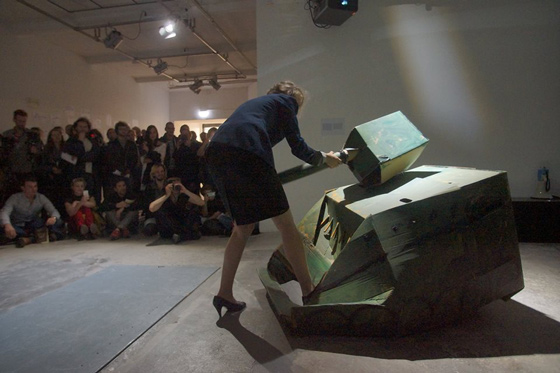 © Roel Weenink Ereed -Domestic. You are part of us! Reenacment of the Anschlus of Crimea, 2015
In general, the theme of a hidden war between Russia and Ukraine was important for today's leadership of the Academy - not only because this is what the media is talking about all the time, and the conversation about it cannot be avoided, not only because Catherine Gaura and her permanent sorcerer David Riffa have the need to express their position on political issues, but also for the fairly simple reason that the purpose of the artistic director of the Academy of World Cooked in time with the annexation of Crimea - March 2014 (in a similar situation were Russian curators who created the Bükü residence in Leipzig ). For tar and riffs, such a coincidence did not become something that forces me to respond on duty-they thought that they themselves want and should speak out. At the opening of Pluriversale The III tar spoke of responsibility for what is happening in the east of Ukraine, which she feels, being a citizen of Russia. However, the curators took some timeout and at the first two Pluriversale discussed other problems that no less lively for Europe-the same topic of migration that did not remain without mention and within the framework of the current issue (in the European media this issue now even overshadowed the discussion of the Russian-Ukrainian conflict).
The exhibition, as the name follows, was collected from very personal stories (the curators specially emphasized this moment), although in order to understand that some of them are really a very personal statement, it was necessary to talk to the author. In others, on the contrary, this personal measurement was read immediately. The graphics of the Ukrainian artist Alevtina Kahidze, whose project gave the name to the entire exhibition, was made based on telephone conversations with her mother, who lives in Zhdanovka, next to Donetsk, and the war for her became not just a reality: the artist’s drawings, children in form, report this unbearable everyday life. No additional comment was required here. Olga Chernysheva has the same in her more “professional” graphics, which is complemented by roughly cut pieces of paper with detached comments: there is no war, but there is everyday horror that turns into everyday life with the help of several words.
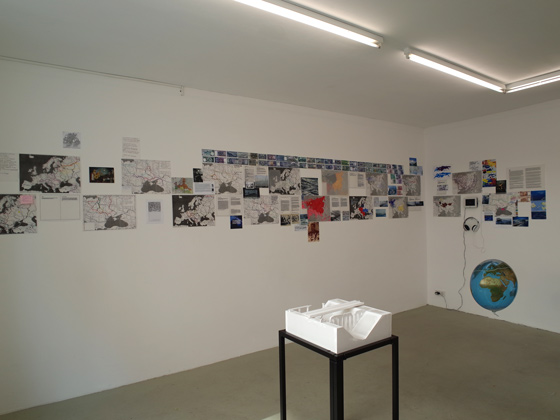 © Ivan Melnichuk Alexander Burlaka, Ivan Melnichuk. Under the bridge. Installation, 2015
The project “Under the bridge” of Kiev Alexander Burlaki and Ivan Melnichuk looks from the side as just an installation about bridges in a very recognizable style for artists: many maps, illustrations, texts-different approaches to bridges that symbolize the association, but in fact serve as the goals of aggression and capture: starting with those who built the great kings of antiquity, and ending with antiquity, and ending The project of the bridge across the Kerch Strait, which should finally cement Crimea in the tenacious arms of the empire. But many other stories are hidden among this pile of historical information and fantasies about the future - for example, the story of the Jewish diaspora that lived in Eastern Europe for long centuries and the victims of endless wars, the redistribution of territories and the change of governments in this region. Melnichuk said that his view of the history of Ukraine and the countries surrounding it has completely changed when, from relatives and later from teachers, he learned about this almost cleaned ethnocultural layer, he saw how much everything changed after the almost complete disappearance of one of the elements that formed the multi -layer environment of the region. The Jews were made extreme in all conflicts, as Protestant priests who were killed, as Melnichuk said, are now extremely in the first months of the existence of the DPR and LPR, as well as civilians and refugees.
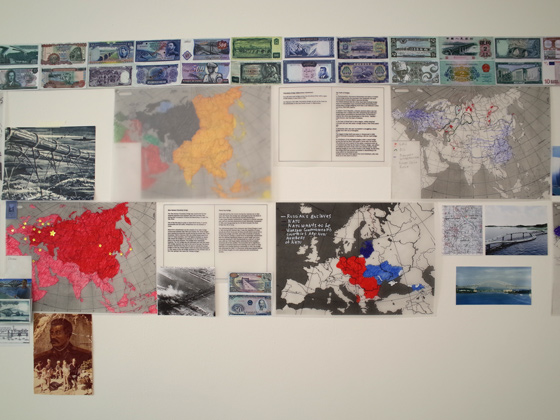 © Ivan Melnichuk Alexander Burlaka, Ivan Melnichuk. Under the bridge. Installation, 2015
When I talked with tar and riff, they talked about the Academy of World Art and its role in the life of Cologne. “We are trying to talk mainly about Germany’s problems, because we are here,” says tar. In Russia, she emphasizes, they would affect other problems - it all depends on the context. And there are many problems - migration, for example, which has just led to a crisis that has split Europe. At the opening of Pluriversale III Director of the Academy said that her utopian horizon is a future without borders, where the words “migrant” and “foreigner” simply mean nothing. But it is clear that the outbreak of wars of recent years will lead (and has already brought), on the one hand, to a huge stream of refugees, and on the other, to twist the nuts from the governments and strengthen the borders. We see how some countries build walls, while others introduce mutual lists of unwanted persons, constantly increasing in size. And besides the Russian war with Ukraine, this is probably the second main topic of Pluriversale III . It is important not only for Germany.
The artist from Kharkov Nikolai Ridny made a film about his city. The viewer sees the places where clashes took place, however, after all the sad events. The city looks peaceful, but the sound path imposed on these calm personnel was taken from the time when exactly the same locations were occupied by activists of the Maidan and Anti -Maidan, so we hear calls, swearing, threats and cries of pain. During the symposium, Ridny said that in connection with this film he heard: "It is not clear which side you take." According to him, he replied that he did not want to occupy one of the two sides torn by the information space. It is important for him to speak from the third position. In the same way, the curators of the exhibition expressed their attitude to what was happening.
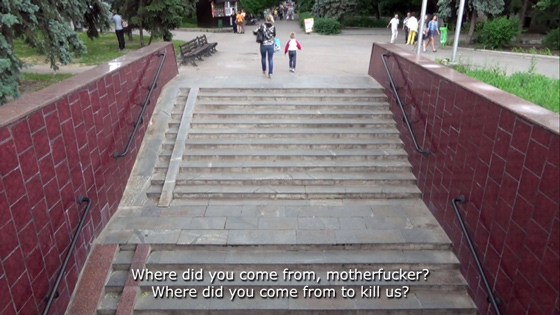 Nikolai Ridny. Ordinary places, 2014. Video
Alexei Radinsky from Kyiv and Tomash Rafa from Warsaw (both authors of the journal Political Criticism) presented at the exhibition at the Academy the result of their trip to Donbass in the early days of the formation of the DPR and the LPR, when the fighting did not really begin, but the mood on the street was already in bloodshed. They had to conspiracy, however, at that moment the audit was not particularly serious and it was more or less easy to get to the Donbass from the territories controlled by the Ukrainian government. They drive around the cities, observe manifestations and ordinary lives, communicate with local activists, who, if you listen carefully, make mutually exclusive allegations. The state of unimaginable inconsistency is adjacent to complete confidence in the correctness of the separation and confrontation with Ukraine. This is not a war, but retrospectively, after what she saw and heard, it seems inevitable, even if you believe that then something could be changed for a minute.
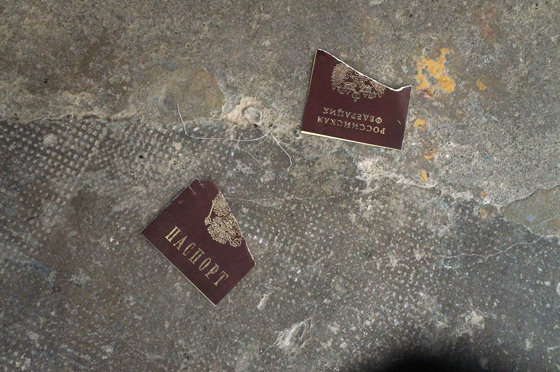 © colta.ru Torn “Russian Passport” after the performance of the Group “Yerebovoy Udobravity”
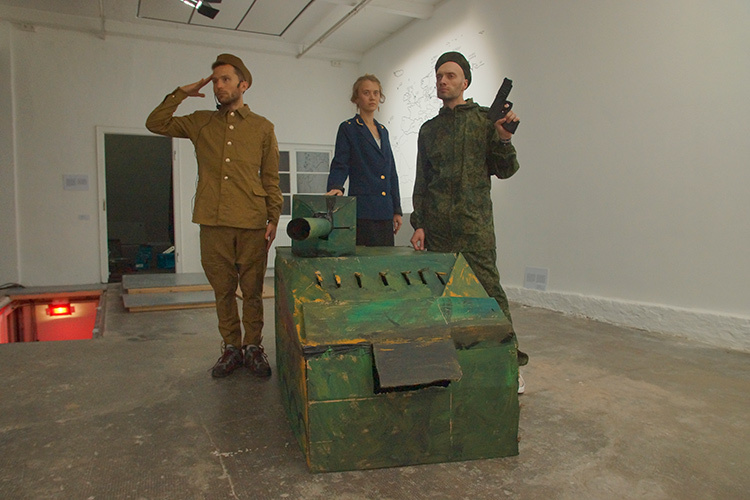
The Group "Yerebovoy Domestic" from St. Petersburg in the person of two of the three participants, Anastasia Vepreva and Roman Osminkin, together with the musician Anton Commander-in-law, held at the opening of the exhibitions the reenactment of the capture of the Crimea with the distribution of Russian passports (in fact it was only a cover, inside which was printed by the Librette of the performance), one of which was later detached. In two and threw in the center of the exhibition. There were “polite people”, and Poklonskaya prosecutor, and a tank (in the end he was also torn), and songs about a happy life in Russia - a set of familiar images. At the symposium, Osminkin also performed a passing of a performing that he was breaking in half the Ukrainian and Russian units.
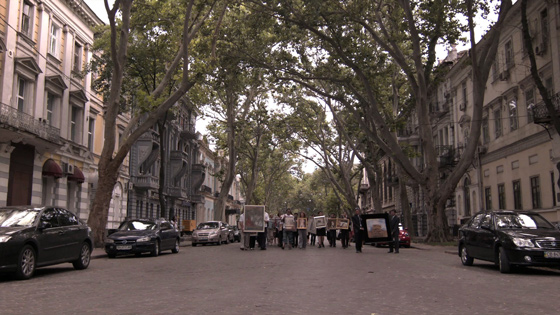 © Courtesy of akademie der Künste der Welt Yuri Leiderman, Andrey Silvestrov. Odessa, fragment 205. Video, 2015
The film of the famous Odessa artist Yuri Leiderman and a director from Moscow Andrei Silvestrov “Odessa, fragment 205” was made specifically for Pluriversale III . Later he was shown at the Kiev school , with which the Academy of World Arts has partnerships. Artists, people from a near -artistic party, invited colorful statists (one of them even managed to play so much that the authors counted him more than a statist) carry pictures along the streets of Odessa, argue about politics and find out (not without HATE Speech ), whose position is more correct. Not everyone plays, many speak from a pure heart. Perhaps this is the strongest work at the exhibition, since it shows that terrible process when, relatively speaking, friends cease to be friends, and people in the family stop talking to each other. Each word, choice of language or expression, handshake or refusal to such a large battles of one big war. At the same time, everything is quiet around: the tanks do not shoot, the “green men” are not visible. And this only enhances fear - because if this happens without weapons, then what will happen when it appears. But, I'm afraid, now we already know the answer.