
Translated material
Talent. Pain. Death
The Yekaterinburg Center for Modern Drama brought to Moscow to the Artmigration festival, the performance of the memory of the rock musician Alexander Bashlachev
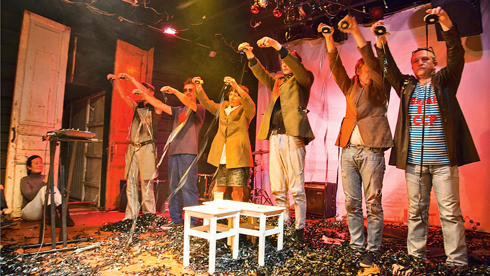
A tape, filling all the playing space, is the main image of the play “Sashbash. Sverdlovsk -Leningrad and back ”broke into Moscow from the second call - last year he was forced to withdraw from the posters of the Golden Mask festival and excluded from the list of nominees for the highest theater award, where it was presented in three nominations - the best performance of a small uniform, the best male role (Oleg Yagodin, the leading role) and the best director (Semen Serzin). Relatives and friends of Alexander Bashlachev, a cult poet and musician of the mid-1980s (he committed suicide in February 1988)-used all possible pressure resources for the leadership of the Golden Mask: the authors were accused of distorting, mockery, mockery and insult. The “mediocre and vile mockery of the dead man” was named by the performance by journalist Marina Timasheva (she was friends with Bashlachev), who published references to several videos from rehearsals on her Facebook page.
As a result of this scandal, the performance was excluded from all the nominations of the Golden Mask and temporarily removed from the theater’s repertoire before making the required adjustments. It is amazing how the time rhymes: in the Soviet past, the director received a list of recommended changes from the Ministry of Culture officials. But at least they watched the performance entirely in the hall, today's huts are enough for one video in YouTube. And the play “Had and Further Countered”-I had to remove the name of Bashlachev, make changes to the text, but the Yekaterinburgers still reached Moscow, to the Boyar chambers on a passionate boulevard, and fell in love with the public.
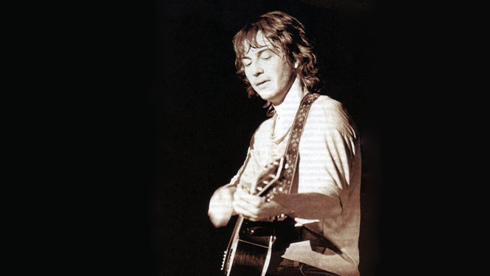
Alexander Bashlachev, Leningrad, 1987 
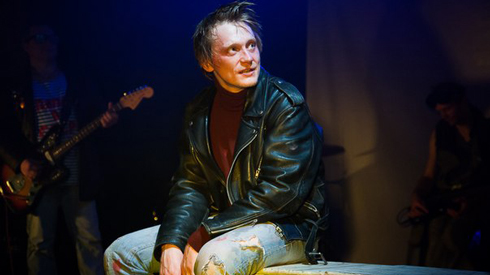
In the role of the poet - Oleg Yagodin, poet and musician
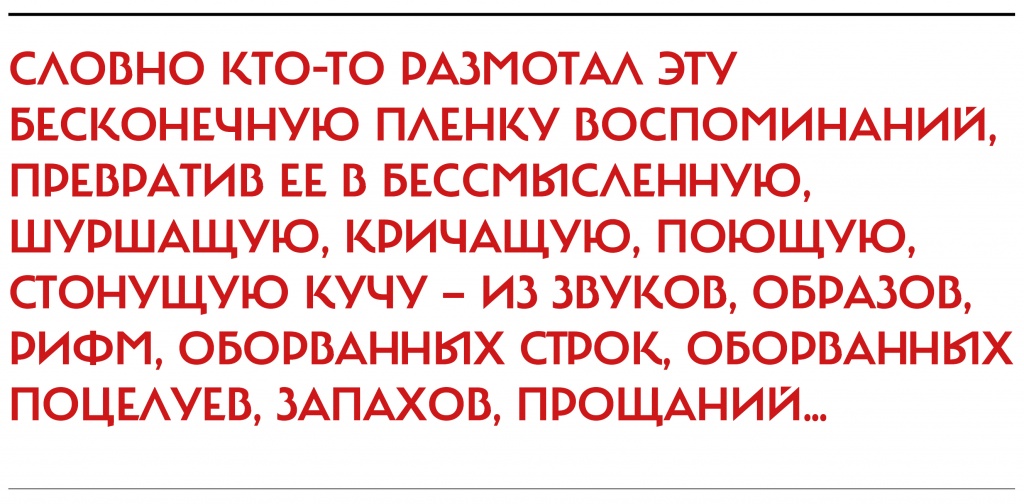
The performance of the seeds of Serzin is swift and burning, sharp, like a stroke, in which, of course, not a biography of Bashlachev, but a pulsating cast of his life - short, tragic, surprised. Here, chronology can be seen with difficulty, fragments of memory flare spontaneously and last exactly as much as a person flies from earth to heaven. It was as if someone unwashed this endless film of memories, turning it into a meaningless rustling, screaming, singing heap-from sounds, images, rhymes, ragged lines, torn kisses, smells, farewells ...
A tape, filling all the playing space, is the main image of the performance, in it the heroes are born, live, create, enjoy, suffer and die. Dead silent river of oblivion.
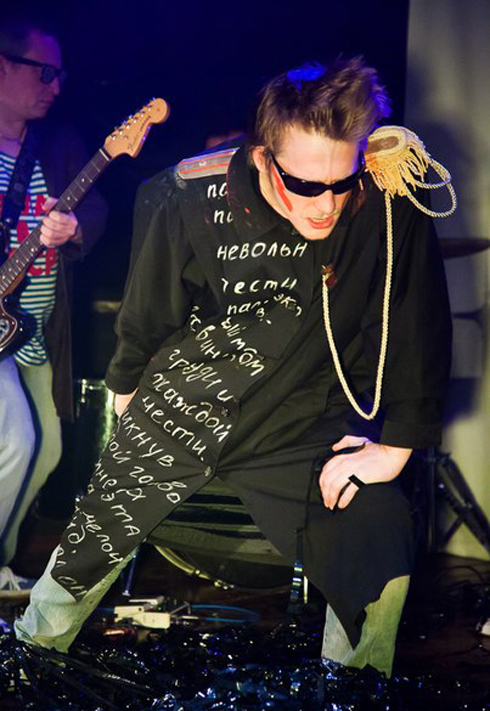 | 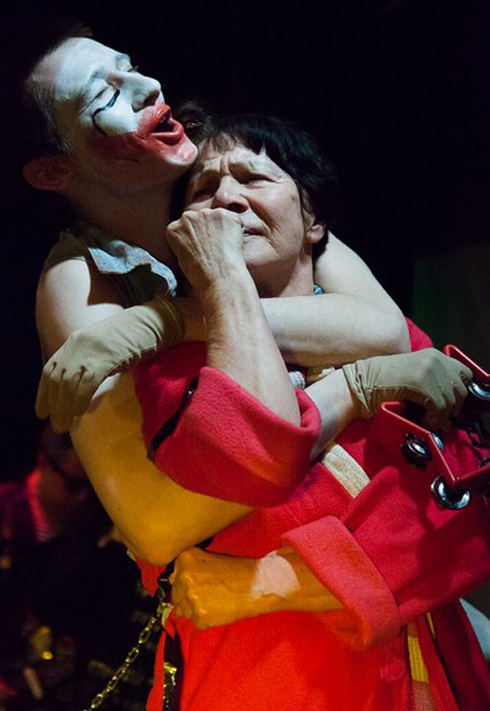 |
| Group "Kurara" - a musical rod of a play | The “Middle Circle” of the hero is a friend ( Konstantin Itin ) and the woman of the poet ( Tamara Zimina ) |
Without a quarter, death is Oleg Yagodin - an actor, a poet and a musician (his group “Kurara” is a musical rod of a play) - in the central role of the poet. Muscovites know Oleg Yagodin as the leading actor of Kolyada Theater, who played all the roles of the world repertoire-from Godunov and Podkolesin to Hamlet and Stanley Kovalsky.
A brilliant sharp actor, instantly grabbing plastic and nerve of any role, has not only cosmic energy, but also the ability to separate from his hero and look at him from the side, without hiding either horror, then pain, then admiration. With the hero “Sashbash”-everything is different, the “poet” takes the actor as a whole, sprouts in him, does not allow him to breathe, does not allow him to break out, this is not even a reincarnation, but a real relocation of souls.
Yagodin does not sing Bashlachev’s songs, but he reads his poems, swinging the electrified hall, like giant swings, which, it seems, is about to break off the hinges and fly into space. Like the poet himself, he came from nowhere and disappeared into nowhere, not able to hold on to the ground, breaking off from it like a leaf.
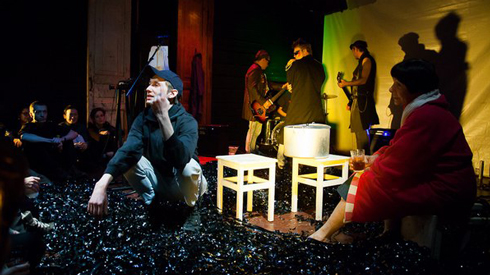
The Sashbash was invented and executed, as a “apartment” genre popular in the Soviet years, a concert in one room “Sashbash” is a dramatic ballad about the nature of creativity, about the pain that talent, about the absolute rumor of the artist, which allows him to hear time and anticipate him, but does not make it possible to change his move. A groovy laughing guy with a hooligan gleam in his eyes and a steel fixture instead of a front tooth is a sashbash for friends, the soul of the company, a balagur and a inventor, a favorite of a girl, a lover of draws and comic parties. A delicate, ironic, curly boy who believes in love and magic is for mom. A vulnerable, romantic, charming handsome man with an unprotected and linking soul is for girls. Everyone loved him, but no one kept him, did not hide.
The poet’s women are both mother and first love Tanya, and the last love of Nastya. All of them are played by Tamara Zimina, actress “Kolyada Theater”, who celebrated the 50th anniversary (!!!) of stage activity this year. Tamara Zimina has neither titles nor age - she has the eyes of an enthusiastic child, which reflects everything that she wants: a girl, a girl, a woman, and mother. And a passionate mistress, and a submissive wife, and a caring mother is all her, a poet woman. Here the girl shakes the cradle with a little son, who is not measured and a year of life, so mother comes to her son to visit Komarovo, so she reads his encouraging letters from Moscow, here she bursts into the young rocker to the microphone and, jumping on thin girlish legs, squeals into the microphone: “Here it is, a chic life!”
The poet and a woman will never be together, they are as if separated by an invisible wall of different dimensions, and the actors play it very accurately: Zimina-hence the anniversary and write memories, berries-from there, because of the line where he will never become older.
The music of time is very important to understand: who we are and where. Sverdlovsk in the 1980s arises in the video stylized for home shooting-black and white gatherings in the tight student rooms of the Ural Uni, girls, cigarettes, explosions of laughter, memories of “potatoes” and evenings, course ditties and converted hits. How many steps separated the poet from a carefree journalism, crackling notes in the Communist newspaper, from Sakko and Vanzetti Street, 22, in Sverdlovsk, from the first apartment and rock touches-to that last window?
Where did this failure occur - when the poet is knocked out of time, like a cork from a bottle? Where did they not match?
Sashbash is not just a generational performance, it is the view of the generation of children of the 1980s: the authors-director Semyon Serzin, playwright Yaroslav Pulinovich and Polina Borodina-hardly older than the hero himself, forever 27-year-old. The Soviet Urals with their eyes is charming and unconscious, they will reconstruct dancing and discos with great pleasure and enthusiasm, the comic evenings of the “parallelepipidist artists”, a meaningless half -drunk journalistic service in the party newspaper. And then the texts of Bashlachev, his poems, fragments of interviews and letters crash into this careless funny, with a terrible tragic roar, to goosebumps, to horror not coinciding the “noise of time”. They say that when he sang, the audience tried not to look at his hands, tearing guitar strings: his fingers were always in the blood.
Photo: Vadim Balakin, nkriv.livejournal.com