
Translated material
Unsuitable Cipras
Alexis Tsipras again became Prime Minister of Greece. In the early parliamentary elections, his Party “Siriza” gained 35% of the vote, the main rivals of their right -conservative “new democracy” - 27. Why did the country not have lost faith in a person who almost led it to bankruptcy, ”the New Times sorted out
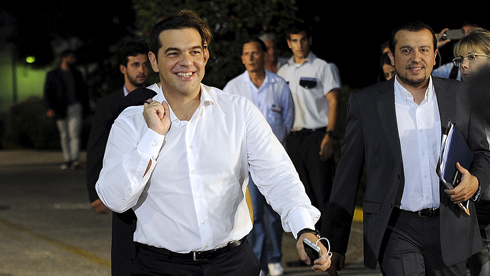
Alexis Tsipras in front of television battles with the main rival from the New Democracy, Athens, September 14, 2015 in Greece is gaining popularity to the old Soviet joke, overwhelmed by the “specially for the Hellenes” by the European philosopher with the glory of Zizhek: “Why do you want to leave Greece?” - Greek asks the border guard at the airport. “For two reasons,” the Greek replies. “Firstly, I'm afraid that Greece will leave the EU.” - "But Greece will remain in the EU if it observes financial discipline!" - "But this is just the second reason!"
After the stress experienced at the end of June, Greece, who remained in the EU and Eurozone on the terms of the “triples” of creditors-the EU, the IMF, and the Euro-Central Bank, is still studying financial discipline. Little by little, Greek families come to their senses, start paying taxes and paying bills again, although the numbers are still yelling about dysfunction: the debt of the population to the Electric Grounding company Dei still amounts to € 20 million. Since June 29, the Greek authorities at the insistence of Brussels established control over the movement of capital, the volume of consumption in Greece has decreased by 70%. The Greeks have mastered the crisis terms well: the words “liquidity”, “summit”, “Bridge Credit”, “Credit-Bomerang” (cm “Dossier”) are constantly heard in the conversations, but they dream, first of all, about “salvation from bankruptcy”, that is, about writing off debts.
“That's exactly what we did with Germany after the Second World War: 60% of its debt was written off. Out of gratitude, they should answer the same thing, ”said Selio sailor, to whom his employer, the NEI shipowner company, owed the salary in two years.
But Germany is in no hurry to “answer the same”, and many Greeks fall into despondency. "Do you know the saying:" The river knows where to flow? " The river knows, but I don’t, ”-the 52-year-old Athenian Georgios, who once worked as a doctor, sits alone in a barrel in a bar, where he is able to pay only a cup of coffee:“ So people now live: they sit for five hours in the bar, then pay one euro and leave ... Ask me how the country lives, I will answer: bad. Ask what will happen next, I will say: worse. ”
Georgios recalls on July 5, 2015, when a referendum started by ex-Prime Minister Alexis Tsiprase-“accept or not the conditions of Euro-Riddlers?” “In a referendum, I answered not - Oxi, but even then a conjecture flashed: there really is no difference between answers.” And so it happened: Tsipras is now supported by those who in July said to Europe yes - NAI.
The right roll in the referendum on July 5 “No” won with 64% of the vote. But already on the 14th, Tsipras said loudly throughout Europe in Brussels: Greece wants to stay in the EU. On the same day, a riot occurred in the ranks of the left radicals: the so -called “left platform” broke off from Siriza. On July 15, thousands of people gathered on the Sintagma Square, near the parliament building, many of them chanted: “Tsipras is a traitor”. The police launched tear gas, many manifestants were arrested.
Another month passed. On August 20, Tsipras, at a meeting with the Siriza asset, unexpectedly announces a resignation and the need to hold early parliamentary elections on September 20 - the fourth in a row over the past three and a half years. “The political mandate received in the elections on January 25, 2015 (then Siriza won with 36.64% of the vote. - NT ), it is exhausted, the Greeks need to speak out about their preferences again,” Tsipras said then. And he added: "I take to the court of the Greek people everything that I did." What exactly?
On August 13, a week before his decision to resign, Tsipras reached an agreement with the European Union on the Assistance Program: Brussels will provide Greece € 86 billion over the next three years in exchange for raising taxes and reducing expenses. On that day, Tsipras actually renounced his January pre -election program: agreed to privatize, sell state -owned enterprises and lands, the abolition of collective labor contracts and amending the Constitution, and also announced permissions in the government and cleaning among ministers. And then his party rebelled again. 40 deputies of Siriza (a total of 149 mandates in a 300-seater parliament.- NT ) opposed the transaction with the EU, the party bodies of the party for the same motives left 53 politicians. However, Tsipras managed to break the resistance: the parliament eventually voted for help on Brussels.

After the demonstration of the supporters who disappointed in Tsipras, no. Athens, July 15, 2015 became clear: Tsipras is not afraid to lose the trust of those who said in July. “Back in early August, sociological measurements showed a high level of apathy among those who bought Tsipras’s populist slogans in the spring,” and he instantly changed tactics, ”says sociologist Evangelos Naksos.
“Almost all my friends who voted in January for Siriza, this time decided not to go to the polls,” 40-year-old Lysyandros Panayotis confirms these guesses, which has not been able to find work for five years and continues to blame European banks in all troubles of Greece. - "For what? All the same, now everything, as before, is decided not in Athens, but in Berlin and Brussels. ”
Meanwhile, the change of economic priorities has set the other part of the electorate - supporters of the agreement with Europe.
“Early elections in which 19 parties participate are not a referendum, here the scatter of positions is much wider. Tsipras reasoned like this: when the country strains forces to get out of the crisis, it is necessary to bet on optimists, supporters of moderate views, ”explains Naksos.
Tactics , however, the question arises: why did Tsipras are in such a hurry, why the elections were scheduled for September 20, and not October or November.
“This is pure tactics. For him, the main thing was to maintain influence in the party and not allow to have time to weed, growing with the allies of the broken “left platform,” says Ellenni Papanassi, an activist of the new left -wing batch of Antaria. - And Tsipras succeeded. In fact, the former “Siriza” as a bloc of left -wing parties is no longer: Tsipras, while he was the prime minister, concluded an alliance with the right and nationalists - “independent Greeks” and nomenclatures from PASCOV (a All -Greek Socialist Movement. - NT ). In short, Tsipras outplayed everyone. ”
Now the only hope of the Left is the new association “People’s Unity” led by Panayotis Lafazanis, the ex-minister of energy in the Cupras Cabinet. Charismatic Lafazanis was the first to leave the Siriza party after Tsipras signed the Brussels memorandum on August 13. And although the Lafazanis coalition, according to all surveys, is gaining a maximum of 3% of the vote in the elections, this result can deprive most votes in the parliament of favorites - Siriza and the right -centric “new democracy”. So, new elections, new layouts and coalitions are possible ...
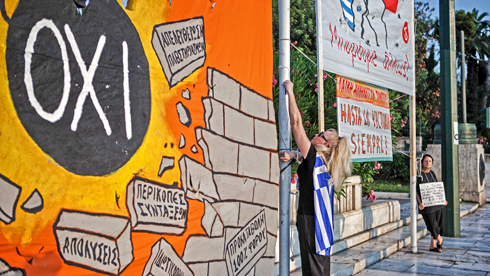
Athens. The “wall of disagreement” with the terms of the Euro -Riddlers - the theme of street graffiti, the new discourse, by tradition with software speeches, Greek politicians perform at the opening of a trading fairy in Thessaloniki in early September. In September 2014, Tsipras made a program speech here as a leader in the opposition, promising, in particular, to put an end to privatization and increase the minimum wage. This year, Tsipras appeared in a new image. It is clear that because of an empty treasury, he had to slow down and offer voters instead of 300 thousand new jobs, as last year, only “150 thousand temporary labor contracts for young unemployed”. The problem is that many did not attach much importance to the “Salonik program” itself. Because since mid -July, discourse has changed in Cityce’s speeches: before Greece and all of Europe, he appears in a new image. Now he reduces pensions, salaries, social benefits, is ready to sell one state property and completely eliminate another, liberalize the economy and resolve mass dismissal of workers. In the spring and early summer, he was a brave Greek David, who came out against the German Goliath, and now he is happy to sit on his shoulders. Previously, who was leaving the Red Revolutionary, Tsipras is now considered a reliable politician in Brussels.
Already in early September, it became clear: the main struggle in the elections will unfold between Tsipras and 62-year-old Vangelos Meymarakis from the New Democracy party. Moreover, the Greeks see: the struggle between them is some kind of fake. On September 10, television fiber was sluggish, in most positions, the rivals agreed with each other. Until mid -September, polls predicted Meimarakis’s victory, but with a minimum advantage of 1% of the vote. Therefore, Meymarakis persistently proposed to Cityce “victory at any outcome”, that is, to form the “Coalition Government of National Unity”: no one will receive the parliamentary majority. But Tsipras arrogantly refused: “You can’t believe surveys. Remember: everyone predicted that on the referendum on July 5, “yes” would win, but “no” won.
The survey on September 16 struck many analysts on the spot: Siriza really unexpectedly escaped forward: 29% against 28 of the New Democracy.
What other surprises will the unstoppable Cipras present the Greeks? And where will the Greek Galer float now?
** ---
Dossier **
Greece takes on a loan to pay for previous debts. Within the framework of the last “Salvation Plan”, Brussels approved the allocation of Greece of a loan of € 86 billion. But they allocated it on the same grounds as the first two loans of € 240 billion-and such a scheme is called “Credit-Bomerang”. So, the last tranche in the amount of € 7.16 billion was received from Brussels to Athens, was registered with the Ministry of Finance, and then returned to creditors: € 2 billion was sent to the IMF, € 4 to the Euro -Central Bank (ECB). And only € 400 million remained in Athens. According to the estimates of the Macropolis analytical center, out of € 250 billion received from the Troika (IMF, ECB, EU) in 2009, only 11%reached citizens. The remaining money went to pay off debt to banks and creditors. When Greece applied for the first loan, its public debt was 127% of GDP, after the introduction of European saving measures, to 176% grew.
Photo: Michela Yakkarino, Reuters/Michalis Karagiannis