
Translated material
In the web of the past
1.
Today it is customary to reproach Russian policy in returning to outdated geopolitical thinking. And this, of course, is so, but, as usual, the situation is more complicated than it seems at first glance. And it is precisely this difficulty that makes it interesting.
The very idea of geopolitics is associated with Hitler (although one of the creators of this doctrine Karl Haushofer was among the conspirators against Hitler and landed for this in Dachau) and generally with the aggressive policy of “life spaces” and “national interests” outside the national borders. Although in reality the idea of geopolitics arises as a reaction to the crisis of historicism that manifested at the beginning of the twentieth century. A story, often associated with chronology and linear time of its deployment, was usually thought in the categories of almost mechanical determinism (the past event determined the future). But by the beginning of the last century, this simple linearity of events, as it were, broke up, in its place there were many lines, flows and “series” (as philosophers love to express themselves now). Accordingly, pure temporality began to acquire a spatial character: after all, the lines, flows and series that exist at the same time suggest the space of their interaction and intersection. The Hausher spoke about geopolitics as a combination of history and geography and emphasized the fact that historical events are determined by the factors in vain in a certain geographical region. Hence his call to describe the history of the regions. The famous history of the Mediterranean of the Remotel is a classic example of such a geopolitical history.
Geopolitics is a kind of “gestalt sociology”-the study of spatial historical configurations as some zones in which there are intensities, power fields that determine their development. Hence the tendency to think in the categories of “living space”, but not in the Hitler’s understanding, but in the sense of self -development of complex systems presented within the framework of a particular region. One of the predecessors of geopolitics is Friedrich Ratzel, a German zoologist who became a geographer and formulated the “law” of the spatial growth of states, according to which the boundaries of the state are similar to the boundaries of the body of the growing organism.
Geopolitics was expropriated by aggressive imperialism, but its meaning lies primarily in the formulation of other principles of historical determinism. In place of the mechanical chain of causes and consequences, it puts forward the complex spatial interaction of factors within a certain geographical zone. Geopolitics turns out to be a step towards a more complex and systemic vision of history and politics.
Today's development of the theory of systems essentially left geopolitical thinking behind. Not so long ago, the French researcher Ignacio Ramona published the book “Geopolitics of Chaos”, in which he convincingly showed that the current system of the world cannot be understood in the categories of borders and territories. Conflicts are shifted inside the territories, cease to have a spatial character (like a Remodel or Hausherofer) and pass inside each society along the lines of section, which do not coincide with geographical boundaries or zones. It is enough to recall Bosnia, Chechnya, Afghanistan, Rwanda, etc., to see that the antagonistic forces no longer have clearly defined territories that would determine their configuration. Conflicts are now associated with terrorist organizations, hackers, drug trafficking, the spread of nuclear weapons, weapons, oil pipelines, the population migration, religious fanaticism, etc. These categories do not lie in the geopolitical area. Events in Syria are a good confirmation of this. The Russian attempt to help Bashar al -Assad's regime is partly doomed because this regime, like any civil war, is only conditionally connected with the territorial zones that can be defended.
2.
The Russian government today really masters the scraps of geopolitical consciousness, developed, for example, by the Eurasianism of Alexander Dugin and his followers. A year ago, Putin's formulations wore such a primitive geopolitical hue. The geopolitical phantom was never an end to Novorossiya or a stillborn Eurasian Economic and Political Union. Fantomic fees are also presented about the approach of NATO to the borders of Russia or mirage of the "natural" zones of influence. This zonal-territorial thinking is not able to accept the positive that is related to the “gestalt sociology”, namely, taking into account the complex systemic interaction of factors. The space seems to be the forefront, but determinism in it remains mechanically liner. The space becomes a simple container of historical chronology. Crimea turns out to be Russians because he was “always Russian”, because Prince Vladimir was baptized in Korsuni, etc. Instead of a place of complex interaction, space factors are thought of as containers of sacred sorcerers of the past. Geography ceases to be relevant, but becomes predominantly historical. And history becomes the process of producing shrines and places of worship that are important for the mythological self -awareness of the nation.
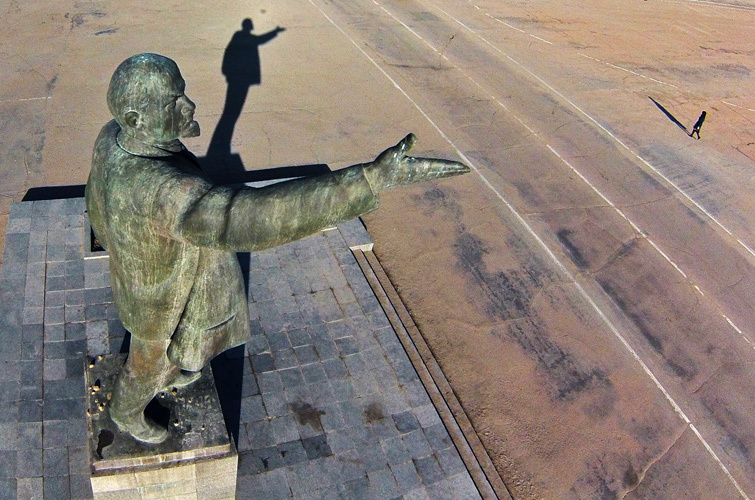
The whole space is covered with a web of the past, in which every vital impulse that is important for geopolitics disappears. Excavations and fetishization of mythological traces - this is what the current geopolitics is. Synchronism here is replaced by petrified diachrony. From here begins the hysterical process of marking the "places of history", in the words of the French historian Pierre Nora. The society is engaged in the hooking of monuments, memorial plaques and their sacred. In parallel, the mass process of vandalism, the destruction of the monuments of the past - from the statues of Lenin in Ukraine to the sadly famous Mephistopheles in St. Petersburg, unfolds. There is a literal marking of spaces using gestures facing memory. The secular space competes with the church, and when believers cross the boundaries of their zone and invade someone else's, conflicts arise on their borders. Geopolitics, instead of being taking into account multi -factority, becomes a mythologized cultivation of historical or pseudo -historical places.
Monuments are significant because they act like the fetishes and idols of the past. The past has disappeared and has no fundamental value today. The fetish, as Freud also showed, occurs at the place of emptiness, gaping, absence, trace of castration, as material compensation for emptiness. In a religious sense, the fetishization of shrines, icons, images, monuments, relics is a direct evidence of the lack of real faith. The fetish replaces the “spiritual” void with the material object. The indomitable struggle of believers with the pictures just shows that the shrine is completely exhausted by its material sign. It is for this reason that the first Christians attacked pagan idols.
Such a circulation of spaces in the container of the traces of the past sneaks the territory not as living developing areas of interaction of different forces, but as a crystallized skeleton of history that cancel all development. The meaning of this marking is simple: it was here a thousand years ago, it will be forever and ever. Khersones Russian! Our Crimea! History turns out to be a sign of inviolability, statics, that is, a sign of the absence of any story. Geopolitics becomes not so much a form of awareness of evolution and processes as a form of symbolic abolition of all historical development. History in Russia today is understood by the authorities as something absolutely unhistorical, canceling any possibility of changes. Instead of the history of space, we are offered space as a sign of the end of history as such.
3.
Geopolitics as a method of thinking is a thing of the past, and other models of the historical process come in its place, among which the thermodynamic model begins to occupy a noticeable place. Thermodynamics are interesting among other things by the fact that it offers an explanation of the connection of space and time. According to its fundamental ideas, a closed system that does not receive energy fueling from the outside (like living organisms) is inevitably moving towards entropy. Her future is predictable, and its existence begins to unfold in an irreversible time. When the state of entropy is achieved, the arrow of time disappears, and time, as it were, is again converted into space. As one of the largest specialists in the field of thermodynamics, Ilya Prigozhin, once the balance of systems was associated with order (crystals), and a violation of equilibrium-with chaos, turbulence. However, today the look is an order of magnitude and chaos has changed. The crystalline order does not know changes, movement, and therefore, history. History arises only where there are turbulence in which individual particles move along the given trajectories. But such a movement in metastable (capable of changes) systems can always switch to other trajectories, the system can accept a different configuration, thereby discovering a historical dimension, always associated with the possibility of a new, unpredictable. The metastable system lies outside the field of mechanical determinism, and therefore turns out to be an arena of nonlinear processes, while a strongly ordered system, as Prigozhin writes, only linearity, predictability is always open.
Thermodynamics invites us to think history as two different processes. One is a linear unfolding that does not know nonequilibrium complexity (that is, the multiplicity of geopolitical factors), a direct arrow without deviations (ideas about history, prevailing in Russia and cultivated by the authorities). Such a linear story always lies in the field of closed systems, always leads to the final energy death and always easily fits into the image of the ongoing tradition and reproduction of the same. But you can think history as a product of interaction in the space of an innumerable set of factors that always can update the configuration of the system and always open unpredictability of events. Prigozhin said about this type of history that it is “interesting”, and about the first - that she is “uninteresting”.
The Russian government, in my opinion, is not capable of complex geopolitical thinking, since it opens the way for historical unpredictability. Today, the country clearly switches to the rails of a rapid and predictable movement towards entropy. The system is becoming more and more isolated, closed, within itself it carefully suppresses all the factors of unpredictable movement and more and more loses its energy, intellectual and economic resources necessary for development. Putin is extremely concerned about the meaning of Russia in the world, which more and more depends in his eyes on the direct use of military, destructive power. Everywhere where Russia leaves its mark, it leaves behind irreversible entropical chaos - Donbass, Crimea, Abkhazia, etc. The more pathos the current government tries to think of itself as an important geopolitical player, the less relevant, alas, it becomes for the world story that gives rise to a new one.