
Translated material
Wipe and turn over
Why sales of vinyl records hit records

In recent years, sales of vinyl records, practically replaced by CDs back in the late eighties, are growing ahead of pace and hit one record after another. According to the results of the first half of 2015, only 9.2 million records of 2,21.8 million dollars were sold in the United States - by 50 percent more than a year ago. At the same time, the revenue from sales vinyl surpasses the income of labels from all musical streaming services with advertising-such as YouTube and the free version of Spotify; Sales of CDs are steadily falling steadily. Medusa journalist Pavel Borisov tells why it happened - and why in the future vinyl has every chance to remain the only popular physical bearer of music.
The record lost the struggle to a more practical CD in the late 1980s. Vinyl was a very convenient format for the musical industry - short -lived, it can only be allowed to listen to a friend, but not to rewrite it. But the plates are bulky, weigh a lot, they need to be turned over and inconveniently squeezed. Already in the 1990s, about a million vinyl records were sold in the year-ten times less than CD and Cassettes. Gradually vinyl turned into a niche product for collectors and audiophiles.
But the recession of the musical industry of the 2000s almost did not affect the vinyl. Closer to 2008, even a small growth was outlined, but it was early to talk about any triumphal return of vinyl. But now, when the US Association reports on the supply of 9.2 million vinyl albums to music stores for the first half of 2015, it is obvious that the records have returned - and, apparently, for a long time. The total revenue from them amounted to $ 221.8 million in the first half of them. Much more popular free streaming services, such as the Spotify version with advertising, music videos on YouTube, Vevo and others, bring the musical industry for six months a little more than 160 million. It is well known that free striming, the income from which should bring advertising is an extremely low -resigned business, but the comparison is still impressive.
In fact, it was the crisis of the musical industry of the mid-2000s, which completely changed the usual approach to music, who returned Vinil popularity. Back in the 1980s, the recording business faced piracy: the cassettes were very easy to copy (the campaign “Home copies kill music” was launched in the UK), and the digital MP3 format made a pirate distribution of music with an incredibly simple occupation. Labels and some groups of the Metalliki type unleashed a real war against ordinary users who set themselves Soulseek or Napster and pumped music, and then received thousands of authorities for violation of copyright laws.
What exactly led the musical industry to the situation when sales of albums began to be calculated by tens of thousands, and not millions - a controversial issue; The labels themselves accuse the pirates, there is a version about the general fall in interest in music as an entertainment industry. Just the numbers: in 2000, according to Nielsen Soundscan, more than 785 million albums were sold in the USA (in the world for a billion), in 2014-257 million, of which 100 million in digital format.
The result of the distribution of digital formats and a key change in the perception of music-it ceased to have any relation to the physical bearer, from the process of buying music, a feeling of possession of an object disappeared. Many musicians, especially beginners and independent, release albums for free or lay them out on Bandcamp, without even thinking about printing disks. There is nothing new in this - the main money to many artists who do not shine ten million circulations have always brought concerts, now it has no need and spend money on disks production. Cassette players almost disappeared, players for CDs slowly scurry their eyelids. Young people-the main consumer of music-simply have nothing to listen to the discs: modern computers refuse CD drives, and now you can often find an audio system for a smartphone as a musical center than boombox.
After some time, iPodes will disappear. It is simply more convenient to listen to music from the phone, especially now, when there is Apple Music, Spotify, Yandex.Music, Google Music and many other striming services that provide access to dozens of millions of tracks at the same time. A little more - and even the process of buying a digital album itself will be forgotten. At least, it’s not very clear why paying for the album in iTunes, if you can listen to it at any time (and save yourself on your phone) in Apple Music, the monthly fee for which is less than the cost of a licensed CD in the store.
Digital music for an ordinary listener is no worse than a vinyl recording-the plate really sounds different, but primarily due to a completely different technology for preparing the source record for replication. The question of quality can be raised when everyone will listen to music on perfect players through expensive columns in acoustic rooms - but only a few do so.
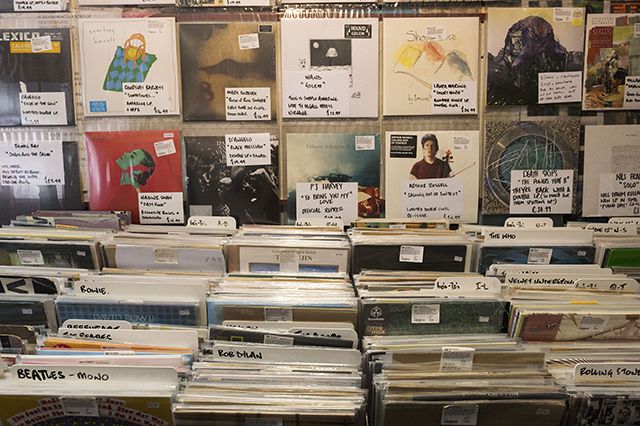
Nevertheless, vinyl remains the only physical bearer of music, the sales of which from year to year, despite the general crisis in the industry, are growing steadily. In a world where a CD for many has nowhere to listen to, Vinil was just the way-this is the perfect way to own music, which leaves no sensation of meaningless money. Vinil has a huge cover and great design potential; Color vinyls, transparent, multi -colored, with a pattern over the entire surface of the plate are produced - whatever. The plate is very nice to hold in your hands, its listening is a whole ritual with wiping vinyl with a cloth and turning - things that we really lack in digital music, and which have nothing to do with the music itself. The physical carrier turned into a souvenir, and the vinyl plate is its perfect option. Almost any more or less important album is now released on Vinil, including in an expensive limited edition, with good printing and multi-page booklets, more like photo albums.
Of course, mostly vinyl is bought by people with a very definite taste and great interest in their favorite groups, and the growth of sales of records is not a salvation for the entire musical industry, but also not a mass phenomenon. For example, in 2014, according to Nielsen Soundscan, Jack White’s new album (about 90 thousand copies), followed by the new Arctic Monkeys, Black Keys and an inconspicuous pop music in the form of Lana Del Ray, simultaneously with The Beatles and Bob Marly, was. In the British vinyl charts, there is about the same picture-modern indie rock, a little decent pop music and classic Led Zeppelin or Pink Floyd albums. However, the queen of the first six months of 2015 in America was Taylor Swift with its incredibly popular 1989.
Pavel Borisov
Riga