
Translated material
The story of the political officer
The court in the Rostov region interrogated Nadezhda Savchenko. Reporting Andrei Kozenko
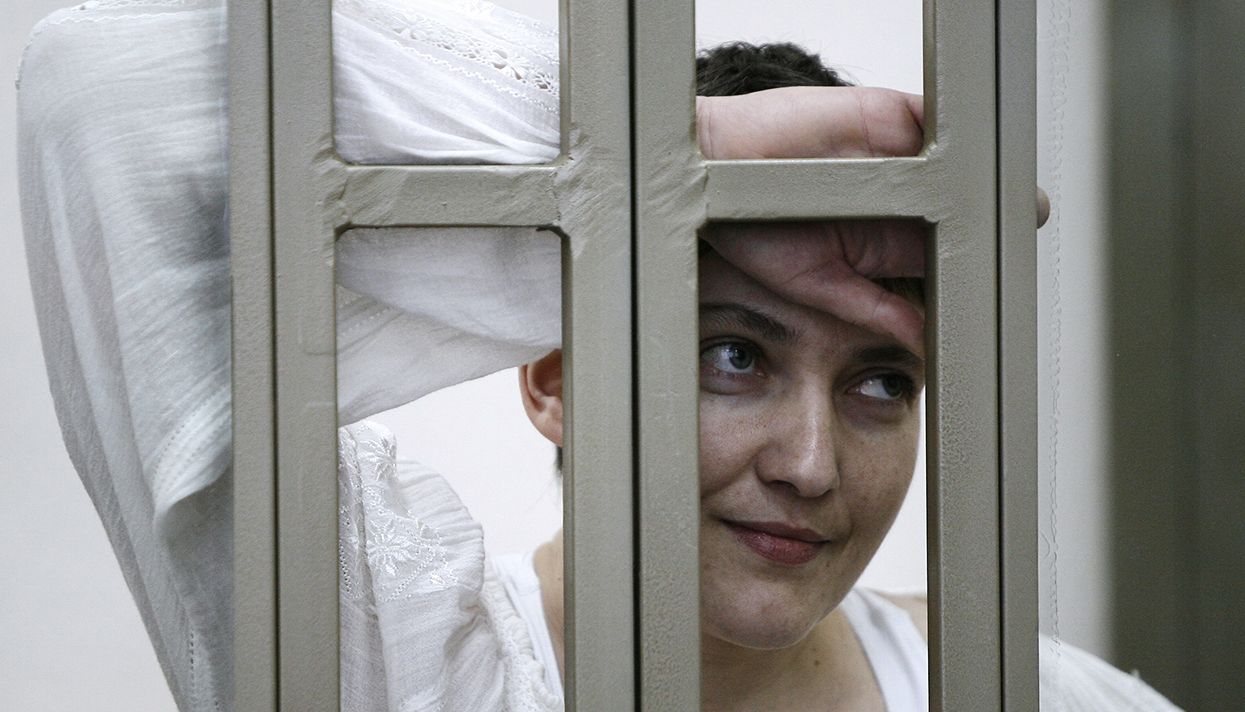
In the City Court of Donetsk (Rostov Region) on Tuesday, September 29, Nadezhda Savchenko, a Ukrainian soldier who is accused of the murder of VGTRK employees Anton Voloshin and Igor Kornelyuk in the summer of 2014, of the assassination of the murder of civilians of the Luhansk region and in the illegal crossing of the border with Russia. Savchenko rejected all these accusations. She said that she killed not civilians, but only those who tried to kill her. Savchenko claims that she was not near the village of Metalist, where the journalists died, and in Russia she turned out to be, because she was captured and abducted by separatists from the self -proclaimed Lugansk People's Republic. This story (and Savchenko also demanded to interrogate it with the use of a lie detector) fundamentally contradicts what is written in the indictment. The prosecution took it very calmly, asking only a few clarifying questions. The process is monitored by the special correspondent of Medusa Andrei Kozenko .
The interrogation of Savchenko began with the petitions of her lawyers Ilya Novikov, Mark Feigin and Nikolai Polozov. They asked for their client to testify with the help of a lie detector and a specialist-polygraphologist, as well as that a map of the Luhansk region is projected during her interrogation on the wall of the meeting room. So Savchenko, according to the defenders, could better prove that on June 17, 2014 she was not near the village of Metalist near Lugansk, and that she did not coordinate shelling, during which Voloshin and Kornelyuk died, and several more peaceful evacuated residents were injured.
They figured out the lies with the detector quite quickly: nevertheless, the court, and not the car, assesses the reliability of certain indications under the Criminal Procedure Code. For the maps, the sides fought longer. Those in the case file are refused to provide the prosecution. And against the Google card (“received, as I understand it from the Internet,” Judge Leonid Stepanenko, the presiding judge, said displeasedly at the trial), because from the point of view of the Code of Criminal Procedure, the map is “inaccurate” and “not official”.
Finally, Savchenko began her story. She said that she would speak Russian, and it would only go to Ukrainian if she could not explain. In the next three hours, she was confused only in the names of the months.
Savchenko was born in 1981, graduated from 11 classes and the Sewe School, then went to the army - first to the railway troops, then to the landing. She dreamed of flying on fighters, but under Ukrainian law, women cannot work on reactive equipment. Six months on the UN peacekeeping line was in Iraq - in the Basra. Five years after that she served as an assistant operator by the Mi-24 helicopter.
Separately, she noted that coordination of fire in aviation and in artillery troops are fundamentally different things. Artillery needs mathematical calculations and knowledge of accurate coordinates. She was not taught all this.
When the events on the Maidan began, Savchenko came there to all his dismissal. “It was my will,” she said. She was on the Maidan and in February 2014, in the days of the most fierce battles in the area of Grushevsky Street, when civilians died. She provided medical assistance, defended the "Berkutov", with whom the crowd wanted to deal. “Then we and the other“ Berkutovist ”persuaded his colleagues not to use power to civilians,” she said. After the accession of Crimea to Russia and the beginning of hostilities in the southeast of Ukraine, Savchenko decided to go to Donbass. She filed an application for transfer to the Aidar battalion, but began the service, without waiting for it to go through the instances.
The prosecution was trying to dissuade Savchenko from political slogans, but this was impossible, because her motives were connected only with politics. “It was difficult for the people of my profession, the lower link, it was difficult to make decisions on top of the departure of the territories that we consider ours,” said, in particular, Savchenko. In her words, she had no hatred to people who were on the other side. Savchenko does not consider separatists - residents of Donetsk and Lugansk regions: they simply “under the influence of propaganda made their choice and became opponents.” Savchenko calls the real enemies those who “came to the Donbass from a foreign country” with someone else's weapons in their hands.
On June 2 or 3, Nadezhda Savchenko arrived at the disposal of the Aidar battalion. She was engaged in everyone at once - there was not enough personnel, weapons, radio, and things. If she entered the service officially, she would become a political officer-an "psychologist-ideologist." According to Savchenko, this was the only position in the regiment that a woman could claim.
The closer to June 17, the more details the story of Savchenko became. On the 15th and 16th, the Ukrainian army repulsed the settlement of happiness from the separatists. “I’m not going to disclose the course of the operation,” the defendant said coldly. She also answered all the questions of prosecutors about the deployment of parts or about the technique in their service. Early in the morning of June 17, Savchenko called the Aydara combat Sergey Melnichuk and informed her of shelling and wounded south of happiness. Savchenko lifted several people from the personnel, and on the Nissan car herself, along with her volunteer surgery, she went to the place.
The case took place in the area of the village of Stukalov Balka. There was no more battle, she said, on the road stood the Route “Gazelle” and two private vehicles with ammunitions abandoned by separatists. Savchenko discovered four wounded soldiers, called Melnichuk and sister, said that they would come to them on light equipment, because it is easier to notice and destroy the armored vehicle. About 15 minutes later, a car with two Aydar fighters arrived behind the wounded, but Savchenko told her, she was also knocked out. She invited them to retreat - as it turns out, she herself went even to the south. What happened next to the wounded, she never said. The village of Metalist, where at the same time she was fired at, remained three to five kilometers west of it.
Savchenko said that she felt an ambush when she had two hundred meters. She stopped, but then right in front of her, about twenty meters, an armed separatist appeared. “I got. Come here, ”he said. Savchenko decided not to resist - opening the fire, she could draw attention to hiding wounded. The guy did not even take her a machine gun. Together, talking together, went to the main ambush. Here Savchenko was already disarmed, they took the money from her. They put a bag on their heads and promised to "send it to expense." It was an hour before the shelling of the village of Metalist began, during which the employees of the VGTRK died.
Savchenko was brought to the sports hall of the military enlistment office in Lugansk, chained an handcuff for a sports shell. There were other Ukrainian prisoners; They were chained handcuffs to weights, for example. The next day, a group of correspondents of Russian federal television channels was allowed into the gym. And only from them, according to her, she learned about the death of Voloshin and Korneluk. Savchenko said to the television cameras that was a gunner of fire. At the trial, she explained that she had done it just like that: "These are Russian journalists, what's the difference what to tell them." And she added: she really called the regiment commander Melnichuk, but did not coordinate fire, but only asked not to shoot along the road.
Fighters of the LPR, Savchenko said, behaved aggressively, but generally normal. They fed that they ate themselves, conducted talks about the exchange of prisoners of war. Then Savchenko saw the current head of the LPR Igor Plotnitsky - he seemed to be the Minister of Defense of the self -proclaimed republic. It was Plotnitsky, says Savchenko, who decided to send it to Russia.
On June 23, she was first taken by car with a bag on her head and handcuffs, and then they were handed over to two people in military uniform, which, unlike many separatists, did not speak Ukrainian at all. They walked through the forest, got into a new car, there people in masked Savchenko. In three and a half hours of the journey, they did not mention her in a word. Then Savchenko ended up in the blue “nine” with two people in civilian clothes. Then she was waiting for a beige minibus and two more hours of the road. Most of the path of Savchenko’s eyes were closed, but once she managed to see the road sign “Boguchar - 60 km”. Boguchar is a district center in the Voronezh region, to the Ukrainian border from it more than 70 kilometers.
Savchenko said that she was at the DPS post, a policeman approached her. "Right Sector"? - he asked her ( The Right Sector was recognized in Russia with an extremist organization, its activity is prohibited ). “I am a prisoner of war,” she answered. Savchenko was taken to the Euro Motel on the Don highway (the outskirts of Voronezh) and kept there under guard. Russian investigators began to come to her. One said that she would be a witness in the case of Avakov-Kolomoisky (the main thing, excited by the RF IC based on Ukrainian events). “I have never even seen them,” Savchenko shrugged. In July, she was arrested already as part of her own business.
Thus, the version of Savchenko fundamentally contradicts the indictment. It said that she coordinated fire on a metal meter, and then illegally crossed the border in the Rostov region. But the prosecution in the courtroom looked as if her discrepancies were not very exciting. Savchenko asked a lot of abstract questions: does she know how to navigate the terrain who she was in Iraq, whether she had to kill people (yes, but only those who tried to kill her, the defendant answered), which is the theoretical training of the helicopter operator and so on. The prosecution, it seems, wants to prove that Savchenko possessed all the knowledge in order to be the person who knows how to coordinate the fire. Whether she was actually - in the indictment of this everything has already been said.
After the interrogation of Savchenko, the court began the interrogation of the victims - the inhabitants of the Luhansk region. It will continue on Wednesday.
Andrey Kozenko
Donetsk, Rostov region