
Translated material
"Oda to joy" for two Germany
25 years ago, Germany again became one. The Germans of the West and the East reunited after decades of a painful split
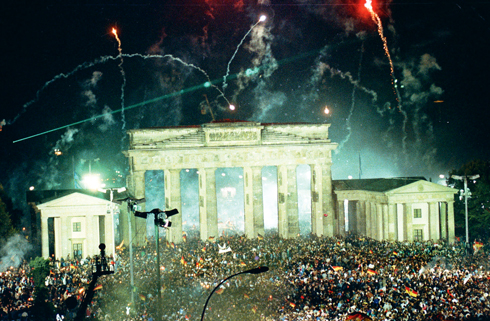
Salute over the Brandenburg gate on the day of the unification of Germany, Berlin, October 3, 1990 on the night of October 3, 1990, spotlights installed on the tower of the English military commandant’s office in the Berlin Park of Tyrgarten were beaten in the Reichstag. And therefore, on the walls of the building, even at a distance, potholes from shells and bullets remaining after the war were visible. On the rostrum along the entire facade, the old and new associates of the German Chancellor Helmut Kolya, who had just led Bay Germany to unity, crowded.
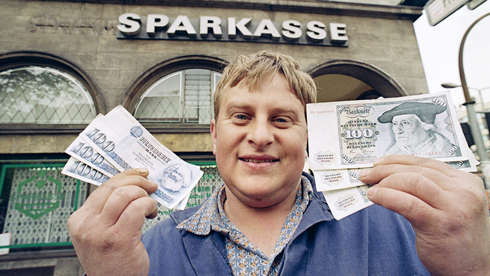
A resident of the GDR Yorg Hartman demonstrates the exchange rate of the Western brand on East, Berlin, 1990 a difficult road to the “flowering landscapes” of the orchestra and the choir under the control of Kurt Mazur performed the “ode to joy” - the anthem of Europe. But for some reason, there was no joy on the faces of Helmut Kolya and standing next to the former Chancellor and leader of the SDPG Willy Brandt. Only monstrous tension. It's hard when the fairy tale becomes the past. Many now say that Kohl did not foresee the development of events, did not direct them, but blindly followed them: simply, they say, the stars came together in his favor. You can speak. But one thing is obvious: this person saw the goal. And he did not cunning when at the beginning of 1990 he assured the French President Mitteran that he was still far away. Just then the time was insanely compressed, and what years could go for - the days left. Kohl did not want to scare the French with the ghost of the new "Great Germany": Paris was already scared and resisted the unification to the last. Not to mention Margaret Thatcher, Italians and Dutch. Kohl managed to achieve the support of President Bush, who was afraid that for the sake of uniting Germany could move away from the Western Union and approach Moscow.
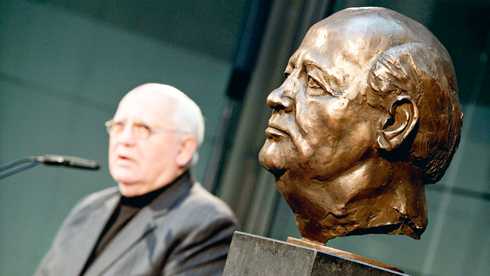
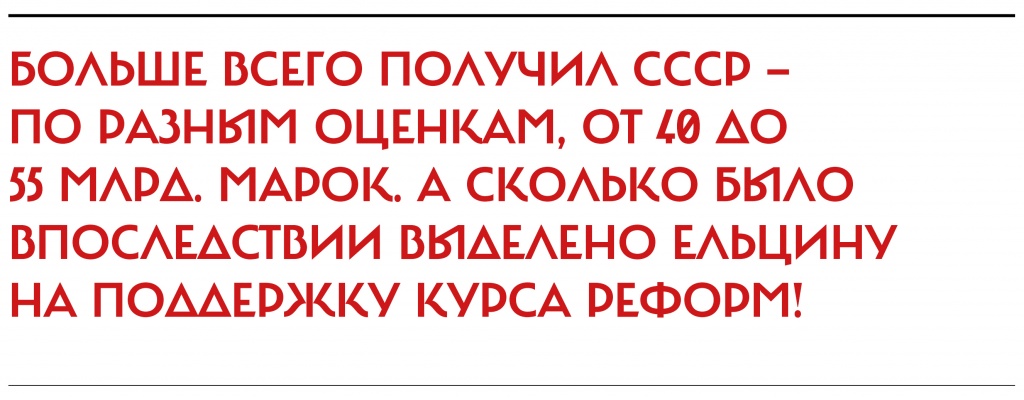
Mikhail Gorbachev at the opening ceremony of his bust, Berlin, on November 9, 2009, Kohl believed in his prophecies that "the east would get to his feet in three to four years." And therefore, in every possible way accelerated the conclusion of a ruin currency and economic alliance between Germany and the GDR, according to which, from July 1, the eastern brand changed to the western fictional course: the amount of up to 4 thousand (to pensioners-up to 6 thousand)-one to one, from above-two to one (a month before that the real “market” course was 10: 1). What gigantic fraud was turning and how much it cost the economy of his country even before the real unification, the chancellor was probably interested in little: people in the GDR, he thought, had to feel the advantages of the upcoming unity in his wallet. Once in the same 1990, he said (documents from the department of the federal chancellor testify to this): "All in the end will fall into cash." So, in general, it turned out. Germany identified “more than expected” for military operation in the Persian Gulf, which appealed to the Americans. And before that, a half -billion loan of Hungary was provided for opening borders with Austria. But the USSR received most of all - according to various estimates, from 40 to 55 billion marks. And how much was subsequently allocated to Yeltsin to support the reform course!
How much the unity of the German unity cost once again proved that a person for the sake of his main goal, for the sake of his understanding of the good of the Motherland, can risk everyone. As the Chancellor Kohl did. And as Gorbachev did - in German unity he is as courageous and great figure as Helmut himself Kol. Regardless of what motives led them. The former ruling burgomaster of Berlin Eberhard Dipgen once told the author of these lines that it would be impossible to be impossible without a change of guidelines in Moscow. And Gorbachev played a decisive role in this. That is why he is an honorary citizen of Berlin, and a monument was erected in the city (near the monuments of Bush and Kolya). The most popular President of Germany Richard von Vaitsecker adhered to the same point of view. In Germany, they still argue how much German unity was “worth”. An expert from Berlin Free University Klaus Schroeder today calls a fantastic amount - about two trillion euros. Of these, 60–65% are social benefits. To make it clearer, only one example. The metallurgical plant in Aizenheuttenstadt was not needed by the economy of the new Germany. All dismissed employees began to receive pensions and unemployment benefits at the level of Western colleagues, while not paying for the relevant funds of neither Pfennig. And this is only one enterprise. Before the “flowering landscapes”, which he promised 25 years ago, is still not close, although, say, autobahns in the east are in a much better condition than in the West. The economic productivity of a resident of the former GDR is only three quarters from the western level. Therefore, money is still pumped from west to east. Not in such, of course, quantities, as before, but still. And although, in general, the power of the united Germany increased significantly, the standard of living of the population has decreased. But still today, a quarter of a century later, most Germans believe that the unity of the country was worth the victims.
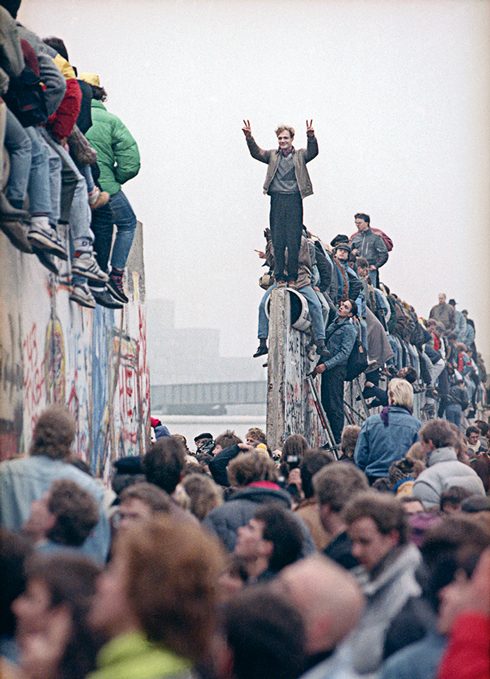
The unification of Germany was preceded by the fall of the Berlin Wall, Berlin, November 1989
Helmut Kohl: “It was important for us not to miss the initiative” One of the main creators of the German unity was the Chancellor of Germany Helmut Kol. At the turn of the century, in 2000, he shared with Alexei Slavin thoughts about what the unification of the country was personally for him*. The main provisions of his response seem important today.
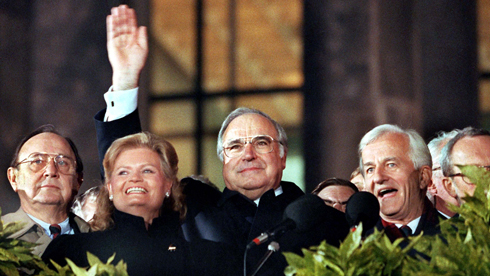
Chancellor Helmut Kohl with his wife on the rostrum of the Reichstag, Berlin, October 3, 1990
When on November 9, 1989 the Berlin wall fell out and the borders protracted by the “thorns” opened, no one could certainly predict the further development of events. Therefore, it was important for us not to miss the initiative in the main thing: in the process of unification of Germany. This was expected from us and our fellow citizens in the GDR. At the same time, three main political directions were implemented, which were outlined at the beginning of my stay as a federal chancellor. The first was that we steadily considered the voluntary unification of the German people as the main task arising from the country's constitution. And therefore, they rejected all the requirements of Honecker (head of the GDR.-NT) and some part of the Social Democrats to recognize the right to their own citizenship for the GDR. The second direction was our “yes” decision of NATO to place a medium -range missile in the Federal Republic. Without this relationship with the allies, and primarily with the United States, would be in a serious crisis. And the third decisive moment can be called our decision to become a kind of European unity process, together with French friends. I have no doubt that the events of 1989-1990 would be impossible without the confidence of our European and American partners in the reliability of Germany. For us, the Germans, the special success was that the head of the United States was then George Bush. It was he who, without any conditions, supported our desire for unity and freedom. Unlike some in the European community, Bush from the very beginning understood that the West would have much disappointed the Germans, he would not accept their fair demands on the issue of self-determination. Just such support on a certain “Day X”, since the signing of Germany’s agreements in 1952, Western allies have invariably guaranteed Germany. It's time to keep the word. So that no one has a reason to doubt the political will of the federal chancellor, we have developed “10 points of the German unity program”. It was based on consistent steps: from the “community agreement” through the “confederal structures” to the “federation”, that is, to a single Germany at the level of the federal state. The lack of clear time frames in the implementation of this program very soon turned into an invaluable advantage: after November 9, 1989, events began to develop too quickly. During my unforgettable trip to Dresden December 19, 1989, I clearly realized that people in the GDR were already ready for unification. From that moment, we stepped forward step by step: from the first free elections in the GDR on March 18, 1990-through the Monetary and Economic Union on July 1, 1990-to the country's unity agreement on August 31 and the Agreement on September 12 in Moscow 2+4 (Germany, GDR plus the USA, USSR, Great Britain, France.-NT). By October 3, 1990, when we reached this goal, not even a year has passed since the fall of the wall. Since then, two dates are for me - November 9, 1989 and October 3, 1990 - the happiest days of my life. In an incredibly short time, in less than 11 months, German unity became a reality. <...> The new united Germany quickly found and firmly took its place in the world. It was possible without a special tear, as it were, by itself, to integrate the united Germany into the traditional system of foreign policy priorities of the old Germany and thereby make it a factor in international stability. It was this way that Washington, Paris, London and Moscow arranged the most. * Partially published in the General Newspaper in October 2000.
Photo: Reuters, Hansjoerg Krauss/Ap Photo, Marcel Mettelsiefen/Picture-Alliance/DPA, Wolfgang Kumm/Reuters