
Translated material
Mikhnik - Navalny: Dialogs
So called a book, the presentation of which will be held in Moscow on October 2
The famous Polish journalist and writer, one of the leaders of the Solidarity movement Adam Mikhnik and the leader of the Russian opposition Alexei Navalny met in Moscow and discussed a variety of issues for several days - the experience of combating a repressive regime, post -Soviet transit, nationalism, corruption, relations of the church and the state, overcoming the split within the opposition movement, etc. The New Times offers its readers the chapter from the book - "Do I need lustration"
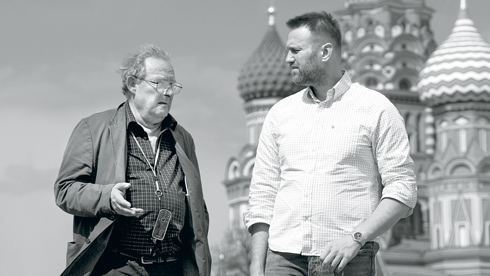
Adam Mikhnik (left) and Alexei Navalny on Vasilievsky Descent, Moscow, April 30, 2015 Navalny: in Russian opposition circles the opinion is that the main mistake of Yeltsin was the lack of lustration. I know that you are an opponent of lustration. But in one of your long -standing interviews, I read that you, in principle, do not exclude the possibility of a ban on certain people to engage in state activities. Have you changed your opinion? Mikhnik: I am still enemy of lustration. Lustration in the form in which it was carried out in Czechoslovakia and Poland in the 1990s, is a moral crime. And the unconditional mistake of our democracy. To transfer judicial powers to special institutions, the activities of which are based on the archives of security services is a complete Orwell. It is necessary to remain within the framework of ordinary legal proceedings. If there is reliable information that a certain official or police officer or special services violated the law, you need to send a statement to the prosecutor’s office and achieve a normal court. You read my interview with Vaclav Gavel, because he also spoke out against wild lustration. Navalny: Let's go on a specific example. The judge who, by order of the Kremlin, put my brother, should be lustrated? Mikhnik: No. It is necessary to create a commission from lawyers and prepare a report on what specific decisions this judge made during Putin's reign. To show obvious things to everyone, so that everything becomes clear and understandable. But this is not lustration. Navalny: This is fair justice. Mikhnik: If, say, the crime is confirmed only by denunciations found in the archives of the security service, then it cannot be considered proven a priori. The same applies to restriction in the rights of people simply in the fact of their cooperation with a particular organization. You need to understand how the special services dossier formed. Suppose they call a certain Mr. X and ask: "What do you know about Japanese espionage?" He replies: "If I knew something, then he would have come to you and told you." And in the dossier of Mr. X there is a record that he himself expressed a desire to cooperate with special services. Completely trusting the archives of such structures, we make a logical mistake: under the “old regime”, everyone lied, and only one conditional KGB told pure truth! Navalny: You were a member of the parliamentary commission, which in 1990 checked the archives of the Polish Ministry of Internal Affairs? Mikhnik: Yes. The commission had four historians. We have not seen everything. We were shown only those documents that were already irrelevant. But I still saw something, and it was a complete nightmare! For example, a photo of a Japanese businessman in a hotel with a prostitute ... And then I realized that it was necessary to take all this for 50 years. So that this information can appear only when all the characters are already in the cemetery. But with one condition: if a person claims a high government position, then the Prime Minister must have access to all dossiers and bear responsibility for his nominee. Navalny: That is, you should not open and publish secret files of persons who apply for government posts? Mikhnik: This is a very interesting question. From my personal point of view, I would say it is worth it. But there is one point: intimate archives. You know how much dirt pours into public politicians. And it is one thing when the media share the information that was obtained on their own, and quite another when they refer to the archive of the state department. This is very bad. Because all these data were collected in violation of the law. State bodies have no right to monitor my private life. And if it were an argument in the election campaign, then this could be considered the last success of the KGB. I do not think that such information needs to be opened and published. Navalny: Yes, this is an important aspect. I share your point of view. Indeed, their secret files are the result of illegal operational activities. FSB officers run after me, take off every second of my life and then they will show it to everyone. I believe that it is necessary to create a special commission from very respected people who will spread the secrecy regime. They will have the opportunity to study all the material and publish only what applies to the elections, and not to personal life, family, children. Mikhnik: And in this commission, historians, sociologists and others must have. Because you need to understand many aspects of what you read. There is a source content, and there is criticism of the source, internal and external. You need to understand who exactly wrote the denunciation and why, how true he is. Navalny: one of the most powerful arguments in favor of lustration is the satisfaction of an objectively existing public request for justice. Mikhnik: Lustration is not justice, but revenge. Navalny: I think there is a certain terminological confusion. In Russia, very often, lustration is understood as a procedure that an ordinary just trial can easily be carried out. Therefore, my position in this matter is as follows: the jury court for everyone. And we must provide it to everyone. To condemn Putin officials, special laws are often not required, because they constantly violate even those laws that they themselves write and adopt. Mikhnik: I agree with you. The decision should always make a court, not politics. Navalny: in the problem of lustration in relation to modern Russia, two points seem important to me. Firstly, its goal. I think it should consist in satisfying the request for justice. In our case, we are not talking about the conclusion outside the normal legal field of all special services agents, for example. In itself, an agent of special services (full -time or secret) is not the main object of public aggression. We are talking about people who committed crimes and must bear a fair punishment in court. And this process should be formalized, because without it, in my opinion, one cannot conduct a “fat line”. After all, then there will be thousands of people who feel deceived behind her. Secondly, I agree that if you allow me to carry out lustration personally to me, then I can get carried away, and people that I just do not like can enter my lustration list. Therefore, we must create a transparent procedure for collecting materials to transfer them to the courts of general jurisdiction to persons who led political repression and violated even Putin laws. I am convinced that the opportunity for them and then to occupy leading political positions should be determined in court. Mikhnik: Only in court. But from a Polish point of view, this is not lustration, but a normal judicial procedure. Navalny: It was important for me to find a point of contact. After all, you do not support the idea that tomorrow we will all forget and forgive those who put us in prison yesterday, and, like Mahatma Gandhi, say: “I forgive everyone.” I can forgive my persecutors, but I have no moral right to forgive strangers. Many people are now in prison because they supported me, and I can’t say to them: “Sorry, but I forgave your persecutors.” Mikhnik: Of course, I agree. But I repeat once again: only through the court. Navalny: Yes, and we must understand that in many cases we will lose these courts. You need to be prepared for this and put up with it. But I believe that you need to go for it. There is another feature of future Russian lustration (let's call it like this): a matter of illegal enrichment. In Eastern Europe, after 1989, there was no such problem on any serious scale. We understand that the nomenclature lived better than ordinary citizens, but she had no such phenomenal wealth that modern Russian bureaucracy. These people need to apply the norms of the UN Convention against corruption in full and the principle of retroactive force, exclude the statute of limitations, etc. Mikhnik: I agree. And again in court. Navalny: Yes. The most important thing is compliance with the judicial procedure. Mikhnik: For Russia, this is a really important question. There were no multimilliarder officials in socialist Poland. Navalny: and in the USSR this problem was not a massive nature. And now, it seems to me that such lustration (although this is not entirely lustration) will be supported by everyone. There are convinced Stalinists in Russia, but in Russia there are no people who support the purchase by officials of palaces. Mikhnik: And yet I want to warn once again: lustration, no matter what we understand by this word is very subtle and complex matter. You need to be extremely careful and stay away from radical dissident measures, do not enter into the logic of cleaning. And it is very careful to treat the materials of the special services that will fall into your hands. Who have they collected incriminating evidence for in recent years? On Petrov, Ivanova, Sidorov? Of course not. On Navalny. And who can become a victim of wild lustration? In Poland, they tried to put Lech Valenes with a secret agent of the Security Service! And you will have radicals who, due to their own stupidity or for the sake of money, will say: "Navalny-the Kremlin project." Navalny: Many say so. Mikhnik: I am afraid of this "spirit of the era." Therefore, we at one time conducted a “fat line” and offered the slogan: “Amnesty - yes, amnesia - no!” You can and should be forgiven, but we must not forget. There are people who were supporters of Putin, and then went to the opposition ... Navalny: for example, Mikhail Kasyanov was the Prime Minister within the first presidential term of Putin, and now I am creating a democratic coalition with him. Mikhnik: This is a great example. 25 years of special services were looking for compromising evidence for me. And they did not find it. And not because I am infallible, but because from their point of view, I was incorrigible. For them, I was already dead and useless. I asked our Minister of Internal Affairs Kshishtof Kozlovsky if there is something on me. He replied: "Do not worry, only girls, and then all beautiful." * Idea: Roman Golubev, Pavel Puchkov editors: Pavel Puchkov, Vaclav Radzivinovich M.: "New Publishing House", 2015 Photo: Andrey Zhilin