
Translated material
Eternal return
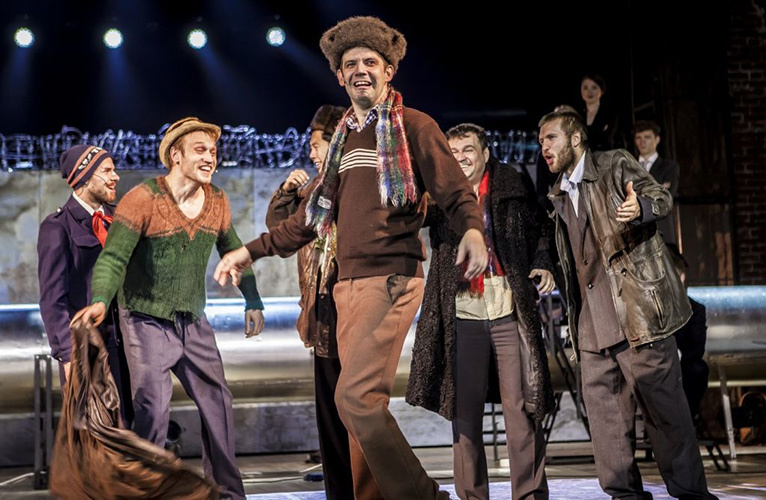
Rushing the performance in the “Gogol Center” by Nekrasov’s poem, Kirill Serebrennikov released “Hero of Our Time” in a large ballet. Before that, he put Gogol, Tynyanov, Saltykov-Shchedrin, Ostrovsky and Gorky on the theatrical stage- “dead souls” , “Kizhe” , “Golovlevov’s gentlemen”, “forest” and “philistines”. There were two more Lermontov-“Demon” with Oleg Menshikov and “Hero of our time” with students of the Moscow Art Theater School. If you add modern texts from “plasticine” to “scumbags” to these names, a voluminous metate of the fate of the homeland will develop: in fact, this is the main plot of the Serebrennikov Theater, pronouncing in his key performances of history about mysterious, incomprehensible, always alluring and always deceiving the “Russian world” with its temptations and demons.
Around the Russian classical text, Serebrennikov always arises a high tension field-from time to time his relationship with this text gains the properties of a lasting historical and cultural dialogue, in which modernity re-reveals itself through the past.
Guys, a fair, tears of a peasant woman, a landowner barbarism, a striped strip: “who lives well in Rus'” belongs to those textbook works of the school curriculum, which are read fluently and not without relief, they are replaced from the memory as a sign in general, or for those who, like Serebrennikov himself, studied at the Soviet school) of the communist system. With the displaced collective unconscious text of Nekrasov, the director began to work at the most difficult time - when the creative and social success, supported by the authorities of the power, was recently held on the crest, was immediately and strongly turned out to be its outcast.
 © Gogol Center
Having set off on an expedition to Nekrasov’s places-to Karabikh, Myshkin, Kukoboy, Poshekhonya-Serebrennikov, along with the artists of the Gogol-Center, walked towards the disappeared world, in the middle of the long-legged “stripes”, among the Rybinsk traces of the Gulag, past the miraculously preserved luxurious churches, tossing over the exhaust villages. This journey, described in detail by Serebrennikov himself in an interview and became the reason for the documentary, in fact, turned out to be the director’s journey to himself the former, a paradoxical return to the topics of Lermontov, Saltykov-Shchedrin and Prilepin.
Boys thrown to the sidelines of all Russian roads - including because they themselves have lost their way - gather here on the stage of the Nekrasovo poem, in the form of a textbook of his questioning peasants - dumping before us a native, saturated with bureaucratic lawlessness, bossy rudeness, his own drunkenness, cruel and lazy cursory, inexpressible patience and tears, passes With resentment and joy, the “Russian world”, which Serebrennikov feels so accurately and subtly.
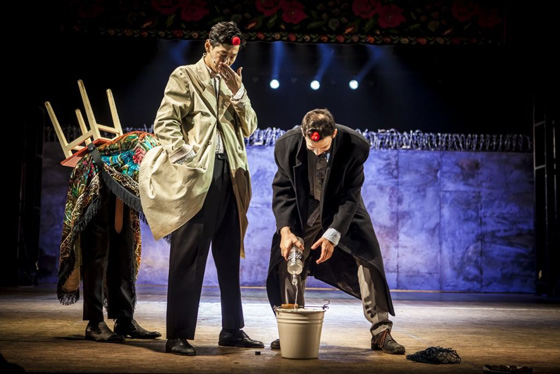
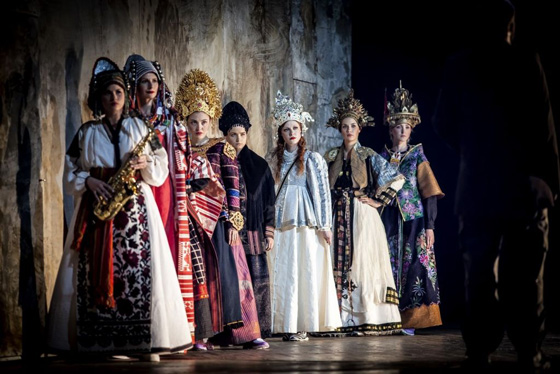
Repressed by memory as an export of socialist education, the poem Nekrasov was first revived on stage in his most complicated polyphony. The solitaire came down: a poem about the poor homeland, dressed in quilted jackets and school uniforms with a pioneer tie, family cowards and luxurious, Haute couture , women's dresses with kokoshniki à la Russe , opened the gateways of the pathetic crying genre. Through the sharp contrasts of the dazzling Nekrasov photography, through the darkness that even Tolstoy was afraid to touch, Serebrennikov was able to speak something secret and important about his bitter love for the Fatherland.
 © Gogol Center
The story of the devastated soul, “extra man” (Serebrennikov so important for many performances - “Preferring the sacrifice” and “Demon”, “Plotonol” and “Hero of our time”), turned here into the polyphonic choir of the languishing and devastated souls of our Divina Comedia . With confidence, moving behind Nekrasov, the theater played overcame the border between the narrator and the object of his description, between the “city” and “village”, between the conditional “creative class” and the conditional “people”. At what point the thin metropolitan guy, looking at how they spit out of his partners, dressing up in their bodyguns and T -shirts, the “ugly ducklings” of the peasant Raik, it himself becomes part of them, it is not easy to say - apparently when the fourth time begins his bike about “seven men” came together.
On the empty stage of the Gogol Center, besides the end to the end of the pipe, the eternal “serfdom” of the property, there is nothing, and who stands on this side of the “Russian world”, “Russian hell”, and who on the other can not make out. In addition to the wise guy, the “storyteller” (in fact, two) here are the glossy whims-gangsters, and their glimmary women, and ruin runs, and a spectacle-dissident from all Russian swamp squares. And all to one - warriors. We will recognize them in their quilted jackets and T -shirts, in their jeans and rushing, in their camouflage of prisoners and guards, always ready to go “to the bloody battle”. They say about the tsar in a whisper, about the priest and at all - about the minister of the sovereign - with fear ... There is nothing to update here - the Nekrasov world endlessly reproduces itself in Holy Rus', repeating all the same words about the tsar, and about the priest and endlessly harnessing the new yoke, the new Burlakov strap.
Russian beauties, singing terrible lullabies/memorial/wedding cries over this eternal field of pain and battlefield, decorate the wretched (empty, poor) space of hell with their postmodern beauty.
 © Gogol Center
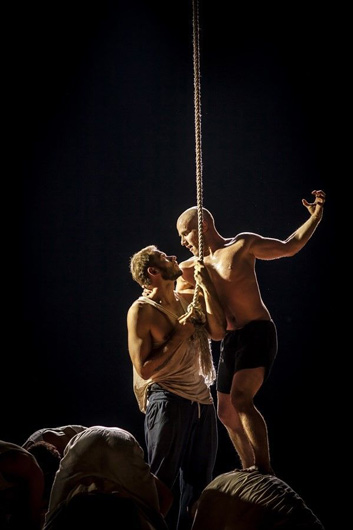
When in the second-choreographic, composed of steamed with Anton Adasinsky-the act of “drunk night” by the bodies of men will be “sown” with a huge scene of the “Gogol Center” open to the brick arore, and the witchcraft voices will conquer over this dead (drunk) field of their mortal songs of sirens, it seems that the same tragic spirit appeared in the modern theater, which the same tragic spirit, which the same tragic spirit. It has never happened in it. The naked, mowed human flesh lies with a witch without moving, and only the palms tremble, like small eternal lights over the eternal Russian graveyard.
And in the third part, one tragic - female - soul will stand out from the choral principle to turn the popular tragedy into a song of fate. Pouring the “peasants” of Vodka, Evgenia Dobrovolskaya - Matrena Timofeevna returns the intonation of tragic actresses of the past to the Russian scene. It is no accident that invited by the director from his “gentlemen of the Golovlevs”, she brings the same unlimited tear to the performance that he was in the Moscow Art Theater. At first, it even seems that this cannot be that her confession tearing the soul is only dressed in a tragic canon to remind of the forever lost secret of this art. But after a few minutes there is no strength to resist the pain that she surrenders entirely, overcoming her with her Suyrian female bravado, by the power of her inexhaustible heart.
Of course, this long confession will be replaced by a choir rock and roll final (all the music was written by two composers-Ilya Demutsky, the author of the score to the “hero of our time”, and his colleague Denis Khorov), will build his difficult relations with Nekrasov’s “Russia”, will sake-without embarrassment, he will get into a reset and seriously-his words about “mighty and the words are powerful and about the mighty and powerless. " And this will be the strongest part of the current statement of Serebrennikov. In all circles of the Russian world, Russian hell, tormentors and martyrs, rapists and victims are inseparable and undividedly responsible for everything.
And it will seem that the army that rises is similar to the served slave, Jacob the faithful, who kills himself in his unknown power and weakness.