
Translated material
The theory of the Great Agu-Agu
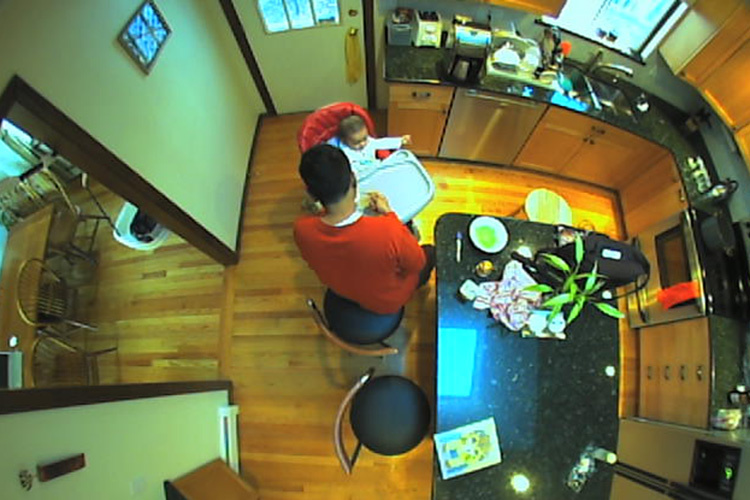
A child is born on the eastern coast of the United States, and from the moment when he is brought from the hospital home, after him (as well as for parents and nanny), 11 cameras and 14 microphones mounted in different corners of the house are observed day and night. For three years, 90 thousand hours of video and 140 thousand hours of audio recordings have been accumulating. The next five years, a team of 70 decoders - work from 2 to 15 people at the same time - spends only on the analysis of materials related to the period from nine -month to two years of age.
The child’s father is Deb Roy, a professor at the Massachusetts Institute of Technology ( MIT ) and the “main scientist on media issues” ( Chief Media Scientist ) at Twitter . His experiment on his own son began 10 years ago, and now, in September 2015, in the journal ProChedings of The National Academy of Sciences finally printed a large academic article , summing up its results.
Roy wanted to figure out where the speech came from. With the filing of Noam Khomsky, the classic of linguistics, for the past forty years, it is believed that a special “apparatus of language assimilation” has been working in the baby’s brain, which has nothing to do with the painful and slow process of teaching adults to English or Chinese. This mysterious “assimilation apparatus” is for some reason only in the language. Arithmetic, a set of protozoa actions on numbers, a seven-year-old child has to learn several years at school, but already three- or four years freely uses a natural language from his dentistly complex system of the rules of manipulations with signs (like contextual and foreign grammar of the same Khomsky- your brain actively launches them, even if you yourself have not passed anything like that).
Class differences are not laid at the time of birth, but they make themselves felt by 24 months of age-and this is due just to the assimilation of the language.
It is believed that the baby listens to adult conversations and absorbs the tongue like a sponge. However, the word “absorbs” creates the appearance of clarity where there is no clarity. Is it enough to put the baby a year before the TV turned on, where adults or cartoon heroes talk to others? If on the screen there are only lectures “Postniuki” and “Arzamas”, will he utter the words “Diachrony” and “Synchrophasotron” earlier than “Mom” and “Dad”?
For the theoretical question “how it absorbs”, for example, an explanation may be hidden why it is so difficult to get out of the poverty trap . An equal access to education does not solve the problem: children from poor families study worse (on average). Does this mean that they have “poor heredity”, the genes of parasites and alcoholics? Not at all necessary. It seems that class differences are not laid at the time of birth, but they make themselves felt by 24 months of age-and this is due to the assimilation of the language, as the experiment of psychologists from Stanford shows, the results of which became known in 2013 . Scientists were interested in Spanish -speaking families in the USA - an obvious risk group where poverty often becomes hereditary. Parents of 29 babies, who turned 19 months old, were persuaded for a short while (for a period from day to six) put a recorder in the child, continuously writing down all the sounds around.
In 24 months, babies compared an active vocabulary (from the point of view of cognitive science, this is not so much about the ability to talk, but about the ability to think categorically). It turned out that the volume of the dictionary of two -year -olds does not directly depend on the total number of words that the baby hears, but on the number of addressed directly to him. The TV or quarrels of adults with each other do not make a significant contribution.
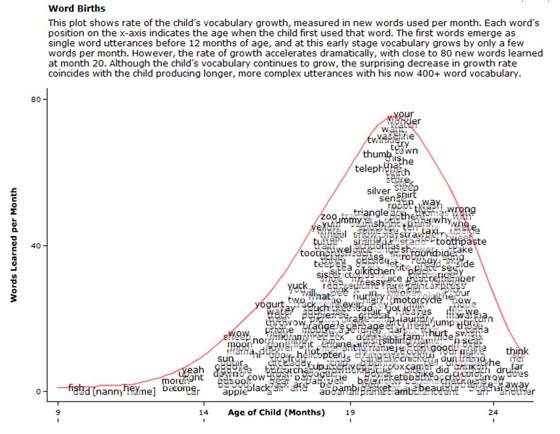 © Courtesy of deb Roy first 400 words of a baby
What does poverty have to do with it? Families with income below 25 thousand dollars a year participated in the experiment (by the standards of California - extreme poverty) and up to 75 thousand dollars (which is also not prohibitively many), so scientists had something to compare with. The poor often cannot afford to spend a lot of time talking with the baby, leave him one on one with a TV - and thereby determine the very difference in abilities long before it comes to study.
But if psychologists from Stanford had only a few hundred hours of dictaphone records, then Debu Roy with his tens of thousands of audio hours and the video were available much more subtle details. For example, for each of the 679 words mastered by Roem Jr. to a two-year age, the moment was accurately calculated when it is pronounced for the first time-“the birth of a word”. " The Birth of a Word ” is also the name of the TED lecture, read by Roem in 2011, when data processing was in full swing; Since then, 2 million 100 thousand times watched the lecture.
Based on the video, Roy built “verbal landscapes”-surrealist 3D-rats on top of the map of the house, where the height corresponds to how often the word is pronounced in one place or another. For example, the word “mango” corresponds to a sharp mountain peak in the kitchen, and some indefinite article is evenly smeared throughout the house. With such an analysis, it is clear that words like “mango”, tied to a particular place, the child assimilates easier, and those that are pronounced here and there are given with great difficulty. The child masters the most frequent words, contrary to expectations, late - because these are primarily pronouns and prepositions, abstract in meaning, and the baby perfectly sorts the incoming speech according to the degree of abstraction.
Comparing the “birth of a word” in a baby with the chronicles of the appearance of the same word in the speech of parents, you can calculate how much the “pregnancy with the word” lasts in the brain. Or to observe how sounds are transformed: for six months, the “water” of the English -speaking baby smoothly turns from “ gaga ” into “ water ” (the lecture of the TED shows how specifically this transformation is: Roy consistently cut out the forms of the same sound recordings in six months and glued together).
Roy created the Bluefin Labs media analytics company, which found out how microbloggers pick up teleclames. Twitter bought it for $ 90 million.
The researchers themselves had to invent the tool analysis tools, which, as it turned out later, are suitable not only for the analysis of children's babble. The semi -automatic decryption system guesses the speaker - father, mother, nanny or child - by voice. It itself removes the intervals when there is noise, but there is no speech. And to interpret the data, they were used in the course of the Great Mathematical Artillery: the article was overloaded with terms like “divergence of a culmus -leibler” (with its help, they find out how the frequency characteristics of a particular word in the speech of the averaged are deviated).
The same mathematical apparatus was quite suitable for analyzing another variety of babble, namely, Twitter reactions to different irritants of the outside world. In parallel with the experiment on his son, Deb Roy created Bluefin media analytics Labs , who found out how microbloggers pick up words from television and how the series influence them. In 2013, Roya bought Twitter For $ 90 million .
If the specific methods of Bluefin media -analytics have never been revealed and remained a commercial secret, then the “Lepeta Corps” is open data specially prepared to ensure that others work further with them. For the curious, the authors of the article created a special site with statistical calculations, and for colleagues-researchers they laid out the sources in the GitHub repository, where it is customary to share a freely distributed code for programmers. It is unlikely that potential users of this code are only mothers and dads of babies, students to speak. The parental speech, which is “absorbed as a sponge”, in the world of information there are enough analogues from advertising to propaganda, in which the model is at least interesting to try.