
Translated material
Two wars
Nearly 36 years, the beginning of the Russian armed intervention in Syria from the entry of Soviet troops into Afghanistan has been separated. What is common between these two events and what is the difference?
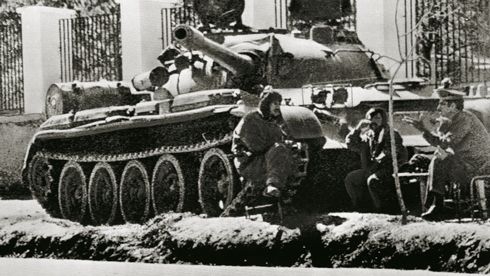
The tank at the USSR Embassy in Kabul, the picture was taken on May 3, 1978, a week after the pro -communist coup in Afghanistan , I will begin by the fact that, both then and now, the actual entry of troops began before the official announcement of it.
In the fall of 1979, I was in Kabul. I, a 23-year-old graduate of the Institute of Asia and Africa at Moscow State University, had to pull the strap of a two-year army service-a translator Farsi in a group of Soviet military advisers, after studying. I will make a reservation that the Soviet military advisers worked in the Afghan army since time immemorial-both at the King of Zahir-Shah, and with the Muhammad Dauda, who had proclaimed him, who proclaimed the republic in Afghanistan, and who ate and killed Levaki from the People's Democratic Party. So neither I nor my senior comrades had anything to do with the commissioning of our troops, they did not know anything about him - he was preparing in an atmosphere of perfect secrecy - and watched what was happening from the outside. But with all the secrecy, already from the summer in Kabul, rumors began to walk about the possible Soviet intervention - I have already shared in detail my memories of this (see The New Times , No. 5 of February 17, 2014 ). Then there were talk that some of our parts are already standing somewhere, that in the city they deploy a special connection unit with Moscow, which our military is guarded, that they transferred either the Pskov or Tula paratroopers to the Bagram air base in Bagram ...
One fine day, walking along Kabul, I saw a strangely looking convoy of armored vehicles, which was walking at all pairs - without the usual Afghan identification marks. The driver’s hatch was opened, and I was ready to swear that, despite the high speed, I managed to see the completely Russian face of the driver. And the cars were some kind of "not like." Then it turned out that it really was the BMD - the fighting vehicles of the landing that were in service in the Soviet Airborne Forces, but not in the Afghan army. This was probably a month before that day in December 1979, when in the sky above Kabul for several days the endless rumble from Soviet military transport aircraft ...
Now in Syria a similar picture: the first cargoes with Russian military equipment and the first "Dopontentents" of the military arrived at the shores of the Syrian Latakia almost a month before the start of air strikes.
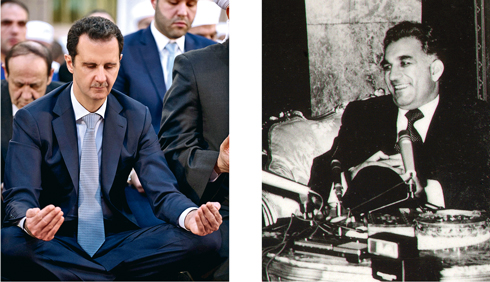
Like Bashar al-Assad ( left ), in 1979, Afghan President Hafizulla Amin ( on the right ) asked for a “big northern friend” of military assistance 
His current Moscow patrons are not going to liquidate Bashar al -Assad. On the contrary, everything is started in order to support the staggered regime, to demonstrate to the degree and the world that "we do not hand over our own."
This is a significant difference. But this does not mean at all that after some time Putin will not decide that Assad should get rid of. Especially if he has real - or imaginary - reason to doubt the loyalty of the Syrian dictator.
Let me remind you that the story with the Soviet military invasion of Afghanistan was largely caused by the desire of Moscow to change the then Afghan leadership. Moscow did not trust Amin. He seemed too independent, too much on his mind. A cunning, insidious, merciless ruler is a typical eastern despot. Marxist rhetoric in his mouth looked unconvincing. The relatively young, energetic, ambitious, he swore love for the USSR, but, most likely, for the sake of maintaining power, any form could throw out. And after the “betrayal of Sadat” - after the then president of Egypt first sent Soviet advisers from the country, and then generally abruptly changed the foreign policy, reoriented to the United States, entered into negotiations with the Israeli Prime Minister Begina, paid a sensational visit to Jerusalem, signed the world and established diplomatic relations with the Israeli, - the possibility of a repeated trick of the trick. The sides of someone else from the closest allies of Moscow in the Third World were a sticky nightmare for the Kremlin. To prevent the repetition of such a script was an obsessive idea for the Soviet leadership.
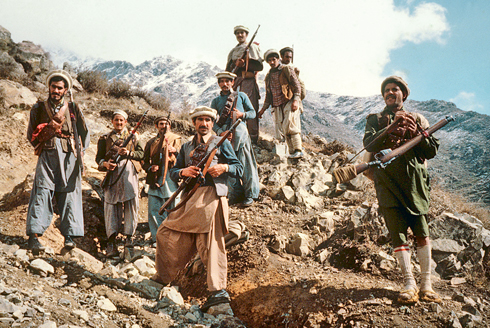
Afghan Mujahideen near Kabul, a picture of the first half of the 1980s
In his world, the overthrown and murdered Amin, retroactively declared the CIA agent, but no convincing evidence was presented to this. Most likely they were not there. But in Moscow, it seems, then they sincerely believed that at first they themselves came up with - as if Amin worked for the Americans or was at least connected with them.
And there is something in common with today. The current Kremlin leaders, led by Vladimir Putin, seemed to be such cynical pragmatists who sometimes live and, most importantly, act and make decisions in their invented world. It seems that it exists in the head of the former head of Russian Railways Vladimir Yakunin, who completely sincerely, in seriously, told in his scandalously sensational lecture to students of St. Petersburg University about the secret world government, which ruling the West, which seemed to be regularly gathering on the top floor of one of the New York skyscrapers. Yakunin fell into disgrace and, apparently, is no longer in Putin’s “near Circle”, but it hardly changes a lot. Others, who have not yet fallen from the nest, think about the same way - re -read the August revelations of the speaker of the State Duma Sergey Naryshkin, who accused America of all the troubles of Russia. President Putin went through the same socialization, formed as a person at the same time when faith in all kinds of conspiracy theories and world Masonic conspiracies were held in high esteem in certain circles, especially in the special services, gradually displacing the decrepit Marxism-Leninism.
As then and now, the country's leadership is captured by its own dogmatic picture of the world order, infinitely distant from reality. The elderly Soviet leaders sincerely believed in all nonsense about the fact that those who were freed from the colonial or semi -colonial dependence of the country of Asia and Africa choose the “non -capitalist path of development”, which will eventually bring them to the world camp of socialism, and were ready to spend millions of dollars on the support of these regimes. True, periodically their leaders, wagging their tail, switched to a completely different path of development and found themselves in a completely different camp, but the Kremlin elders continued to bend their line.
Well, in the case of Afghanistan, the temptation was especially great. Still, this country bordered the Soviet Union, and how could you not get captive of a sweet dream about de facto of the 16th Soviet Republic, which is almost to the warm waters of the Indian Ocean ... Unlike Afghanistan, Syria and the Russian Federation do not borders. Neither Abkhazia, nor South Ossetia, nor the LPR-DNR will come from it.
With the stigma of the “invaders” ... Like 36 years ago in Afghanistan, today in Syria our country appears on the side of the extremely unpopular regime hated for most society. In other words, the Russian military in Syria will soon begin to be perceived in the same way as the Shuravi once in Afghanistan-like the invaders acting as punishers. Worse - as "infidels."
Moreover - but this was not in Afghanistan! - Russia draws into a conflict with two legs, which has an obvious interfaith basis - on the side of the ruling Alawit (Shiite) minority based on the support of Shiite Iran, Iraqi and Lebanese Shiites, against the Sunni majority of the rest of the Arab world. I’m not sure that the Kremlin is in charge of what they are doing - at least from this point of view.
... And without allies, the Soviet Union was, without a doubt, superpower. He had numerous allies-satellites: countries-members of the SEV, Warsaw Treaty, etc. And in general, the world was arranged differently. The USSR could afford to conduct both the arms race with the United States, and the war in Afghanistan, and to support money and weapons at once by many pro -war regimes, fighting with their political opponents, in different parts of the world - in Ethiopia, Nicaragua, Angola, Cambodia.
True, in the end the USSR broke and died. To what extent Afghanistan played his role in this - there are still great disputes on this score. The late Egor Gaidar, for example, in his wonderful book “The Death of the Empire” carefully expressed the idea that the colossal military and military-political expenses were not a decisive factor in the collapse of the USSR.
But today, even if no one can give a confident answer to the question of whether Russia will pull in the current economic circumstances and the war in Syria, and the continuation of the hybrid war against Ukraine, there is a feeling that the Kremlin will not be able to afford for a long time and another.
Confrontation is like fun and finally one more - very alarming! -The difference between Afghanistan-1979 and Syria-2015.
Thirty -six years ago, there were people in power in the Kremlin who, in my deep conviction, no matter what, sincerely wanted peace, did not want the third world war. First of all, because they themselves went through the Second World War, in their own skin they experienced what war is. Even if sometimes with their clumsy actions on the world arena or frank foreign policy adventures, they lowered the threshold of international security.
The current leadership of Russia does not have this priceless personal military experience. And sometimes it seems that he is seriously amused by the thought of the possibility of victory in a military confrontation with the West. And this is especially dangerous in the situation with Syria, where-unlike Afghanistan-79-there is a real probability of an accidental clash with the US armed forces or their allies participating in operations against ISIS (
The Islamic State is a group banned in the Russian Federation. - NT ). With all the consequences that, right, it’s even scary to think.
Photo: Associated Press/Fotolink, Reuters/Sana/Handout Via Reuters, Independent.com.mt, AFP Photo