The confrontation in Syria entered the new phase: the Iranian infantry hurries to the help of Russian aviation, which destroys opponents of Bashar Assad from the air. “Thank God, we will not fight each other yet,” a source in the American White House remarked in a conversation with NT
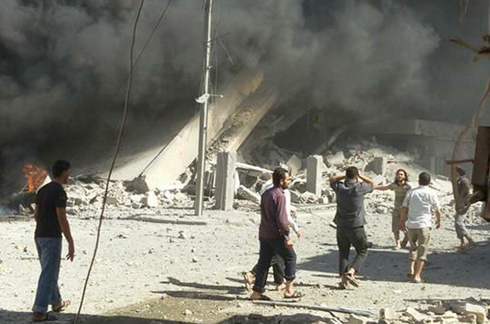
As a result of the bombing of the city of Talbisa ( in the picture ), dozens of civilians were killed, says Syrian opposition, Syria, September 30, 2015 Hydra "Islamic state" * must be destroyed! " - Valentin Matvienko cheerfully produced the tasks of the current moment at the end of the first autumn meeting of the Federation Council on the morning of September 30, which was closed: the senators urgently considered and unanimously approved the president’s appeal to use the Russian armed forces abroad. The rush was explained. The telephone message that the “stamp stands” and the green light at the beginning of the military operation was given urgently to send to all foreign diplomatic mission of the Russian Federation, so that they knew how to respond to calls on a hotline - from state and military structures of the countries of stay. In the Pentagon that Russia was ready to start an air operation in Syria, they knew a day before it began, but the US Embassy in Damascus received an urgent dispatch from Washington only an hour before the two Russian Su-24 bombers, as reported by the Interfax agency with reference to the Kurdish television channel, threw the first bombs in the Kurdish television channel. The area of the city of Ham, which is 213 km north of Damascus, was happening on September 30 at about an hour of Moscow time.
And then the main question arose:
Who will we bomb? At 14.43 on September 30, the American television company SIN-EN, citing a source in the US administration, reported that the first airline fell on the suburbs of Homs, where the Christian community once lived in Syria. Homs, since the civil war began in Syria four years ago, as a result of which more than 250 thousand people were killed, Assad’s resistance citizens were killed, the city learned a lot of tragedies, there were street battles, the Khoms suburbs were repeatedly moved to hand - from government troops to the Syrian moderate opposition and back, but there was still no message that there was no message about the fact that they were close to the fact that they were close Homs concentrated by ISIS fighters * . Even in the southern suburbs of Damascus ISIS * hid his “sleeping cells”-they woke up, for example, in mid-September, entering the battle with one of the Islamist groups subordinate to al-Qaeda * . But why did you need to bomb Homs' suburbs?
After about an hour, the Syrian Center for Human Rights was distributed by the news, which, however, was not confirmed by any other source: as a result of the bombing of the suburbs of Homs, 27 civilians were killed, including 6 children ... And one of the organizations of opposition groups claimed that "the Russians bombed the warehouse with bread."
The reaction of Moscow was extremely painful: Maria Zakharova, an official representative of the Russian Foreign Ministry, said that an information war was launched against Russia, for which "someone was very well prepared."
By the end of the second day, the bombing of the Ministry of Defense of the Russian Federation reported: 12 objects of IG * were destroyed per day, not a single third -party civil infrastructure object was injured. But other messages were in parallel: two Russian airstrikes in Syria came to the camp of the "Sokolov Mountains of Mountains", who were trained with the American CIA fighters; The Russians bombed the objects in 11 settlements under control by no means ISIS * , but the Syrian moderate opposition, the American NPO Carter Center ( see map ) reported.
Why now? The summer of 2015 was extremely unsuccessful for the army of Bashar al-Assad. Here is an excerpt from the military reports of the Syrian opposition forces for the beginning of August: “As a result of an attack on the positions of the Assads in the province of Homs and in the province of Idlib, a number of settlements - Ziyar, Tal Vasiet, Mansura, hirbat were seized ... This opens up new prospects for the opposition.” In the Damasian suburb of Zabadani, the onslaught of the opposition forces are completely forced to take on the volunteers of the Shiites from the Lebanese Hzbollah group and the Iranians from the guard corps-Assad already did not have enough strength to defend the capital. But the most alarming: the forces loyal to the Damascus handed over several strategically important settlements already in the coastal province of Latakia - the key to the Assad Alavite clan: since 2012, Assad and its environment began to consider this region as a reserve airfield in case of disintegration of the country.
The opposition of the opposition of a tactical initiative in the province of Latakia was alarmed by Moscow: it was here, in the port of Tartus, that the Russian naval base is located. Considering that since 2013, the Russian Navy in the Mediterranean Sea has been present on a permanent basis in the amount of 5-6 ships, the operational-strategic value of the “Material and Technical Supply” in Tartus will only increase. Not to mention the prospects of losing a longtime - and almost the only one today - an ally in the strategically important region of the globe.
According to NT sources, since mid -July, the Russian and Syrian General Staff "have been in constant data exchange." A critical day became August 28, when the Islamists from Jabhat al-Nusra (subordinate to al-Qaeda * , but is at war from ISIS * ) managed to capture the Abu Dukhur airfield in the Idlib province and the Syrian Air Force aircraft practically lost the last opportunity for surgical maneuvering in the western and northwestern part of the country. The 29th, according to sources, the head of the Ministry of Defense of the Russian Federation Sergey Shoigu reported to Vladimir Putin: the situation in Syria is completely ahovaya, without urgent reconstruction of the air base under Latakia at Assad, consider there is no aviation, and it is his last trump card. At the beginning of September, the Mozdok air bridge was established-Latakia: military cargoes went to Syria in a continuous stream, up to a thousand military specialists were transferred here over the next three weeks-a half-abandoned runway at the Syrian base in Khumaimim near Latakia was expanded and adapted for the reception of Russian combat aircraft (see The New Times , No. 30 From September 21, 2015) However, Moscow did not want to go further than air support, and Assad did not insist: they say, there is still someone to fight on Earth.
According to the Lebanese newspaper al-Safir, in Moscow, at the end of the first decade of September, Iranian Major General Kasem Suleimani, the commander of the Al-Kuds unit, the elite part of the Islamic Revolutionary Guard, for the second time over the past two months. NT failed to find confirmation of this information in Russian sources, but in European diplomatic circles in Moscow they assure: there really was a visit. But the fact that on August 4 in Tehran was visited by the Deputy Minister of Foreign Affairs of the Russian Federation Mikhail Bogdanov, the envoy of the President of the Russian Federation in the Middle East, is a well -known fact. NT sources in the circles of the Syrian opposition in Istanbul are sure: Bogdanov discussed in Tehran the format of Iranian participation in a joint military operation in Syria with Russia. During the September visit of Suleimani, specific terms were discussed: the Iranians made it clear that they were ready to additionally transfer and deploy two brigades in Syria, reinforced by volunteers from Hezbollah by the beginning of October.
Istanbul sources also have “reliable information” that in Tehran was aiman al-Za-Zawakhiri in the beginning of September, the number one in Al-Qaeda * : “Iranians discuss with him the conditions under which al- Qaeda controlled in Syria can stop active hostilities in Latakia, Idlib and Homs to ease the Assad of the lost lost territories ".
On October 1, on the second day after the start of Russian bombing, Reuters reported that hundreds of Iranian military with weapons arrived in Syria to support Assad’s military campaign. On the same day, Israeli newspapers also distributed information.
Again on October 1, Moscow, which previously rejected the “speculation” about the prospects for expanding the military operation into the territory of Iraq, unexpectedly changed his tone: they say, if the corresponding request comes from Baghdad, Russia will consider it. On the same day, Iraqi Prime Minister Hyder al-Abadi praised Putin for surgery against ISIS * , adding that the defeat of the group “in the interests and Iraq”. It is worth adding that al-Abadi personally authorized the creation of the coordination anti-terrorism center of Russia, Iran and Iraq in Baghdad-this was a real surprise for the Americans, who in the middle of the zero years accused Al-Abadi, at that time, at that time, the Minister of Communications of the temporary transition government, of corruption, which, of course, did not forget. Vladimir Putin knows who to look for friends and allies.
“Iran is busy preparing a large -scale ground operation against ISIS * not only in Syria, but also in Iraqi territory,” says Iranian historian and dissident Ramin Parham. “And most likely, this will happen with Russian support: the Americans will not allow the Iranian Air Force to fly over the territory of Iraq, even with the permission of the government in Baghdad.”
It is clear, however, that the counterattack of Assad’s troops coordinated by Moscow, Tehran and Baghdad seriously increases the rates in the Syrian conflict. But the risks too.
What is fraught with? On September 21, the Prime Minister of Israel Benjamin Netanyahu arrived in Moscow, accompanied by a solid number of people in uniform (army, of course). The Israelis already knew: Putin was ready to bomb Islamists in Syria from day to day and you will not be convinced. But perhaps Putin does not quite understand: since the war is in Syria, Israeli pilots-just in case-patrol the sky not only over the Golan heights, but also a little east and southeast, that is, those areas of Syria, where only vague memories remained from Assad’s power. It happened to them and use standard weapons. “Our main problem: however, Russian planes mistakenly“ hooked ”us, and we - them,” explains the Israeli diplomatic source in a conversation with NT . “The military had to coordinate the identification parameters of air goals.” As a result, it was possible to coordinate even something more - the creation of a situational center that eliminates the risk of random clashes of the Air Force of Russia and Israel.
The Turkish President Erdogan arrived on September 23 in Moscow in fact for the same purpose.
It was the agreements with Netanyahu and Erdogan, the leaders of the key countries of the region, Moscow tried on the eve of Putin’s visit to New York, on September 28, to use as an argument in a conversation with the Americans: they say, it remains to agree on everything only with you. The meeting of Obama and Putin at the UN headquarters two days before the start of the military operation of the Russian Federation in Syria made sense only in order to avoid possible clashes between the coalition forces and the Russian Air Force. After all, Bashar Assad is still a wall between Russia and the USA: the White House does not see the opportunity to resolve the political crisis in the conditions of preserving the “tyrannical” regime in Damascus, for the Kremlin he is the only legal ruler, without negotiations with which there will be no solution to the Syrian problem. Obama and Putin went to one and a half hour negotiations from such poles of intransigence.
“They understood each other. They perfectly understood each other, ”Sergey Lavrov assured the press at a press conference at the UN on October 1, on the second day of bombing. He said that at that prolonged meeting Obama and Putin agreed that they would maintain constant contacts on Syria at the military level. Nevertheless, in the early days of bombing, the military departments of the United States and Russia spoke different languages and did not believe each other. Sometimes there was a feeling: Moscow and Washington, finding himself on different sides of the Syrian barricades - yes, they have one enemy - ISIS * , but different allies - were on the verge of a power confrontation.
Most likely, “neither Moscow nor Washington had a clear and complete idea of whom air bombers were brought down, because the first supplies Damascus with its data, and the Pentagon bases its information on the information received from the rebels,” said Nikolai Zlobin, head of the Washington Center of Global Interests. “One and the others could confuse.” Conclusion: such a situation, given the extremely high degree of distrust of between the Russian Federation and the USA, is “very, very dangerous”: “In this military mess that we received in Syria, the risk of a direct military clash between Russia and the coalition forces is very great, if there are no clear agreements.” And although the expert recalls, President Putin in his speech at the UN promoted the United States and France about the low efficiency of their efforts in Syria, his own tactics made the situation even more unpredictable.
For example, Saudi Arabia and Qatar in response to the military interference of Russia already strengthen military assistance to Syrian rebels. Experts do not exclude the radicalization of part of the so -called moderate rebels and their tactical alliance not only against Moscow, but also against Washington. “Russia today is an accomplice in Assad’s crimes and has come to kill us from the approval of the United States and the international community,” the New York Times quoted the Words of Hudar, one of the opposition leaders in the province of Homs. The anti -government coalition in Syria also stated that she considers Russia an aggressor.
However, the discontent of Er-Riyada or Dochi is not the only unpleasant moment for Moscow. Pulling into the war on the side of the Shiite minority - Shiites in the world 10–13% - Russia must clearly realize that there is also an absolute Sunni majority - more than 80% of all Muslims. “Imagine that by some miracle the Russians will be destroyed by ISIS * ,” writes the Columnist The New York Times, the Middle East, Tom Friedman. - The only way to consolidate such a victory is to replace them with moderate Sunnis. Question: What such moderate Sunnis can enter into an alliance with Russia when Putin is considered by them as the main ally of a person who destroyed more Sunnis with his cassette bombs than anyone in history? ” The only way out for Putin, according to Friedman, is to participate in the development of a political decision for Syria with the participation of the United States. And this is possible "only on condition of coercion of Assad - Iranians and Russians - to the transition period, leaving power, and then from the country."
Thinking for his people a small victorious war as a cure for the Afghan syndrome, the Kremlin did not calculate the consequences of the invasion of the Arab world, Nikolai Zlobin is convinced. However, he adds, "no one has yet calculated them."
** ---
Russian combat aircraft in Syria: **
Su-34 6 aircraft. One of the new developments of the military -industrial complex, the front -line bomber, with the possibility of long -term flights and long -term expectation of the order in the sky. It is even equipped with toilets and a kitchen, and the crew sits "in the vehicle", in the proximity to each other. In addition, he can fly, adjusting to the terrain, roughly speaking, without crashing into the ground, and is also equipped with a GLONASS system and laser guidance.
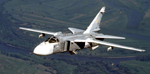
Su-24-M 4 aircraft. The front-line bomber from the 1970s, which has since passed more than one war and modernization: it was applied, for example, in the Afghan war and in the Iranian-Iraqi. It can be used for point (strategic) bombing and bombing freely falling bombs, effective for the destruction of living, “tactical” goals. As well as the previous plane, the Su-24 is able to fly, adjusting to the terrain, and at the so-called "ultra-small" heights, up to 50 m above the ground. At high altitudes, the plane flies at supersonic speed.
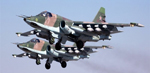
Su-25-Cm 12 aircraft. The attack aircraft equipped with uncontrolled C-25 missiles, designed exclusively for the destruction of people and military equipment. Accordingly, this plane works at subsonic speed - with such missiles you need to be more accurate - and affects the targets in the front -line zone, providing support to the ground forces in the battle.
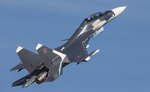
Su-30 12 aircraft. A heavy fighter from the 90s. Although he is now in Syria, he has not yet participated in air strikes. Immediately the question arises: why do you need a fighter in the war, where all the stated opponents of the ACAD Air Force are absent as a class-both the “social” of the Syrian opposition, and the “Jabhat al-Nusra” and the IG * . Most likely, a certain standard set necessary for the successful conduct of a military operation is “seconded” to Syria, and the Su-30 cover the airfields exclusively “for any fireman”.
Prepared by Dmitry Sidorov
* “Al-Qaeda”, ISIS, or IG (“Islamic State”), are banned in the Russian Federation as terrorist groups. Photo: Syria Civil Defense Via Ap, Igor Korotchenko, Andrey Zinchuk/Airforce.ru, Igor113.Livejournal.com
Syria: flight map • New Times • RIMA — Russian Independent Media Archive