
Translated material
"The prize will live"
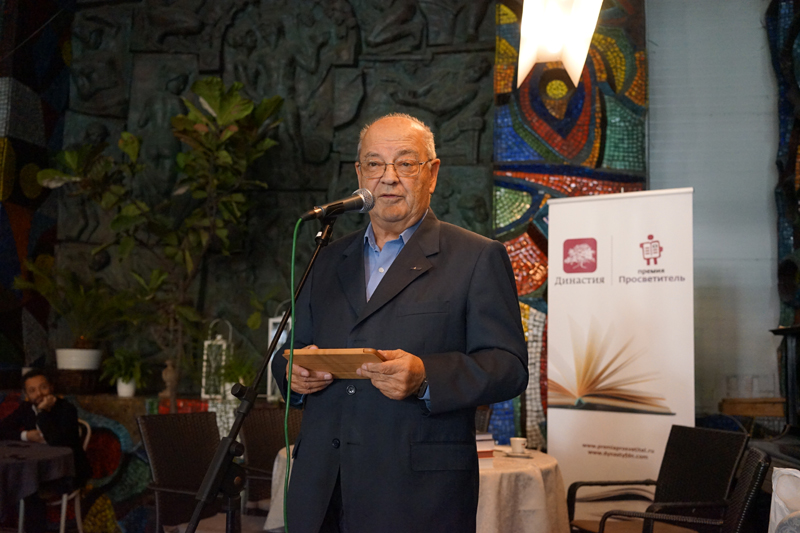
The press conference of the Enlightener Prize, at which the authors and finalist books were announced, was in a sense farewell. The Dynasty Foundation, which all these years was the organizer of the premium in the field of popular science literature, ceases its official legal existence on October 31. The fund's logo will disappear from the banners of the award.
The co -chairman of the Enlightener Organizational Committee, Alexander Arkhangelsky, pleased that the award would live, but already under the auspices of Dmitry Zimin.
“The prize will continue. ... Rosa Khatskelevich, who was one of the clues and advisers D.B. Zimina at the time of the foundation of the prize remains inside the project. But the project is isolated, it will be associated with Zimin and Zimin personally, but it will no longer be associated with the Dynasty Foundation. And this is the best of what could be. ... Whatever the atmosphere outside this beautiful building, the atmosphere is weather and political, important things must be continued. The prize remains and will be next year, ” said Arkhangelsk.
After this optimistic statement, authors who fell into a short list of awards, as well as the winner of the biographies competition and other lucky ones, were announced. The collective Santa Claus and the Snow Maiden in the person of Alexander Gavrilov and Alexander Arkhangelsky took books from the bag.
It turned out that 2015 entered the final of the Enlightener:
- In the nomination "Humanities":
1) Evgeny Anisimov . "Imperial Russia." St. Petersburg: Peter, 2015.
2) Julia Kantor . “Flying friendship. Secret cooperation of the USSR and Germany of the 20-30s. ” M.: Political Encyclopedia, 2014.
3) Alexey Yurchak . “It was forever until it ended. The last Soviet generation. " M.: New Literary Review, 2014.
4) Mikhail Yasnov . “Traveling to miracles. A book about children, children's poetry and children's poets. ” St. Petersburg: Union of Writers of St. Petersburg, Foundation "House of Children's Book", 2014.
- In the nomination "Natural Sciences":
1) Nikolai Andreev , Sergey Konovalov , Nikita Panyunin (editors-compilers). "Mathematical component." M.: Foundation "Mathematical Studies", 2015.
2) Alexander Markov , Elena Naimark . "Evolution. Classical ideas in the light of new discoveries. ” M.: AST: Corpus, 2014.
3) Alexander Sokolov . "Myths about human evolution." M.: Alpina Non-Fix, 2015.
4) Vladimir Surdin (Ed.) Of the Galaxy. M.: Fizatlit, 2013.
Such a short list appeared after a 3.5 hour discussion of the jury, which was the day before.
Video of the press conference on October 6, 2015
The director of the jury, the scientific journalist Ilya Kolmanovsky praised one book from the Long List that did not get to the finals: Sergey Gagaev “Notes of the Diving Surse. The gaze of the zoologist-naturalist. "
In turn, the 2014 enlightener laureate, scientific journalist Asya Kazantseva, said a few words about Igor Dmitriev’s book “Stubborn Galileo”: “We did not understand all the time whether it should be included in the list of biographies or humanitarian books or natural science. The book is so good and comprehensive that it covers all these topics. This is a serious study of the era in which Galileo lived and worked. This is a serious and large -scale cast of the era. ”
Asya also noted Vladislav Smirnova’s book “Two Wars - One Victory”, which was published with a “monstrous cover”: “She is quite friendly to the reader and is very good as a source of additional reading for those who study history at school.” In addition, Kazantseva mentioned Natalia Lebina's book “Soviet everyday life: norms and anomalies. From military communism to a large style. " (M.: UFO, 2015): “This is a good and important book and I am sorry that it was not included in a short list.”
“Personally, I liked the book of Vladislav Dorofeev about the great medicines, since it forms an interested reader an idea of how a scientific search for drugs was going on. This book was written by journalists, not biologists, and as a book written by journalists, it is amazingly good, ” Asya Kazantseva emphasized.
The chairman of the jury, the President of the Polytechnic Museum, Boris Saltykov, emphasized that during the 3.5 hour meeting, the jury "fought to death, the eyes were different." He expressed regret that the book of Stepan is the individual “So who invented the radio?” (Yekaterinburg: Cultural Information Bank, 2014). “Dmitry Borisovich Zimin and I are both regretting that she did not enter. ... The book managed to avoid banal dichotomy, who invented the radio, priests or Marconi. In fact, this book gives a look at the history of those people who were involved in the process of broadcasting. It all started with Hertz, and the author consistently gives not formulas, but the fate of people ... and reaches Popov and Marconi, but explains that Popov mostly worked for the naval department and his work was mostly secret. He really transmitted the signal between the warship and the shore, and this is his merit. And Marconi worked as an open entrepreneur ... But if you can write about Popov that he did something, then Marconi made a universal brand out of this and after a couple of decades everyone knew what radio was. ... unexpectedly for the reader it turns out that the invention of the radio was patented by Tesla, and there was a large judicial dispute .... "
Already answering questions , Alexander Gavrilov said that the book on the history of the radio is clearly not enough scientific depth and preparedness. “Yesterday we suggested that if, on the one hand, this book was a little edited by scientific editors and journalists, but on the other hand, if it were released not in 300 copies, but in electronic form or somehow, it could be more solid and noticeable ... and if the author who does not know about this will agree to cooperate in this project, we will re-renew it. And this will be a serious reward to the works of the author, his reader and writer's courage. This kind of creative process is that I personally, not as an administrator, but a person is terribly valuable. We live like that. ”
In the humanitarian list, Boris Saltykov also highlighted V. Smirnov’s book “Two Wars - One Victory” about how the first and second world wars were going on: “The main thesis of the author was that the war did not end, and the First World War transferred to the second ...” .
“If we talk about voting, then we also had ideological discrepancies. The words sounded that you should not choose such a book, because it is too ideologized. We tried not to attach ourselves to the current moment or to the personal platforms on which we are standing, ” said Boris Georgievich.
Dmitry Zimin acted, according to him, as "the inferior member of the jury with the right of an advisory voice." “We had a dramatic jury. ... I am very sorry that the book "So who invented the radio" was not included in the short list. "
Zimin regretted that he almost convinced him to include the book in the short list, but did not finish the matter. “I only realized this morning that in vain I took off my proposal. Read this book, I highly recommend! Naturally, it was written not by a physics specialist, and the author is not too “sip” in Maxwell’s equations. But this is a reconstruction of historical events. I am a professional radio engineer and was once a radio amateur and learned a lot of interesting things from the book. To a certain extent, the myth of Popov was debunked in it. Yes, the author treats him kindly, but Popov is a marginal figure in this whole story. ”
Dmitry Borisovich also said several kind words about Igor Voitenko’s book “The Territory of Inability” about the opening of the land of Franz Joseph, the archipelago in the Arctic Ocean. “This is such a layer of human heroism, drama ... I did not know that Kropotkin was a great geographer.”
The founder of the award could not help but say a few words about the fate of the prize and the Dynasty Foundation: “As for the sign of the“ dynasty ”at the Enlightener prize ... We see it for the last time. The "dynasty" will soon disappear, soon closes, soon there will be a farewell to management. A lot of kind words were said addressed to the fund. But all sorts of other words were not said for long ... "
Zimin was silent for a moment and continued: “The soul clung to the Enlightener Award, my son and I thought how to continue this business. “Zimin-Fund” as a trust remains abroad, and if there is an operator in Russia who agrees to accept money directly from abroad, but he agrees (this is not political activity), then we will continue our work. The book program is one of the most pretty programs of the Dynasty Foundation. "
“So life continues,” Zimin noted to the applause of the hall.
The press conference ended with a minute of silence in the memory of the laureate of the “Enlightener” of 2014, historian Sergei Yarov. “Although he did not manage to take part in the jury, he advised a lot. We assume that the tribute to him, although not special, is that the three books of St. Petersburg historians and writers are included in a short list, ” said Alexander Arkhangelsky.
The jury was also especially noted by Alexander Alekseev’s book “History measured in fifth graders” (M.: ANO “editors of the magazine“ Science and Life ”, 2014). As an exception, it will be included outside the competition in the library newsletter of the Enlightener Prize and will go along with finalists in the cities of Russia.
At the press conference, the winner of the special nomination “Biography” was announced. They became Oleg Klevnyuk with the book “Stalin. The life of one leader ”(M.: AST: Corpus, 2015).
Alexander Gavrilov shared the details of the discussion. It turned out that the biography of the leader and book by Valery Shubinsky “Daniil Harms, competed for victory on equal terms. Human life in the wind. " Gavrilov handed over the words of Vladimir Plungan, a member of the jury, who noted that “it would seem that the decision is obvious. But we do not choose between Stalin and Harms, we definitely like Harms, not Stalin. We choose between books, and then we need to carefully focus not only on whom the book is written about, but also how it is made. ”
In the special nomination "Local Lore", the Enlightener Award was divided equally. Laureates became:
1) Stanislav Goldfarb "The World of Baikal". Irkutsk, 2010.
2) Elena Lebedeva and employees of the museum (S.V. Vorobyova, A.S. Kuusel, I.I. Nabokova, T.V. Pavlova) “The island of the Transfiguration (to the 300th anniversary of the Preobrazhensky Church on the island of Kizhi)”. M.: Moscow Packaging Center, 2014.
3) Alexander Potnovnov, Tatyana Khmelnik "Traveling around Ladoga." St. Petersburg: that "Baltic Star", Reed "Alaborg", 2013.
The laureate awarding ceremony will be held on November 19 in Ramt, and on the eve of November 12 to 15, the Enlightener Festival will be held, in which the finalists, members of the jury and sympathetic will participate.
Already after the press conference, they asked me a question on Facebook, but how the book can fall into the specialization contest “Biography”. I replied that I needed to send the book in the usual order for the premium contest, but my answer to the author did not satisfy the question. “It is not very clear where to send, because It is written on the website of the Black and Black Awards that biographies are not accepted for the competition. ”
Indeed, neither the jury nor the public “long list” of biographical books is given, the organizing committee appoints the three books, and the jury already chooses inside the “short-day list”. But then is it correct to talk about the top three authors as finalists? It seems to me that the selection of books in these and other special drugs should become more transparent and understandable for authors, publishers and public, since the biographical competition has ceased to be an exception, but becomes a tradition.
Videoscomers:
The popularizer of science Nikolai Andreev spoke about the new book "Mathematical Component", published immediately with two different covers - for children and youth and adults:
“The first. This book is unique, because no one has stated mathematics in this form. The second is the second. Among the authors are leading Russian mathematicians working in Russia and in the border. They set out the plots about how mathematics manifests itself in our life, where it determines the achievements of modern civilization (computer tomography, GPS navigators, genome reconstruction, Internet, traffic management, and control of transport, and control of transport. streams), to everyday plots.
Why does a sheet of A4 paper have such a size? What are the ratio of the parties in the book? What is the size of foreign and Russian passports? How does the cataphote work? One of the goals of the book to show where and what mathematics is found around us, and show not a mathematical community, but a wide circle of readers. All three editors of the book (Nikolai Andreev, Sergey Konovalov, Nikita Panyunin) represent the laboratory of popularization and propaganda of mathematics Mian named after Steklov ".
Member of the jury of the Enlightener Prize, physicist Alexei Semikhatov told everyone interested, including D.B. Zimin, about the 2015 Nobel Prize. He expressed his attitude to the Nobel Physics Prize of 2015 as follows:
"Today's Nobel Prize is terribly interesting. This is, in a sense, the denial of the Nobel Prize of 2013 during the prediction of Bozon Higgs, which was successfully found. The Higgs Bozon was positioned, and he is the last missing brick of the standard model, describing how our world is functioning at the micro level. Already at the time of the award for the boson of the Higgs, it was clear that it was clear that it was clear that it was clear that it was clear that it was clear that it was clear that it was clear that it was clear that it was clear that it was clear that it was clear The standard model is incomplete.
See: Dali the Nobel Prize for the Higgs boson as the completion of the standard model, but at the same time this model is not full, i.e. does not describe all the reality. A reality protruding beyond the standard model is primarily or, perhaps, in the second - the presence of a mass in neutrinos and neutrino oscillations confirming the presence of mass. The 2015 Prize in Physics is a challenge to theorists. Look, you have a standard model, you are big fellows, but it does not describe all the reality, it operates with neutrinos, which, in fact, do not fit into the framework of the standard model. This is a challenge to theorists - think on how a real complete theory works, and in this sense it is very cool! ”
Photo and video of Natalia Demina