
Translated material
War and oil
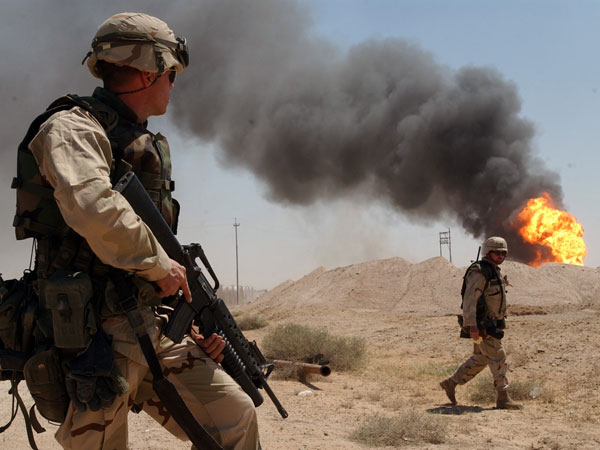
In recent days, commentators in the Western media are discussing a lot of the state of the oil market. Firstly, this topic is related to conflicts in the Middle East, in the region that leads oil production. Secondly, the discussion revived due to a sharp jump in oil prices on Tuesday.
Oil prices on October 6 rose due to the hope of reducing the supply in the United States and in world markets, explains Wall Street Journal . The American Agency Energy Information Administration reported that oil production was reduced from August to September in the United States. Now its volume has reached the lower level over the entire year. The agency also adjusted its forecasts for 2016, reducing the estimated amount of production per day.
In addition, news about the upcoming meeting of Russia and OPEC contributed to prices for prices. Finally, prices went up due to the reduction of investments in oil production, because it also leads to a decrease in the offer. As a result, prices rose by almost 9% compared to last Thursday and ended up at the highest starting from August 31. Experts do not make hasty conclusions, since it is not yet clear how quickly prices will rise and at what point they will stop. In addition, uncertainty in the short term is aggravated by the fact that large oil manufacturers (Russia and Saudi Arabia) do not reduce production. This means that with a general tendency to reduce the offer, price fluctuations are possible.
Analyst Nick Batler in his blog at Financial Times writes about oil prices in the context of rivalry between Iran and Saudi Arabia. The crisis of the oil market coincided with two serious military conflicts. One unfolds in Syria and Iraq (war against the Islamic state) and another in Yemen (with Husites). Both of these wars are not directly related to the important areas of oil production, but they are an indirect conflict between Saudi Arabia and Iran. At the same time, the risk of a direct military clash between Tehran and Riyadh increases. If this happens, then the places of oil production and oil exports will become the main targets. The question is whether it is possible to prevent such an escalation.
The conflict between Saudi Arabia and Iran partly has religious roots, and partly unfolds on economic and territorial grounds. In addition, both states claim regional leadership. In recent months, the situation is aggravated. The death of 169 Iranians during pilgrimage to Mecca this year contributed to this. The region now most of all resembles Europe a few months before the outbreak of the First World War, and the state of affairs there is the same explosive.
The situation is complicated by three factors. Firstly, Iran, thanks to the conclusion of a nuclear transaction, received more space for maneuvers, which allowed him to expand and strengthen the connections with the Husites and Shiites throughout the region. Secondly, Russia intervened in a conflict in Syria, which strengthened the positions of President Assad and, accordingly, supporting him Iran. This once again demonstrates the inefficiency of the American strategy in Syria, the author emphasizes. Thirdly, the Saudis are now firmly intended to defend their interests, since the allies with the United States turned out to be useless for them (in particular, contrary to their violent protest, the deal with Iran was nevertheless concluded). And here the case again returns to the topic of the oil market, as this is the main source of the income of Saudi Arabia, and it is ready to protect its market share at all costs.
Thus, if an open conflict arises, they will beat, first of all, according to oil infrastructure. An open conflict can be avoided. In the end, these two states once coexisted among themselves in the last hundred years. None of them is now interested in a direct war. On the other hand, one can not always rely on the rationality of the participants in the confrontation.
Telegraph also write about the oil motives for Russia in the Syrian war. Contrary to Russia's statements, the author believes, the main goal of the intervention is not to support Assad, but to influence oil prices. The author compares the current situation with the war in Afghanistan in 1979. Then the actions of the Soviet Union were also due to the state of affairs in the oil market. Then the oil prices were very high, and the USSR decided to invest in strengthening its positions in the Cold War, and at the same time weakening the positions of opponents (the invasion of Afghanistan was a threat of an energy corridor vital for the West in the Persian Gulf countries). But then the strategy did not work. Oil prices fell, the Kremlin turned out to be bankrupt, which led to restructuring and then to the collapse of the USSR.
Now the drop in oil prices, adjusted to the main allies of the United States (Saudi Arabia, the UAE, Qatar and Kuwait) weakens the Russian economy. As in the Cold War, oil remains a key source of income of Russia. If oil will continue to cost less than $ 50 per barrel, then the standard of living in Russia will fall, and Putin’s power will be at risk. Inclusion in the Syrian war, the author explains - this is Putin's attempt to violate the American strategy aimed at bankruptcy of Moscow.
So far, the Russian invasion has not had a strong influence on oil prices. But the situation can change dramatically for three reasons. Firstly, participation in the war is an indirect pressure tool on Saudi Arabia and its friends in the Persian Gulf. The regime in Saudi Arabia is already under pressure, in particular because of the oil strategy chosen by it. At some point, the reduction in oil production can be a decisive issue for preserving the Saudi dynasty. Secondly, the Russian presence in itself strengthens the tension in the region, which accounts for about 1/5 of the global oil production.
An increase in Russia's influence in the Middle East can lead to the fact that it will be able to influence the volume of oil supply. Thirdly, Russia supports Iran. Iran, whose economy has already suffered greatly from sanctions, now suffers from low oil prices. He needs to produce more oil, but here he is interfered with OPEC, in which Saudi Arabia is the leader. Now that Russia has joined Iran, Saudi Arabia has a serious incentive to rethink its position.