
Translated material
An attack of crimes
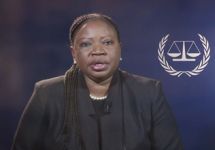
The prosecutor of the International Criminal Court in The Hague Fatu Bensud requested a permit for the beginning of the investigation of the 2008 events in South Ossetia, the court website reported . She intends to study the actions of both parties to the conflict.
According to the prosecutor, there are evidence of the death of up to 113 Georgian civilians, as well as evictions of 18.5 thousand people in the framework of the "campaign of violent movement" conducted by the authorities of South Ossetia. "The ethnic Georgian population in the conflict zone decreased by at least 75 percent," the prosecutor’s office said. It is noted that the crimes were committed with "the possible participation of the Russian armed forces."
In addition, there is evidence of the attack of both parties on peacekeepers. As a result of the shelling of the South Ossetian forces, two Georgian peacekeepers were killed. Georgian troops are suspected of killing 10 Russian peacekeepers and the destruction of a medical institution.
Now, judges must decide whether to resolve a complete investigation that will affect Russia, which is not a member of the Mus. The investigation of some events of 2008 on the investigation of some events in Russia may also be an obstacle. The court in the Hague, as the last instance, in this case cannot have complete jurisdiction in relation to crimes covered by such investigations.
It is also noted that the International Criminal Court considers the beginning of the investigation of crimes committed during the conflict in eastern Ukraine.
On October 8, the head of the Investigative Committee, Alexander Bastrykin, said that the International Criminal Court in the Hague requested Russian investigation of war crimes in South Ossetia in 2008. Bastrykin did not rule out that this is "also a kind of sanction." According to him, the Georgian side will present its counterarguments. “They will begin to squeeze us there for sure, accusing us of aggression,” said the head of the TFR. At the same time, he noted that Russia since 2008 tried to introduce the materials of its investigation into the Mus.
In July 2009, Bastrykin said that the Investigative Committee at the Prosecutor's Office (until 2011, was not an independent department and was a member of the prosecution system) established the guilt of the Georgian military in the genocide in South Ossetia in August 2008. The fault of Georgian military commanders was established at the level of brigade generals, Bastrykin noted. According to him, the use of prohibited means and methods of warfare was also proved by Georgia. According to the Russian side, as a result of the actions of the Georgian military, 162 civilians were killed, another 255 were injured and injured.
In the report published in September 2009, the report on the investigation of the circumstances of the Russian-Georgian war stated that the war in South Ossetia began Georgia after numerous provocations from Russia . The commission decided that the initial military response of Russia to the Georgian attack on South Ossetia was justified from the point of view of protection, but the subsequent actions of the Russian troops were excessive. Both Georgian and Russian and South Ossetian troops violated international humanitarian law during the conflict, the document was noted.