
Translated material
Conversation with a defector
In the United States, an interview with a Soviet pilot who escaped to America through Iran was declassified in the United States
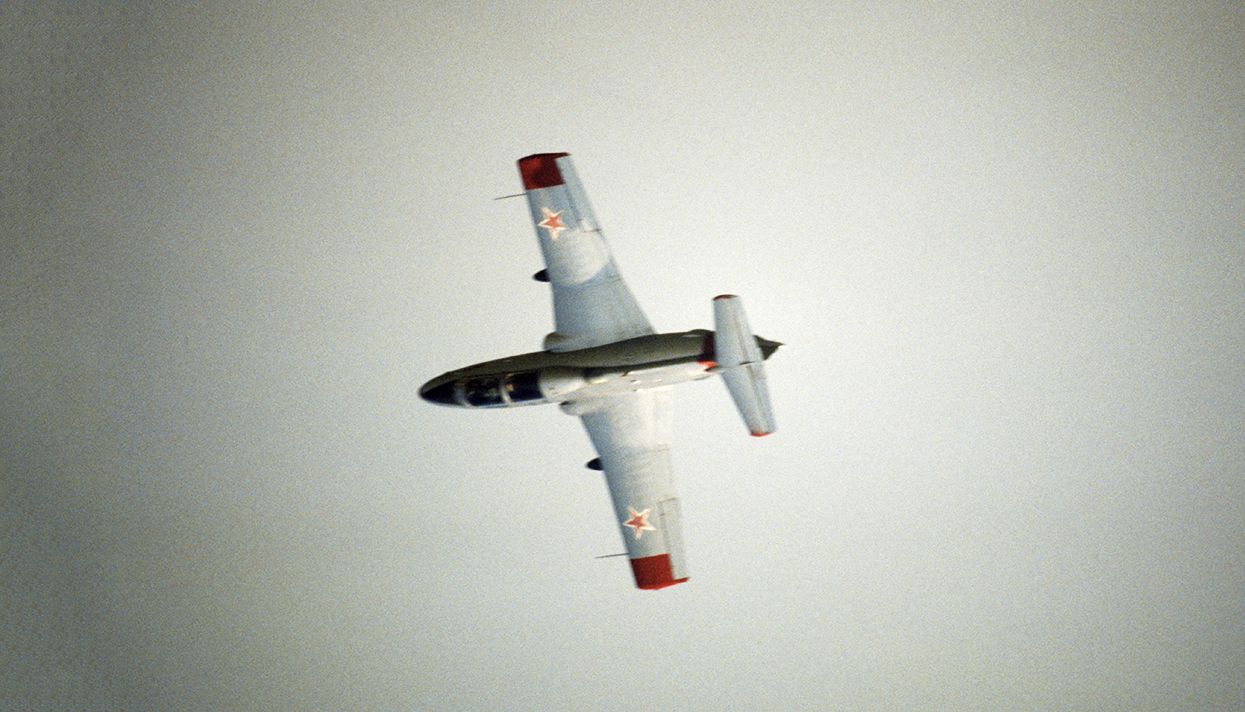
In October, the Cryptome website published a video of the conversation of the US Air Force officer Captain Kilikauskas with a defector from the USSR. The hero’s hero-the Soviet instructor, who is called the “Victor”-escaped from the USSR to Iran, and from there to the United States, stated. During the interview, Victor explains what made him run away, and also talks in detail about the structure of Soviet air forces. "Medusa" talks about the film and who his hero can be.
As the American officer explains, in 1973 Victor, the 27-year-old senior lieutenant of the Soviet Air Force, stole the L-29 training aircraft in Iran and from there moved to America. There, he began to cooperate with intelligence-the special services knew him under the code name Defector Source 306, “Source-revering No. 306”. Victor transmitted information about the preparation of pilots, aircraft and weapons. In addition, he attended educational institutions of the US Air Force and talked about the Soviet military air forces.
According to Kilikauskas, these lectures could not accommodate everyone, so it was decided to record an interview with Victor. Presumably, the recording was made in 1973. The description says that the film was made by order of the 7602nd air intelligence group. In July 2015, the film was declassified by the decision of the Interdepartmental Appeal Commission for Assignment of Secrets (Cases No. 2005-030, the List of Decisions: XLS ), in September, employees of the Department of National Archives and Accounting Documentation recorded it on DVD.
The list of decisions of the Interdepartmental Commission says that a request for shooting made a certain equalist. We can talk about Michael Plain, which is known for publishing materials received under the law on freedom of information . Cryptome indicates that the site received a disc from an anonymous source, but Cryptome's reputation allows you to trust the publications of the project.
What Victor is talking about
The first question that Victor answers is why he, an experienced pilot, a member of the party with brilliant career prospects, decided to escape from the USSR. Victor explains that the decision was difficult for him and was not spontaneous: he speaks of dissatisfaction with the Soviet system. According to him, communist philosophy is outdated and not related to reality, and the reality in which the only party erades any political opposition and encloses dissenters in the camps, "close to fascist." At the same time, Victor was able to move on to the preparation of the escape only after he was transferred to the air base near the Soviet-Iranian border: before that he served in the central regions of the USSR, it was impossible to fly away from there unnoticed.
Victor describes his escape in detail: he devoted two years to preparation, drawing up the route, studying the location of Soviet air defense systems and the Iranian Air Force bases near the border, and the search for a place for landing. In January 1973, when the preparations were finished, Victor flew from the base into a planned single flight, and under the cover of the clouds, being in the blind zone of the radar (a radius of about 3600 meters), headed towards Iran at an altitude of about 180 meters. Having flew into the radar coating area, Victor decreased to nine meters and flew about eight minutes at a speed of 560 kilometers per hour. For another two hours he flew over Iran: having not met a single interceptor and exhausting the supply of fuel, he landed in an emergency in the planned area.
After the description of the escape, Victor proceeds to the story of the Soviet Air Force. He tells how the pilots are preparing - he lists 14 higher flying schools (according to him, the entering this or that did not know which pilots they were preparing there: this information was considered secret); He tells how many pilots the USSR prepares a year, what percentage and for which they deduct. Victor describes the usual day of the Soviet pilot, talks about the conditions of service: the living conditions are bad, but the lieutenant receives 220 rubles per month with the average salary of the country at 140, but still three to four times less than the American pilot.
According to Victor, Soviet aircraft in all respects are inferior to the American: both in design and electronic equipment (computer systems have already been used in the USA, there were no them in the USSR), both in flight characteristics and in the characteristics of weapons. However, during the war in Vietnam, Soviet pilots came to the conclusion that the performance characteristics are not crucial: no one flies at maximum speeds. After Vietnam, the USSR also understood the importance of radio interference, began to learn to fly closer to the ground.
If information about aircraft in the USSR received from open sources, information about the experience and level of training of American pilots is just during conflicts: wars in Korea and Vietnam. According to Victor, despite the fact that almost all Soviet officers were members of the CPSU, they did not have any ideological hostility to the American pilots: they were more perceived as a sports rivalry with them. Victor explains to the party, they do not enter into its ideals because of devotion, but from career reasons: “Your career, income, promotion, and the welfare of the family depend on membership in the USSR party in the USSR. The Communists say they are a party of workers, but this is not so. This is a party of managers, officials, bureaucrats. ” Victor calls party work in the troops a waste of time.

Who can be "Victor"
There are not many cases of theft of military aircraft from the USSR abroad, in the post -war period in open sources there is information about all of a dozen such incidents . In 1973, two cases were happening: one of them appears an aircraft technician who hijacked the Su-7BM fighter-bomber from the GDR, that is, not from the territory of the USSR. The second case is just about the escape to Iran. He was performed by the "pilot-instructor of the Armavir School of Safronov." This surname is mentioned in other publications on the network ( sometimes, together with the title - captain), but the sources of this information are not indicated anywhere.
In specialized forums, you can stumble upon the mention of Yuri Nikolayevich Safronov, a graduate of the Yeisk Higher Military Aviation School of pilots . According to this information, having graduated from the school in 1968, Safronov in 1973 flew to Iran on the L-29 aircraft from an airfield in the Azerbaijan SSR. On the website of Evvaul, in the list of graduates of the school, indeed, Yuri Nikolaevich Safronov, who produced in 1968, was indicated .
The Armavir School, an instructor of which Safronov (now - Krasnodar Higher Military Aviation School of pilots ), in the 1970s used airfields in the territory of the Azerbaijan SSR - you can find the mention of four airfields , two of which, Adjikabul and Salyana, are located in Azerbaijan. In both pilots they cooked, including on the L-29. Judging by the map given in the film (in the video, the fragment begins at 12:55), Victor flew out of the Salyana airfield.
The forums also have information about Safronov’s biography. These data are fragmentary; A participant in the discussion, telling about them, refers only to the unnamed "classmates of the pilot." In particular, it is said that Safronov came from a “very decent diplomatic family” and “loved to listen to Western voices on the radio”. There is no big reason to trust these information, but they would allow you to explain why the Soviet pilot, without spending a lot of time in the States (between the Victor’s escape and the alleged time of the recording of the interview, has passed no more than a few months), so she learned to speak English fluently. Victor talks with an accent, in his speech there are many constructions that give a Russian-speaking person, but it is unlikely that such a level of English ownership was characteristic of graduates of Soviet flight schools in the 1960s. Nevertheless, it is impossible to say for sure that Victor - this is Yuri Safronov. There is no information about how the fate of Victor in the United States has.
Denis Dmitriev
Riga
Konstantin Benyumov