
Translated material
Skeletons in the safe
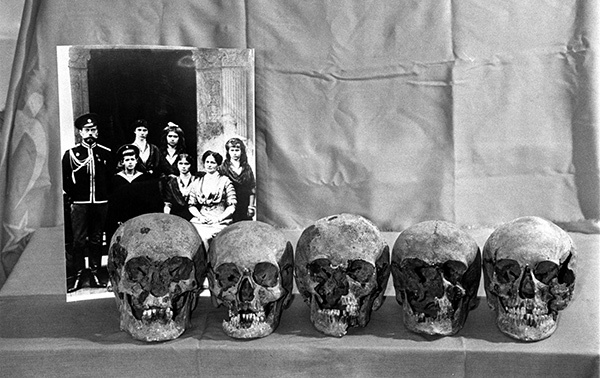
This fall, state media published a series of materials about the examinations of the remains of the last Russian Tsar Nicholas II and his family. The Russian newspaper interviews with the head of the Federal Archival Agency Andrei Artizov and the director of the Russian Center of the Forensic Medical Examination of the Ministry of Health of the Russian Federation Andrei Kovalev. On the website of MIA Russia Today - with the director of the Institute of General Genetics of the Russian Academy of Sciences named after N.I. Vavilov Nikolai Yankovsky . They explained in detail why, from the scientific and legal point of view, there was no doubt that it was Emperor Nicholas II, Alexander Fedorovna and three of their daughters were buried in the Peter and Paul Fortress, and Tsarevich Alexei and Grand Duchess Maria, whose remains were found later, in 2007, in the near future they would fall next to parents and sisters. The media reported that the burial will occur on October 18 , and then - that the funeral is postponed indefinitely . Finally, the other day it found that the remains were subjected to a new examination .
So again one of the longest and most symbolic plots of the latest Russian history, which has been stretching since the early 1990s, was updated, and it has been rooted in 1918. The main role in it is played by hierarchs of the Russian Orthodox Church, as well as part of the Orthodox community, to which scientific institutions, together with the prosecutor’s office, are trying to prove what they are in no hurry to believe in.
The question of the authenticity of the remains of the royal family buried in the Peter and Paul Fortress in the tomb of the Romanovs, throughout the post-Soviet history remains one of the main contradictions in church and state relations. Everything else is solved - tax benefits, real estate transfer, school lessons of Orthodox culture, a trial over Pussy Riot and so on. But regarding the identification of the “Yekaterinburg remains”, the Moscow Patriarchate for decades shows the distrust of the prosecutor’s office, the Investigative Committee, and the government commissions of various compositions, and the entire scientific institutions of the Russian Academy of Sciences.
Nicholas II, his wife Alexandra Fedorovna, their children and servants, shot in 1918 in the Ipatievsky house, were canonized in 2000 as passionate people, their remains should be revered by believers as holy relics. However, in the Catherine’s chapel of the Peter and Paul Cathedral, where the king and his family were buried in 1998, pilgrims can be found very rarely. Sometimes, on a private initiative, panachids serve there - as a rule, freelance priests. The abbot of the cathedral, Archimandrite Alexander (Fedorov), says : “At the time of worship in the cathedral, we simply close the Catherine’s chapel, where the remains are buried, he does not appear in the service space. Of course, we do not forbid anyone to approach there - access is open. Another question is that believers practically do not go there. ”
The generally accepted version: the bodies of the king, queen, princess and prince, as well as their servants and doctors of Botkin were burned by the Bolsheviks to the ground in Ganina Yama near Yekaterinburg on the night of July 18, 1918, and some anonymous victims of the Red Terror were buried in Petropavlovka. To the question " Cui Prodest?" - Why was the state to bury fake remains - usually the conspiracy -free answers are given: to whitewash the Bolsheviks, silent, or hide that it was ritual, “from the Jews”, murder with cutting off their heads. On this conspiracy theological base, its own mythology, overlapping the cult of the Martyr king and monarchical aspirations, have been raised. For years, the ultra -right Orthodox media like a “Russian line” or “Russian messenger” spread it for years.
The question of the authenticity of the remains of the royal family buried in the Peter and Paul Fortress in the tomb of the Romanovs, throughout the post-Soviet history remains one of the main contradictions in church and state relations.
Officially, the position of the Russian Church was formulated in the decision of the Synod of June 9, 1998: “Assessment of the reliability of scientific and investigative conclusions, as well as a certificate of their inviolability and irrefutability, is not included in the competence of the Church <...> the decision of the state commission on the identification of the remains of the remains belonging to the family of Emperor Nicholas II caused serious doubts and even The confrontations in the church and society <...> when all doubts will be removed regarding the “Yekaterinburg remains” and the grounds for embarrassment and confrontation in society will disappear, one should return to the final solution to the place of burial. ”
Both believers and officials understand this streamlined formulation unambiguously: the church does not recognize the remains. But the loophole was left: it may admit if it is presented with new evidence.
And in July 2015, by order of Prime Minister Dmitry Medvedev, an interdepartmental working group was created on issues related to the research and reburial of the remains of Tsarevich Alexei and Grand Duchess Maria Romanov, which was headed by the head of the office of the Cabinet of Ministers Sergey Prikhodko. On September 11, according to the results of the next meeting of this group, it was announced that the results of natural science and historical examinations were not in doubt, there are no obstacles to the burial and it was scheduled for October 18, the day of memory of the saints of Moscow and the day of the angel of the murdered prince Alexy.
But then the media reported that in the Peter and Paul Fortress an exhumation of the remains of Nicholas II and Alexandra Fedorovna was being held, and the Investigative Committee resumed a criminal case of the murder of a royal family, closed in January 2009. It became clear that on October 18 there would be no burial - new genetic examinations for which the exhumation was carried out will not end so quickly. And for sure: on October 6 it became known that the burial was postponed indefinitely .
Since 2009, the remains of the Grand Duke of Maria and Tsarevich Alexei have been in a safe in the State Archive of the Russian Federation (GARF): after the investigation, material evidence should be either destroyed or turned into state revenue. In this case, the Investigative Committee could not make either one or the other, therefore he transferred the remains for temporary storage to the archive. Nothing happened for six years: the examinations are completed, the church considers their results unconvincing, the state does not bury the remains.
In an interview with the Orthodoxy and Peace site, GARFA Director Sergei Mironenko, who has been engaged in the history of the death of the royal family and the identification of the remains since the beginning of the 1990s and was included in all state commissions, including the last interdepartmental group, to the question of why conduct an exhumation, said : “The answer is very simple-at the request of the Russian Orthodox Church.”
The opening of the graves and the capture of the samples was observed by the Metropolitan of St. Petersburg and Ladoga Barshofius, the governor of the Alexander Nevsky Lavra Bishop Nazarii and other representatives of the church. “We looked very carefully about everything that was happening. Almost all the time I stood next to people who made manipulations with bones, ” says Archpriest Vsevolod Chaplin . - They periodically try to tell us that only science needs to be listened. But it is known that one of the historical versions implies the presence of a thoughtful and large -scale falsification, carried out by the Soviet government, and perhaps the Western authorities, and in these conditions you need to try to establish the truth as much as possible. ”
In 1998, the royal family was not yet canonized. Then the opinion of the church - the only social institution preserved since the time of the Russian Empire - was also taken into account. Metropolitan Krutitsky and Kolomensky Juvenal was part of the Government Commission for the study of issues related to the research and reburial of the remains of Russian Emperor Nicholas II and his family members, the so -called Nemtsovskaya, since at the final stage it was headed by Boris Nemtsov. But the decision on the burial of the remains of the imperial couple and her daughters was made by President Boris Yeltsin without taking into account the sudden disagreements with Patriarch Alexy and Synod.
The senior investigator-criminalist of the Investigative Committee of the Russian Federation Vladimir Soloviev in January 1998, together with Boris Nemtsov and his assistant Viktor Aksyuchits, met with Patriarch Alexy. Within three hours, the guests reported to the Patriarch on the results of the research, and at the end they asked if he agreed with their conclusions and would go to the funeral. “The Patriarch asked Nemtsov to assure the president, which fully supports the decision of the government commission to burrow the remains,” Soloviev recalls .
The church does not recognize the remains. But the loophole was left: it may admit if it is presented with new evidence.
But in the end, the Patriarch did not go to the funeral to Petersburg, the priests of the St. Petersburg diocese, led by the then abbot of the Peter and Paul Cathedral, Archpriest Boris Glebov, served the memorial service. In order to get around the sensitive issue of the authenticity of the remains, they prayed for the unknown killed "the names of them, Lord, Versay."
Then the media wrote that for the church to recognize the authenticity of the remains means bending to the state power, that the Patriarch and Synod were put pressure to be in time-the burial was timed to the 80th anniversary of the murder of the royal family. Journalist Konstantin Dushenov wrote a few days before the funeral: “The authorities organize a theatrical action and consider the clergy as actors. And the refusal of the bishops from participating in the ceremony indicates the presence of the will of the Synod to confront untruth, but nevertheless the half -hearted decision of the Synod creates a temptation for many. " The Archbishop of Solnechnogorsk Sergius (now Metropolitan Voronezh) said: “We respect the conclusion of experts and commission, but we receive a lot of messages from the places in which the“ Yekaterinburg remains ”are not recognized as tsarist” ( quotes: Evgeny Strelchik, “Game in Kostya” // “Evening Moscow”, 07/09/1998 ). The arguments “from the places” are operated on today, after 17 years: the rector of the Peter and Paul Cathedral also says that "the Orthodox people have strong intuition, subtly feels falsehood."
The remains of nine people found in the summer of 1991 on an old Koptyakov road in a place called Log Pigs, all conceivable expertise at that time passed. From August 24, 1991 to January 24, 1998, microostoid and forensic-dentic examinations, traceological, ballistic, anthropological and other studies were carried out, and the method of computer photo surveillance was used. All of them confirmed that the found remains belong to Emperor Nicholas II, Empress Alexandra Fedorovna, three of their daughters, maid Anna Demidova, valet Aloiisia Troupe, Dr. Evgeny Botkin and cook Ivan Kharitonov. In parallel, historians on archival documents reconstructed how the Bolsheviks tried to destroy their bodies and why they ultimately hid them in the piglet logs. The main evidence was the story of the killers, Yakov Yurovsky, recorded from his words by historian Pokrovsky, as well as the text of Yurovsky’s speech before the Bolsheviks in Sverdlovsk in 1934 and the tape recordings of the memoirs of his henchmen, Isaiah Rodzinsky and Grigory Nikulin.
But the results of genetic examinations turned out to be truly sensational. From the remains it was possible to distinguish DNA and compare them with the DNA of the living relatives of the emperor and Alexandra Fedorovna, as well as members of the British and Danish royal houses. Not only Russian research centers were involved, but also the criminal center of the British Ministry of Internal Affairs in Oldermaston and the US Military Institute of the US Ministry of Defense in Washington. Genetics Pavel Ivanov, who recalled this experience with enthusiasm in 2014, led research on the Russian side: “The leg of the Soviet man did not step there, it was a high-tech training ground, something like“ Formula 1 ”for automotive industry.”
The most dramatic was the discovery of a rare mutation in Nicholas II, which casts doubt on. While persuaded blood to give blood for the analysis of Prince Tikhon Kulikovsky-Romanov, the nephew of the last emperor, he died. The widow collected blood, but also dragged on with the decision. Then Ivanov achieved the exhumation of his brother Nicholas II, Grand Duke Georgy Alexandrovich, who discovered the same mutation and fully confirmed his kinship with Skeleton No. 4 from the burial ground in the piglet logs. When the widow of Tikhon Kulikovsky-Romanov allowed the geneticist to work with the blood of her husband, the geneticist to work with the blood of his husband, kinship was also confirmed.
The main thing that prevented the researchers from putting the final point in the case of the “Yekaterinburg remains” was the absence of two bodies - Tsarevich Alexei and Grand Duke Maria. The memoirs of the killers said that two bodies tried to burn. And in 2007, 70 meters from the main burial, the charred remains of a teenage boy and a girl with signs of violent death, as well as shards from bottles with sulfuric acid and bullet, were found.
The criminal case was resumed, genetics and historians were able to continue research. Moreover, they studied not only the remains found in 2007, but also bone fragments of all nine skeletons from the first burial of 1991. If in the 90s scientists worked only with mitochondrial DNA, then in the zero they have already learned how to highlight the Y -chromosome -it became possible to trace the relationship both along the female and male lines.
A forensic research was conducted at the Russian Center of Forensic Medical Expertise under the leadership of Professor Viktor Zvyagin, and a genetic examination at the Institute of General Genetics of the Russian Academy of Sciences under the leadership of Nikolai Yankovsky. Michael Kobble, the head of the DNA of the US Armed Forces and the Walter Parson Laboratory of the Innsbruk University, worked in parallel. Professor Rogaev worked both at the Institute of General Genetics in Moscow and at the Medical School of Massachusetts University. Rogaev investigated not only the remains, but also the blood with a shirt of Nicholas II stored in the Hermitage - in it he was at the moment when he was attacked, traveling around Japan in 1891.
The research results Yevgeny Rogaev and his employees published in the journal Science . This is an article on hemophilia: thanks to working with the remains of Rogaev, it was possible to find the exact place of breakdown in the genetic code, and at the same time determine that the bearers of this mutation were Alexandra Fedorovna, Tsesarevich Alexei and Grand Duchess Anastasia. The publication also appeared in the journal ProCheding of the National Academy of Science of the USA (PNAS) (Genomic Identification in the Historical Case of the Nicholas II Royal Family ” ). Rogaev writes: “The results of our research are undeniable evidence that the remains of Nicholas II and his entire family, including five children, are identified. We show that the analysis of sequences of complete mitochondrial DNA in combination with nuclear DNA profiles is effective and sufficient for individual and related identification of samples obtained from historical remains. ”
If in the 90s scientists worked only with mitochondrial DNA, then in the zero they have already learned how to highlight the Y chromosome-it became possible to trace the relationship both along the female and male lines.
New examinations confirmed the results of the former. All members of the interdepartmental working group under the government agreed with the conclusions of scientists - which the state media wrote about this fall.
But, despite this, the bodies of Emperor Nicholas II and Empress Alexandra Fedorovna were exhumed - in order to conduct the same genetic examinations again. With new samples, at the state expense. On September 30, the Synodal Information Department of the Russian Orthodox Church sent out a press release: a special commission was created in the church for "studying the results of the study of the remains found near Yekaterinburg." The Commission is headed by the Metropolitan of St. Petersburg Barsonophia, but its composition is not announced. Archpriest Vsevolod Chaplin to the question of the Orthodoxy and Peace site about who nevertheless became part of this commission, replied: “The full composition was not published, there are scientists, secular specialists to whom the church trusts. Perhaps not every of them would like his name to be published. After the publication, he will receive a huge shaft of interest to both colleagues and journalists and officials. ”
It is difficult to assume whom the church can attract as experts if leading specialists in this field have already been involved in the work of state commissions and research groups for the identification of the “Yekaterinburg remains”. Where will other competent experts find to judge the quality of scientific research? It can be assumed that the composition of the commission is classified, because it does not exist de facto yet-suitable people will be promptly involved on the development of events.
It is unclear whether representatives of the Russian Orthodox Church abroad (ROCZ) entered this commission, the position of which on the “Yekaterinburg remains” has changed significantly over twenty years. В 1990-е священноначалие РПЦЗ оспаривало их подлинность, а в 2013 году первоиерарх РПЦЗ митрополит Илларион в интервью «Новому журналу» сказал : «Наш епископат, Зарубежный, убежден, что это подлинные останки. Было проведено и в России, и в Америке достаточно исследований, в том числе анализ ДНК, которые доказывают это. Но Русская Православная Церковь в России приняла решение воздержаться, пока не будет проведено более полное и в том числе — самостоятельное, со стороны Церкви, исследование. Я надеюсь, что это произойдет в ближайшее время и вопрос раз и навсегда будет закрыт».
Неизвестно, входят ли в новую церковную комиссию потомки Романовых, чьи позиции тоже разнятся. Игорь Аришевский, российский представитель Объединения членов рода Романовых, сообщая, что глава рода Дмитрий Романович Романов — праправнук Николая I — собирался приехать на захоронение останков царских детей, сказал : «Мы много лет боролись, чтобы именно РПЦ признала эти останки, следственные органы готовы подтверждать их подлинность, есть данные массы экспертиз. Но этого до сих пор не произошло». А великая княгиня Мария Владимировна, считающая себя главой Российского императорского дома, и Ольга Николаевна Куликовская-Романова, вдова племянника последнего императора, солидарны с позицией Русской православной церкви.
Удовлетворят ли церковь результаты новых экспертиз? Вряд ли это зависит от степени их научной достоверности, скорее, от желания высшего церковного руководства, читай — политической конъюнктуры. Будет ли государство хоронить останки, которые оно признало останками царевича Алексея и великой княжны Марии, вне зависимости от выводов, к которым придет церковное руководство? Возможно — ведь держать останки в архиве проблематично, а Романовы уже несколько лет настаивают на захоронении и имеют на это право.
В этом случае перед церковью встает новый вопрос. Полностью игнорировать похороны не удастся — они будут происходить в действующем храме. Но снова служить простую панихиду по безымянным «жертвам террора», как было в 1998-м, уже не получится — это будет совсем уж оскорбительно для родственников царской семьи и всех, кто уверен в подлинности останков. У мощей канонизированных святых по правилам служится не панихида, а молебен. Церковь молится уже не за них — перед ними.
Государство, которое не сомневается в выводах правительственной комиссии, сделало жест в сторону церкви, согласившись на эксгумацию и снова выделив средства на дополнительные исследования. Слово за церковным руководством. Как руководство, последние годы, казалось, во всем солидарное с властью, ответит на этот жест? Преодолеет ли то загадочное препятствие, которое 17 лет мешает признать подлинность останков царской семьи?
17 лет наблюдатели гадают о настоящих причинах этого затруднения. Возможно, причина в искреннем благоговении перед конспирологическими версиями о фальшивых документах и подложных образцах ДНК. Или руководству РПЦ кажется, что признать свою ошибку 98-го года и согласиться с наукой и государством было бы проявлением слабости.
Весьма вероятно, что в вопросе о признании останков столкнулись внешние и внутренние церковные интересы: объективные преимущества согласия с государством конфликтуют с необходимостью учитывать настроения ультраконсервативного крыла паствы, и без того в любой момент готового припомнить патриарху Кириллу его былой экуменизм. Для фундаменталистской — весьма обширной — части православной общественности признание подлинности останков будет выглядеть как крайне «либеральный» шаг, ассоциативно крепко связанный с «врагами России» Ельциным и Немцовым.
Так или иначе — дети последнего русского царя по-прежнему остаются разменной картой в политических раскладах. Есть в этой неупокоенности что-то мистическое.