
Translated material
I am drawn from here in the air
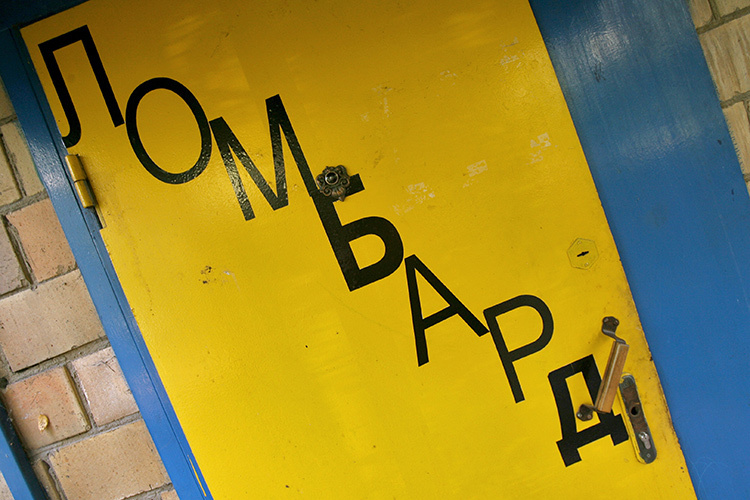
The pawnshop, where I got a job as an assistant appraiser, is in the basement of a residential skyscraper on the outskirts of Moscow. Instead of the name, there are faded letters above the entrance: "Sail and buying jewelry." Below the inscription: "We do not serve drunks and drug addicts!" Its main clients are visitors from Central Asia. The local gold is affordable for them: the gram of Loma costs only one thousand rubles. And the opportunity to leave a deposit is perhaps the only way of a loan available to migrants. They come from the nearest construction projects and the grocery market, which, according to rumors, will soon be closed and there will be fewer customers. However, now the pawnshop is flourishing - a crisis.
1.
My colleagues Vadim and Sergey Mikhailovich, whom everyone calls Moiseich, are many -armed shiva this pawnshop. They are owners, appraisers, guards - and relatives. The Vadim, obsessed with iron and near -football, is Moiseich son -in -law. His working day is busy viewing battles without rules and searching for “environmentally friendly steroids”:
“Such that the hell is and the muscles grow,” he says, and until evening it plunges into a chaotic mess on the screen. In the evening he has a training.
Because of the eternal headphones on the head of Vadim, I fulfill all the minor orders: I close the door, reduce the air conditioner, turn off the “crap”. So Moiseich calls what he makes noise and distract - a TV, radio, phone.
- You will raise your crap, no?! - He yells his son -in -law.
But the son -in -law does not react. He sits opposite, buried in the laptop screen, and squeezes a black expander with his left hand. He broke his right hand a month ago in a street brawl and spent a week on sick leave. Moiseich had to hire a temporary guard, and he “put them up”:
- Everything took away! Bitch!
- Did you contact the police? I ask.
- For what? I found it myself. He put him on a chain and held for three days on bread and water. He almost went crazy! Then I bought a bus ticket for him and sent him home - with a kick in the ass! After all, my nephew, ”Moiseich sighs sympathetically and promotes a keychain on his finger with a security call button.
I have returned from the war. I was bored. After the war, it is always boring. For a year drank. Then he became a private appraiser.
I think he invented the story with his nephew in order to scare me in advance. I also think which of the things on the counter are stolen. It turns out half. But the pawnshop for this is not responsible. The police held only four recesses here. Moiseich is proud of this, as well as the fact that he once caught a thief with red -handed.
“The earrings have brought the earrings, which the prostitute dragged us before, so busty,” he draws two large hemispheres in the air and quite smacks. - In short, we twisted him and handed over to the cops. She then came and asked to take the testimony. Torchka was her roommate.
- How did you know the earrings?
“I have a good jewelry memory,” Moses boasts. - In general, why they just do not drag us! Last year they brought a lunar stone. Lipa, of course! They thought to pass on a sucker. One hundred thousand asked. Astronomers, damn it! - he laughs. His laughter goes into a cough. Moiseich is an elderly, heavy man who has long been in this business. He discovered his first pawnshop in the 99th year, hoping to earn money after the default.
- I have returned from the war.
- Chechnya?
- Yugoslavia. I was bored. After the war, it is always boring. For a year drank. Then he went to jewelers and became a private appraiser. He worked with banks, casinos, pawnshops. I decided to open mine with a friend. They invested about a million. Money mainly went to bribes: give me, give firefighters - give me rats in the tax - give ...
- Isn't it like that today?
- Not today. If the documents are in order, open and work.
- And nobody needs to be brought?
- Mentes - always need! Amazingly greedy tribe. But I have my own “shoulder strap” on Petrovka. They fought together.
I think which of the things on the counter are stolen ones. It turns out half.
An elderly woman appears in the doorway. Moiseich is busy busy and slowly approaches the counter. I notice that he is slightly lame.
- What did you want?
The woman held out a thin engagement ring - probably the last of her decorations. Wedding rings are usually carried by the last.
“I can give three thousand,” he suggests, without even looking.
She nods silently, and blue bills are hidden in her small handbag. Having lowered her head, the woman leaves us. A sense of shame from going to the pawnshop will soon pass. I am sure (or so it seems to me), she will not tell anyone that she visited here-neither the alcohol-muzh, nor her son in the army.
“This one will not come to redeem,” Moses squeamishly examines the ring under the light of a table lamp.
- Why?
“Have you seen her hands?” A woman with such nails in despair. She has nothing to buy a ring. We will melt, ”he concludes in the tone of the surgeon, who has to amputate the patient's limb.
Nobody takes other people's engagement rings, crosses and other cults - these things are considered personal and therefore go to the alloy.
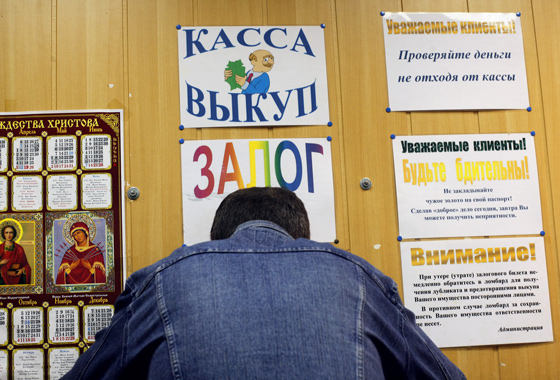 © Sergey Mikheev/Kommersant
2.
There are more than two thousand pawnshops in Moscow - legal and “black”. Legal live due to interest on the loan, “black” - by fraud: for example, when expensive stones on jewelry are replaced with cheap glass, and fakes are returned to customers or sold.
The pawnshop of Moiseich and Vadim seems legal to me. It takes only jewelry, less often - antiques, but no broken iPhones and other equipment. The conditions of the pledge here are very simple: the margin of the thing is 10% of the loan amount per month and 12%, if the loan amount is over 50 thousand rubles. If you buy a thing, you pay them. The thing must be redeemed for two months, otherwise it will go for sale, and then the pawnshop risks losing money - if it does not work out. But this happens extremely rarely compared to the 2008 crisis, when Moses with a son -in -law almost burned out. However, in one or two years, almost any thing manages to sell, having beaten off not only the cost, but also their interest. Moses calls these percent “blood” and repeats as a mantra:
- We do not need someone else's, only blood.
At night, values are locked in a repository - this is a back room with an iron door and alarm, forced by boxes from household appliances. Several heavy boxes are full of chains, bracelets and rings. They are packed in cellophane bags. I glue for each of them the price tag, taking into account the “blood” and send the counter for the glass. In the evening I repeat the same thing, but in the reverse sequence-I take bags, rip off obsolete price tags from them and put it in a box from under an electric kettle or iron (interest rises every day, the price changes).
A woman with such nails in despair. She has nothing to buy a ring. We will melt.
On one of the rings, engraving is visible: "Artem and Lena - together forever."
“This is a“ scrap, ”Moses suggests. - He is to the side.
So my first and last day of work in a pawnshop stretches. The time here is measured not for hours, but by customers. The working norm is 15-20 people a day. After eight customers, Rashid came, a frequent visitor. Moiseich recalls that he met him many years ago when he wanted to surrender the golden crowns: “He had nothing to eat. So he brought “teeth to the shelf”. ”
This time, Rashid removes a thick bracelet from his wrist and explains guiltily:
- For a couple of weeks. My daughter has a wedding.
Moiseich nods knowingly and counts 13 thousand rubles. He holds cash in a barce on his belt - an old -fashioned one. After thinking a little, adds one more - superstitious.
Once Rashid taught music in Tashkent, and now he works as a garbage truck driver in Moscow. For his large family, he remained the only man. His eldest son shaves the deadline for the trading of heroin, and the youngest went to work in Russia and went missing. Perhaps the guy died at a construction site and was pouring into concrete. So get rid of corpses of illegal migrants, on whose bones there are shopping centers. But Rashid wants to think that he went to ISIS (terrorist organization, prohibited in Russia) . This leaves him the hope of seeing his son alive.
Rashid and his fellow countrymen are reliable customers. They have a special attitude towards gold. They do not throw him in a pawnshop and often give each other instead of money, although Islam condemns Ribe (usury).
- And I do not work with “rhinos” and shopping - they will steal, laid and not buy it. Although these pederasts I had long killed to go here. Yes, and there is nothing to carry them - everyone was lowered to Shyrevo, - Moses teaches the intricacies of doing business. He calls the Caucasians "rhinos".
Perhaps the guy died at a construction site and was pouring into concrete. So get rid of corpses of illegal migrants. But Rashid wants to think that he had gone to ISIS. This leaves the hope of seeing his son alive.
He divides his customers into two categories - “hard workers” and “closed”. If Rashid is a “hard worker”, then the former businessman Sashch is “Zakreditati” with a “wolf ticket” to the bank. Once a month he brings the old icon of Nikolai the Wonderworker to the pawnshop to lay it for 50 thousand rubles. He asked more, claiming that the icon would bleed.
“The icon to the money,” Moses jokes and Panbrat’s clappers Sasha on the shoulder.
But that humor does not share. He counts the money twice, is baptized three times and, wrapping the face of the saint in a dense fabric, admonents:
- Do not put your feet up - a sin.
- Remember. Which time I brought ...
“Today - to the last one,” says Sasha. - I'm leaving for the village. I’ll begin to lead the farm, I will build a church.
- Do you have few churches in Moscow?
- Is this the church? This is a falsehood! And Putin and the Patriarch - a fake! They secretly accepted Judaism. Orthodox will not bring the country to such shit.
After his departure, Vadim tells the bike how, in the 90s, one crazy old woman came to the buyers on the Arbat and gave the Faberge bracelet for a penny. They threw their junk and left to live comfortably.
“We would have to quit everything and leave,” Vadim says dreamily. He drops a sweatshirt and goes outside. In the courtyard, a rusty horizontal bar is waiting for him. I follow. I am drawn from here in the air.