
Translated material
How to help an action movie
In which regions of Russia, the authorities have the experience of adapting people who have passed through the war and trying to return to a peaceful life, and how it works
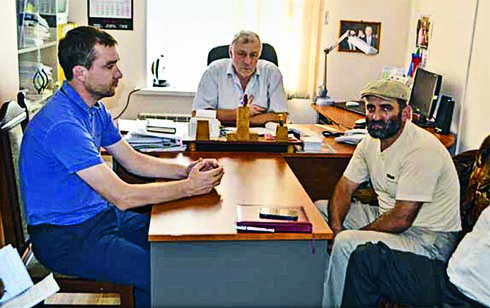
The Commission on the Reconciliation and Consent of the Tsumadinsky District of the Republic of Dagestan holds preventive conversations with local residents, September 11, 2015/ Photo: Mo-tsumada.ru
On October 13, in Nalchik, the chairman of the National Anti -Terrorism Committee and the director of the FSB of Russia, Alexander Bortnikov, said that the number of people prone to refusal “illegal activities” increased four times. However, the statistics of Rosfinmonitoring say the opposite: in the basis of individuals involved in extremist or terrorist activity, there are 4431 people - twice as much as it was last year - 2826 names. Most of them are residents of the republics of the North Caucasus.
“Refusing unlawful activities” is not so simple - for participating in the illegal armed formation of the Criminal Code of Russia, a punishment is provided for from 5 to 15 years in prison. But if the wine is not proved, then it is possible to return to ordinary life through repentance-there are special state commissions, but only in two of the most problematic North Caucasian regions-in Ingushetia and Dagestan. Initially, the commissions were intended for militants of North Caucasian groups, who decided to stop terrorist and extremist activities in the territory of their republic. But with the advent of IG *, the commission began to consider the affairs of those who returned from Syria. In order to get legal, material, medical or psychological assistance, repented by the commission - often unofficially: trust here is a key issue.
The first commission “On Adaptation to Peace Life” was created in Dagestan in 2010 and was transformed in 2013 to the Commission on Reconciliation and Consent. In addition to recommendations on the pardon of those who decided to lay down their weapons, the commission decides land disputes and submit proposals “aimed at activating work on information and propaganda support of anti-terrorism measures”. There are also regional centers in the republic - one for each territorial education.
Following the example of Dagestan, such a commission was created in Ingushetia in 2011. For four years, 68 people wanted to “adapt”. This year - five people, three of whom returned from Syria.
“Previously, 15-17 people were adapted a year,” says Magomed Kadiev, assistant secretary of the commission. - Last year there were four statements. Someone comes, some relatives submit statements. ”
According to him, they usually ask to revise the matter, or about pardon. This year there was one statement with a request for employment - from a sports master. Half of those who wanted to return to a peaceful life left the republic. Although the chairman of the Memorial human rights center Alexander Cherkasov is sure that now the adaptation system is operating only in Ingushetia.
“In Dagestan, she worked until 2012. And then they began to prepare for the Olympics, trample throughout the clearing. In Dagestan, this was arranged as a show, as propaganda for young people, underground. In Ingushetia, the work was built closed, ”the human rights activist said. - While this policy was pursued, there was a tendency to reduce the activity of the underground. In Chechnya, for example, only strict measures are used. Experience shows that if you act only, there will be no sense. ”
The main problem, according to Alexander Cherkasov, is that the security forces are not very interested in ways to solve problems an bloodless way. Including the Investigative Committee: “If there is a militant who can close the checkplace“ a serious or especially serious crime ”, then why not do it - this is obvious. Here is the struggle of tactics with the strategy. Tactics - improve karma, that is, indicators, by the end of the quarter. The strategy is to bleed underground not by striking on it, but by the fact that no one will go there. Because this is the only way to discharge the mine that is under the Caucasus and all of us. ”
* IG, or ISIS ("Islamic State") - is prohibited in the Russian Federation as a terrorist group.