
Translated material
We join
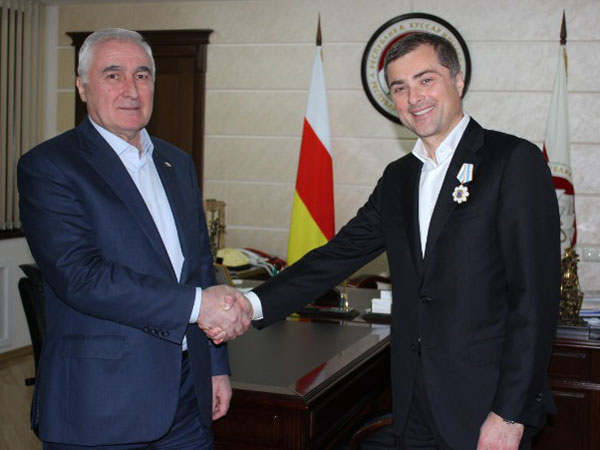
On Monday, South Ossetia President Leonid Tibilov unexpectedly stated that he decided to initiate a referendum on the accession of the republic to Russia. These words seemed to be a surprise not only for Russia, but also for South Ossetia.
The loud statement, as Interfax reports , sounded during a meeting with the assistant to the President of Russia Vladislav Surkov, who, recall, officially responsible in the Kremlin for interaction with Abkhazia and Southern Ossetia. Tibilov said that the reunification with Russia "is a centuries -old dream of the South Ossetian people, who suffered this idea for two centuries of confrontation with Georgian chauvinism and fascism."
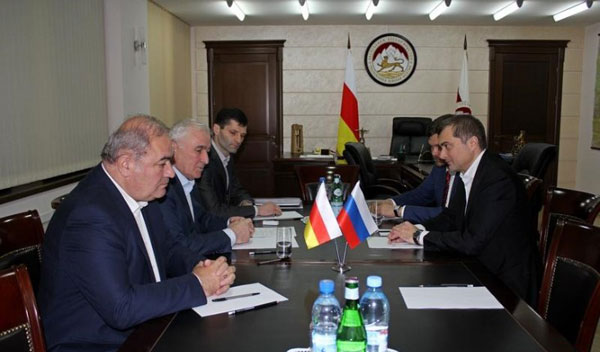 The meeting of Leonid Tibilov with Vladislav Surkov. Photo: Presidentruo.org
“Today's political realities are such that we can make our historical choice. They must reunite with fraternal Russia and for many centuries to ensure the safety and prosperity of South Ossetia and its people, ”Tibilov solemnly said and added that the referendum is necessary from a legal point of view due to the features of republican referenda held in 1992 and 2006.
Recall that in 1992, residents of South Ossetia answered two questions at once: "Do you agree that the Republic of South Ossetia be independent?" And “do you agree with the decision of the Supreme Council of the Republic of South Ossetia of September 1, 1991 on reunification with Russia?” An affirmative answer was given to both questions, according to official figures, more than 55 thousand people came to the sites, 48 votes were cast against independence, and as much as 57 against joining Russia.
In fact, the Ossetians managed to build an independent state of Georgia, but with joining Russia, as you know, it was not set. So in 2006 a new referendum was held, just about independence. Of course, the referendum at that moment was rather explained not by legal reasons, but by political ones-during the next exacerbation of Russian-Georgian relations in Tskhinvali, some “bonuses” from such a demonstrative anti-Georgian step were expected. Naturally, the results of the referendums did not recognize Tbilisi: firstly, the inhabitants of the Georgian villages did not participate in them, which then still existed on the territory of the former South Ossetian Autonomous Region, and secondly, referers were not attended by refugees who lived in Georgia. This is not counting such trifles as a vote is not according to Georgian law and the absence of any independent observers.
“Despite the fact that the idea of a 2006 referendum was independence from Georgia, and not from any other state, from a legal point of view, the results of the 2006 referendum will be leveled by the results of the 1992 referendum. In this regard, we must hold a new referendum on the issue of joining the Russian Federation, ”Tibilov said.
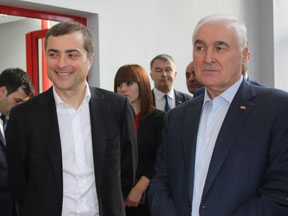 Photo: Presidentruo.org
The head of state said that he would attract “the widest segments of the population” to organize the referendum and hopes that all political parties of the republic will support it in this matter. “The referendum, in the positive outcome of which I have no doubt, will allow us to rally our people, will lead to renewal and revival of all positive processes in society,” the president of South Ossetia said and added that “all the steps to implement the referendum results will be carried out only in agreement with the Russian side.” How to join Russia, without coordinating this step with it, Tibilov, however, did not specify.
Since it is somehow assumed that Tibilov could not make such statements on his own initiative and without agreeing with anyone, the first time after the publication of his words in all the information agencies of the country it seemed that the issue of entering South Ossetia was resolved in Russia. As if Moscow now lack other problems in the form of an economic crisis, Crimea, Donbass, downed by Boeing, a war in Syria.
The Kremlin press service reacted relatively quickly, the next morning. Dmitry Peskov said that South Ossetia "this is an independent state that is recognized by the Russian Federation with which we have diplomatic relations." “In fact, if I understand correctly, such a statement was not made directly at the meeting (Tibilov and Surkov),” Peskov noted, although before that it was reported that Tibilov made his speech in the presence of the assistant to the Russian president. Peskov also recalled that in South Ossetia "there are a lot of supporters of integration with Russia" and suggested that "this was said by Mr. Tibilov."
Peskov, thus, gently tried to disavow the words of the president of South Ossetia, although it is difficult to do it - Tibilov said what he said. I must say that the prospect of joining South Ossetia is somewhat frightened by Russian bureaucrats and politicians. So, for Crimea, in Russian legislation, in fact, a special status is prescribed, which manages with great difficulty to reconcile with the federal constitution, which says that all regions are equal to each other. Plus, the inclusion of Crimea in Russia has created many unresolved problems in foreign policy. If you imagine that in a few months South Ossetia will also join Russia, then doubling all these problems may seem like an optimistic forecast.
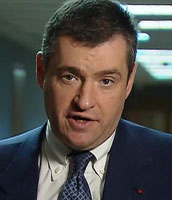 Leonid Slutsky
The head of the Duma Committee on CIS Affairs Leonid Slutsky said on Monday that the entry of Ossetia into Russia “this is the next step” and “you need to carefully discuss whether the need has matured”. “We must understand that the reaction of the world community will be absolutely explosive. We, as it were, we ourselves will throw another powerful information consumption into the global information space, while a powerful information war is underway against Russia, ”said a cautious deputy.
It is all the more strange to conduct a referendum that literally just, in the spring, between Russia and Southern Ossetia, an agreement was signed on allied and integration, which even without the entry of the republic to the Federation makes it virtually part of Russia. Its power structures in fact should become part of the Russian, and social standards to rise to the level of the North Caucasus Federal District, of course, at the expense of Moscow.
In fact, the citizenship of South Ossetia merges with the Russian one: Moscow pledged to “take additional measures” in order to simplify the procedure for obtaining Russian citizenship to local residents. Moscow is additionally obligated to South Ossetia: to allow citizens to receive a Russian passport without abandoning their citizenship, as well as allow Russians who also have Ossetian citizenship, to occupy posts in the civil service.
Thus, it can be said that South Ossetia already has a special status in the framework of the Russian Federation, but without all unpleasant formalities associated with the official expansion of the territory of our country.
And of course, all this is understood by Leonid Tibilov, and perhaps it is better than anyone. Now it remains only to understand why he publicly spoke about the referendum-only so that Moscow does not forget about its small republic in the presence of other, much more serious projects in the international arena, or he really prepares something. And the second option, it seems, does not carry anything good for Russia.