
Translated material
Petrovich
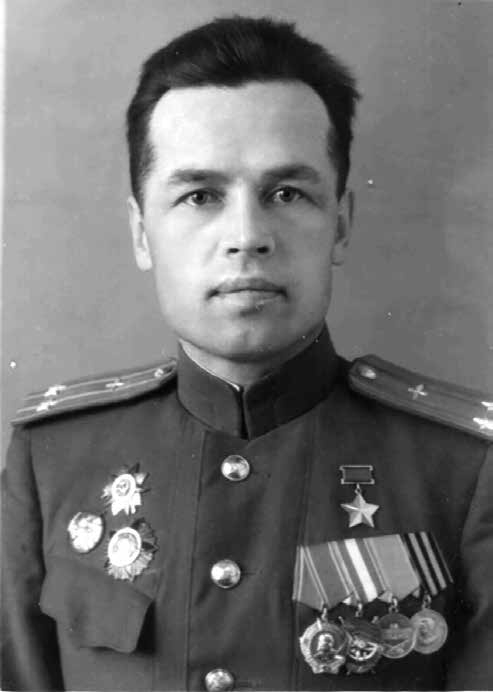 In the year of the 70th anniversary of Victory, it seems very important to me to recall the person with whom it was lucky enough to work in our beautiful ITEF. “Consisted” and “beautiful” - these are not from that time, much later I began to understand this; Holy of youth is careless, everything is good both natural and endless.
November 3 marks the 100th anniversary of the birth of Alexander Petrovich Pyankov, pilot, hero, engineer; We sat with him in the same room, worked, talked, he remembered, I listened - he listened badly, did not write down, scolded myself, you won’t return it. I will not retell the amazing biography of this person, I will remember several episodes.
He graduated from the flight school a few years before the war. He received the hero in 1939 for Khalkhin Gol. Petrovich - I will call him so, this is not familiarity, so they called him in the eyes and eyes of literally everything, so we continue to remember him - he talked about the first air battles with the Japanese, as not for a long time they could bring down a single plane, lost their own, were afraid and how they gradually overcome themselves. I remembered two episodes brighter than others.
They had a pilot in the squadron, older than Petrovich in rank - captain. Some breakdown happened to this person. He was afraid of air battle, afraid to fly. Specialists were going to hand him to the tribunal, such a time was. Petrovich persuaded the commander to give the captain a chance, and after a long conversation, they flew to their souls in reconnaissance: Petrovich ahead, the captain behind him. Petrovich saw a Japanese plane ahead, swayed his wings, flew into battle. They fought for some time, the Japanese was shot down, but there was no lean, the captain disappeared. Petrovich flew further, conducted reconnaissance, returned. At the airfield, a car was waiting for him, took Petrovich and took him to a special department. The captain flew earlier, wrote a statement that he fought with the Japanese, shot down him, and Petrovich threw him in battle. It helped out that the captain incorrectly called the brand of the Japanese aircraft. They sent ground intelligence - and there was no more this captain, and they were afraid to remember.
Another episode is connected with the battle between the red horsemen of Choibalsan and the Manchurian cavalrymen dressed in blue uniforms. Petrovich at the head of the three flew over the battlefield and could not decide on the intervention, was afraid to kill his own. However, he decided when he saw that in one section the blue was squeezing and driving the red. The aircraft intervened, on each of the planes stood on the machine gun, 600 shots per minute, if I remembered correctly. The battle ended right away, the horsemen scattered each in their direction; 40 years after these events at the reception in Ulan-Bator, one of the survivors in that battle came up to Petrovich and said that he did not experience such horror in his entire life.
After the events on Khalkhin-Gol, the elder Lieutenant Pyankov, as an instructor in Kubinka, worked as an instructor in Kubinka near Moscow. The next episode stuck in my memory is associated with Vasily Stalin, whom Petrovich taught to fly. Vasily with an instructor flew for a long time, but the day of the first independent flight was scheduled. In the evening, the plane was checked, hidden in the hangar, exhibited watch. In the morning he frowns, the weather is not quite bad, but not too good. Fly or not? There is no head of the air club on the spot - urgent cases in Moscow; The head of the educational part, responsible for flights, and all other commanders are absent, got sick, there is no one in place. Petrovich should be decided: to let Vasily fly into flight or not. I called in Moscow - what to do, the sky frown and the wind? "Decide on the spot." He thought and decided: at first I would fly, then I will release Vasily. He flew, everything is normal, he was going to sit down - the chassis is not released; Experience, managed to land on the sandy braid and water of the Moscow River. I got out of the aircraft - the car is already going, Petrovich is being taken to Moscow, investigators, interrogations; He was returned to the club, but from the leadership he no longer saw anyone, and they did not dare to remember these people.
In 1941, he began to fight in Ukraine. For the first time, they shot down somewhere at the end of summer, they gave under the command the section of the left bank of the Dnieper, not to defend the Germans-there were no them yet, to catch deserters; Those who are crossing the river without weapons were supposed to be taken to a special department. Petrovich saved these people as he could, helped to obtain their weapons, sent at night back through the Dnieper to look for his rifles, and sometimes documents; He did not like to send the soldiers to a special department. In the beginning of the fall of 1941, he was again shot down over the steppe Crimea, for a long time he was treated for hospitals, he could no longer participate in battles. In 1942 he was in the hospital in the Caucasus. I remembered the story of a pilot-player who fought there: in the morning, flying north against the Germans, in the evening to the south, along the auls. I am still terrible from this memory.
By the end of the war, Petrovich worked as an inspector of aviation in Siberia, accepted and sent airplanes to the front, then graduated from the academy, commanded a regiment, division, and did not appear twice to the general rank, did not receive, and graduated from the colonel in 1960. That's how it was.
He commanded a fighter division, which was based in the very south of the USSR, the airfields were scattered along the southern borders of the Central Asian republics. It was remembered: "In the sky, hell, and on the ground-Kyzyl-Arvat." Pyankov was a member of the Central Committee of the Communist Party of Tajikistan, on May 1, 1960 he stood on a rostrum in Dushanbe among other leaders of the republic, welcomed a demonstration. The signalman was, as always, nearby, causes a violation of the air border, our two fighters went on interception. The car, the airfield, the plane - and the commander itself is already in the air. He caught up with the offender quickly, it was Powers on the low-speed U-2, but it was not possible to knock him down. He said that by the time of crossing the U-2 border, he scored about 18 km of height, and the ceiling of the moment was 16 km, while trying to lift his nose to start the rocket, a moment fell down a couple of kilometers down, and again and again. Powers flew their zone, was shot down by a ground missile over the Urals. The division, which Pyankov commanded, was disbanded. He was offered a position at the district headquarters of the district; He refused and went to study at the physical faculty of Moscow State University - “Loved Physics”. The colonel, the hero, the commander sat at the desk and began a new life.
I found Petrovich in 1975, he held a small but very important position of the secretary of the commission for the distribution of time on the proton accelerator ITEF. Recently, the reconstruction of the accelerator was completed, and bunches of secondary particles for the experimenters were still built and established - what a living time it was! Almost a dozen groups of physicists competed for the right to get into the nearest schedule of the accelerator, each had their own irresistible arguments about the birth of mesons and baryons, about inclusive sections and triple correlations; All the nuclear physics affordable to 10 Gavas was divided between fanatics of their business, each hurried first, unique installations were created, young people ran, drove in crowds, argued, argued, chose and decided.
The process of distribution of time firmly and calmly steamed Petrovich. Only his authority was kept from quarrels in this delicate matter, where one was getting more convenient time for work, the second - less, the third received uncomfortable, and the fourth and fifth moved away later. It is difficult to believe today that it happens that it was; Remembering that time, I try to see something that made it possible to experience such massly against my youth against the backdrop of natural nostalgia - I am not afraid of the word - delight from work. I can formulate this important something like that. We were the same team - old and young physicists, engineers, technicians, accelerator workers, institute administration - and were sure that they were busy not only useful, but also extremely important, as if an infinitely distant state concluded a contract with us to study these mesons and baryons. Each of this big team knew that the institution exists for science and everything here is subordinated to this. I'm afraid that young people who have come to science today simply cannot imagine that this is possible.
Petrovich knew and loved all his wards, he was worried about everyone as for his own; During the operation of the accelerator, he went around the houses of the experimenters, asked about work, successes and difficulties; He knew how to keep abreast of all problems, and this helped a lot then in the distribution of time. He loved physics naively and disinterestedly, brought the nonlinear equations of magnetic optics long linear - and solved them, clicking on his arithmometer. In life, he was direct and naive, strict and kind, read Marx, already only in such a distant hoping to find the origins and truth; He taught me to knit fishing nodes and persuaded me to join the party: “We will put things in order there”; He went to schoolchildren to talk about the war, hesitated and did not put on orders, only at the very end of his life he asked his superiors to transfer him from engineers to senior engineers: “And it’s embarrassing to speak at school.” In the summer of 1988, our Petrovich died quietly at home.
I walk along the corridor to our door, near which it was once fun and crowded; It smells of damp and cats, the smell of Gary from the fire that destroyed the accelerator in early 2012 did not disappear; empty, loud, uncomfortable, I want to leave.
When I think about the war and the victory, when I recall my youth and rejoice that I found the time when it was possible to work with pleasure, one of the first to come to mind by my senior comrade, combat pilot Alexander Petrovich Pyankov, who managed to affirm himself in peaceful life. I remember you, Petrovich, and this memory is very dear to me.
Vladimir Rusinov,
Art. scientific. sore. ITEF
Photo from the site http://dobryanka-city.ru/o_dobranke/uchrezhdenija_kultury/istoriko-krajevedcheskij_muzej/pobediteli/