
Translated material
MIS Van der Roe: "Less means more"

Less Is More - that was the motto of Misa van der Roe, one of the founders of Bauhaus and an outstanding architect of our time. Perhaps the most bright embodiment, this installation of Mis received in the private house he built by Farnsworth House (1945–1951). This one-room house, made completely of glass (except for gender and roof), was erected by order of the Chicago-neufrologist Edith Farnsworth as Weekend Retreat-that is, cottages. It was assumed that the owner would spend his leisure time there, engaged in music and contemplating nature.
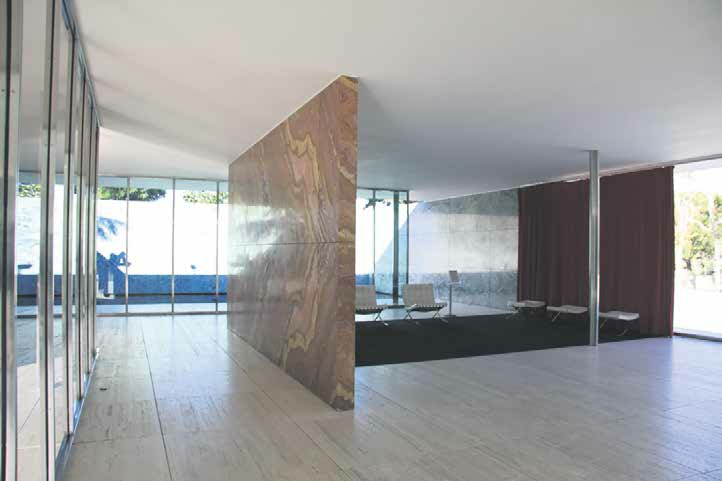
In the late 1940s, the shore of a small Fox River about 90 km southwest of the center of Chicago was a fairly secluded place to count on rest and peace among the glass walls. Actually, the idea of a “glass house” was already implemented by Mis in his famous Germany pavilion at a worldwide exhibition in Barcelona in 1929.

In this exhibition pavilion, nothing was exhibited - the building itself was the exhibit. It was “Barcelona” who brought world fame to the author, and “Farnsworth House” showed that the architectural ideas embodied in the Barcelona project of Mis, not “exhibition” fantasies, but the real basis for housing that reveals the genuine possibilities of unity of man and nature.
The history of the construction and further functioning of Farnsworth House is repeatedly described and, as a rule, consists of two plots.
The first applies to the trial between the customer, Dr. Edith Farnsworth, and Mis van der Roe due to a significant increase in construction. A very conflict trial not only quarreled Mis with Dr. Farnsworth, but also repelled from the author of the project a desire to visit the house in the future, meanwhile, which has become a landmark far beyond the borders of the United States. The second plot is associated with the 2008 flood. This natural disaster had destructive consequences for Farnsworth House, but the house saved the American cultural community, which mobilized huge means and better forces for this.
The small Fox river flowing near Farnswoort House, to which the facade of the house was addressed, as well as the territory adjacent to it, were not “cultivated” in any way - neither bridges, nor park plantations, nor benches, nor paths. The main decoration for many years was a huge old maple, growing against the wall of the house, and when it was still dried, the barrel was specially processed and saved as part of the landscape. But was it possible to live in Farnsworth House? How realistic was the embodied in this building Mis's favorite idea about the “universal space”?
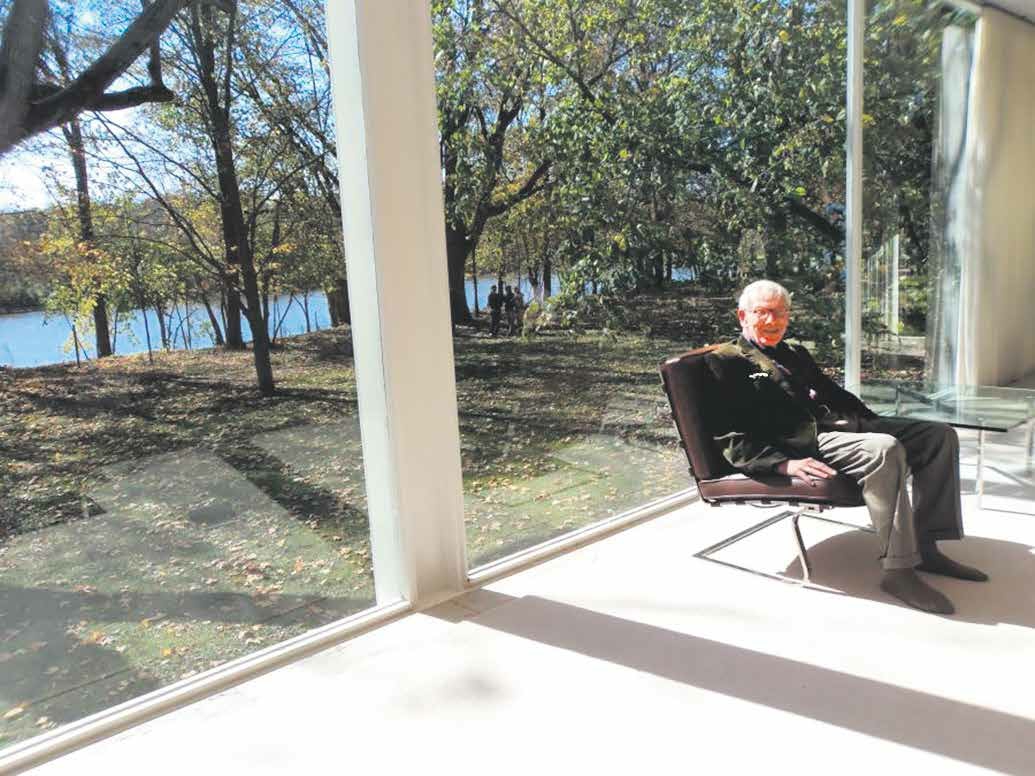
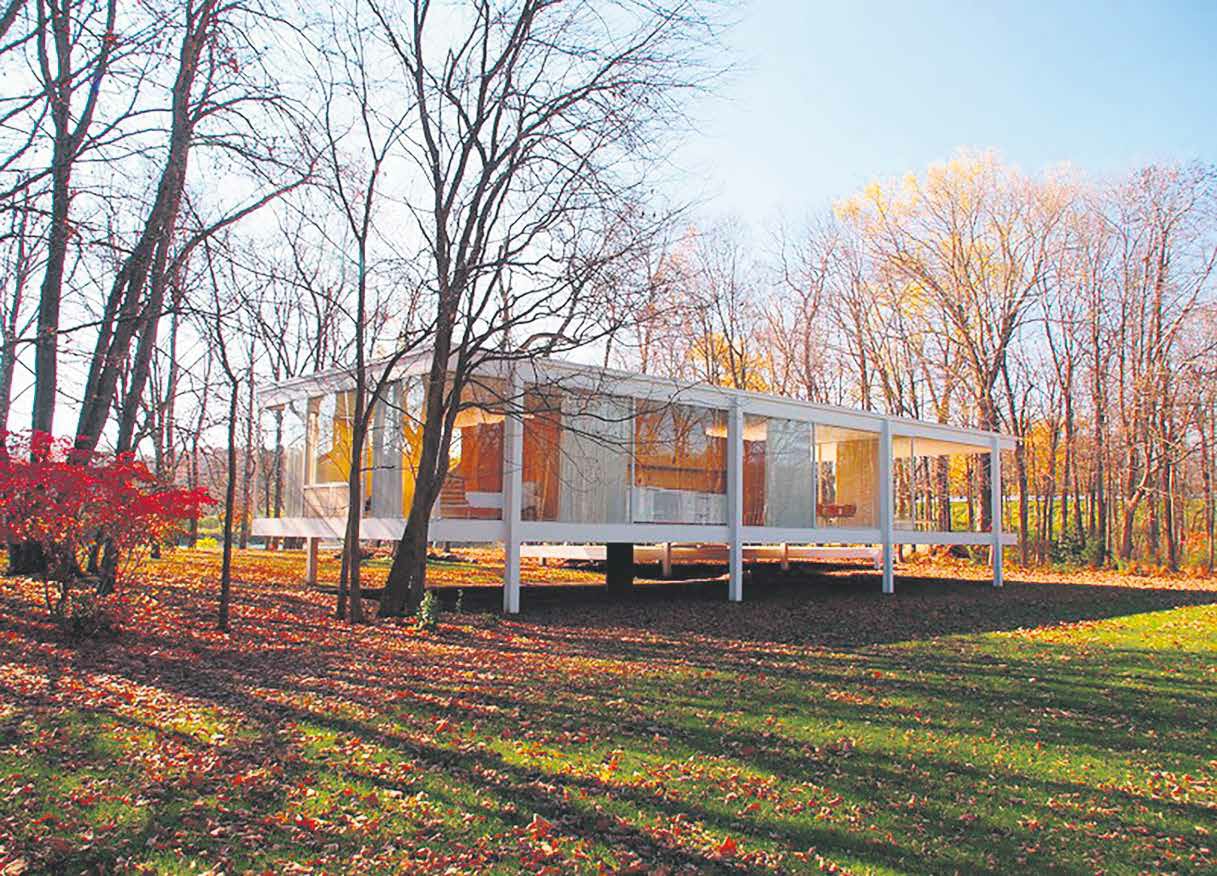
In Barcelona, MIS proposed not so much a house as an artistic idea that includes a house in a more general spatial context (a mirror of a pool water, a sculpture of colbbe above the water and partially closing the space with a length of more than 100 m). On the contrary, “Farnsworth House” is precisely the house as a universal space for housing . The area hidden from prying eyes is only a bathroom and a toilet; However, if desired, you can completely close the glass walls with curtains - technically this was even provided. But just as an opportunity . The charm of the “glass house” consisted in the merger of its inhabitant with nature while maintaining all the amenities of modern housing, as well as the conditions for ordinary forms of modern life, whether it is an eating fire, an intimate solitude by the fireplace, work at a written table, etc. So, against the backdrop of judicial scandals, Edith Farnsworth, as the press wrote, continued to invite famous people to her house, including from artistic artistic arts. Mira ... In general, for 21 years, Dr. Farnsurt was not just the legal owner of a glass masterpiece, but also actively used the house and, undoubtedly, was proud of them.
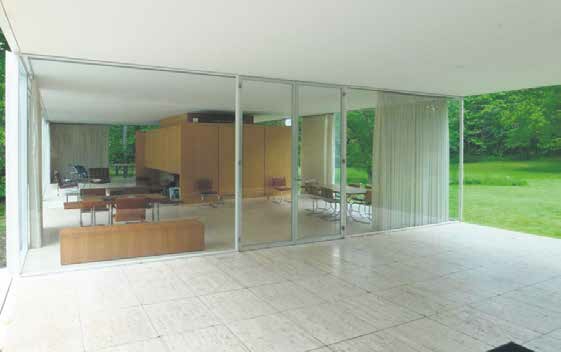
As for the 2008 flood in Illinois, it affected huge territories and was a disaster of a national scale. No one could foresee its destructive power in advance. (Likewise, who could imagine that such an earthquake can happen in Moscow, that a chandelier was being pumped on the fourth floor of a brick house? And this was a witness in 1977.) On YouTube, there are shots where it can be seen that the “Farnswort House” wall can only be swimming on a boat ... The creation of Misa Van der Roe was preserved and restored thanks to a high level of social activity of American citizens.
The famous American writer Joyce Carol Outes wrote in her memoirs about the role that they and her husband of life played the opportunity to merge with nature. At the same time, she fluently noted that the walls in the house were glass ...