
Translated material
Remove Stigma
Why is the production of clothing for people with disabilities - a business of the future
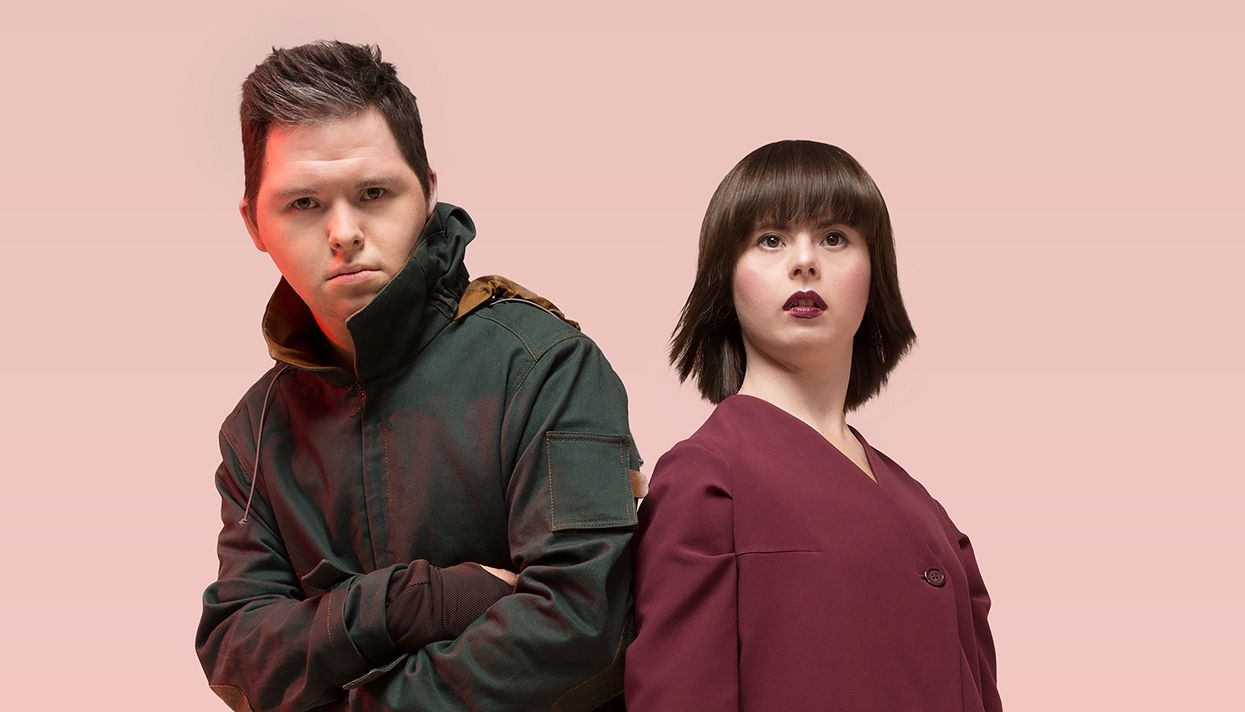
On October 23, as part of the Fashion Week Mercedez-Benz Fashion Week Russia will be shown collections made by students of the British design school for people with features of the body structure. At the request of Medusa, Tatyana Zarubina talked with designers, models and organizers about why to show fashion in public without legs and arms, who sews it all and why put on something special.
Yanina Urusova
Bezgraniz Couture project founder
8 years ago, Tobias Raisner and I undertook to do the Bezgraniz Couture project for people with disabilities. On the one hand, we wanted to engage in a social project, on the other hand, it is interesting to us, just like a business case. On our planet, 1 billion 300 million people with disabilities live on our planet, this is approximately the size of the Facebook audience. Another 650 million elderly people (and by the 2050th year there will be 1.5 billion) is a huge target audience that needs new products and services. Every fourth Russian family has people with disabilities. There is an opinion that families where there are people with disabilities are low -income, but this is not entirely true. People with disabilities and their environment have great purchasing power. This is a large market, comparable in size to China, which, in particular, was confirmed by many studies, including the last one that was carried out by our order. Those who see these opportunities now will find themselves in a large win.
Since 2011, we have held two international competitions for designers who were judged by a professional jury from nine countries of the world. For the second year, we have been screening and are going to launch experimental production in partnership with the Burda publishing house and the global brand of Burdastyle. Last year, for the show, we invited professional designers from Russia, Germany and Portugal, and this year our designers are students of the British Higher School of Design in Moscow. This year we made clothes for people using a wheelchair, people with cerebral palsy, people with Down syndrome and having amputation. In the next semester, we will most likely work with a new course on headdresses for people after chemotherapy and shoes for people with amputation and difficulty fine motor skills. Unlike few existing industries now, we work with different types of disability. There are no more such projects in the world, at least until we heard about them. What we do is truly "done in Russia."
We see our global task in creating a market:. On the one hand, we organize training projects, prepare future professionals. The Parsons School of Design, Fashion Institute of Technology, Massachussets Institute of Technology, and five designer schools in Russia are ready to connect to the global educational project. When, in a couple of years, the fashion industry will find this market the size of China, there will already be professionals who can develop the necessary design.
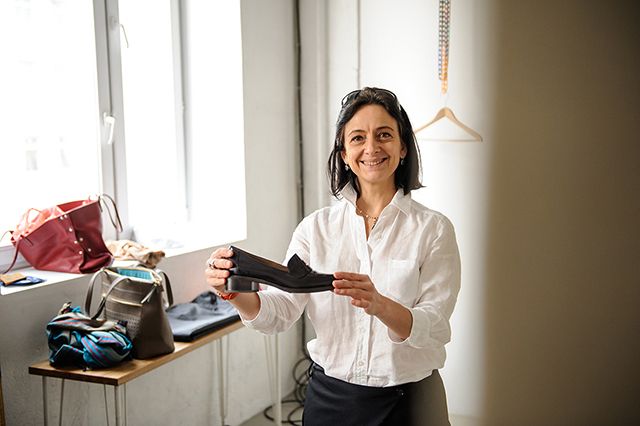
And we are engaged in "rebranding disability", creating a new type of communication and. As specialists and social entrepreneurs, we will organize seminars and training projects for companies that somehow work with the topic of disability or affect it in their social projects, advertising and communications. It is important for us not only to tell, but also to demonstrate that real equality is not only and not so much ramps (although this is very important), but all that creates a feeling of full life, joy and dignity.
We are talking about the fact that clothing for "disabled people" can and should be not only comfortable and functional, but also stylish. She must remove the stigma of marginality. This is a story about Lifestail: a lifestyle and design, as Steve Jobs understood it.
Marina Zharova
British school student
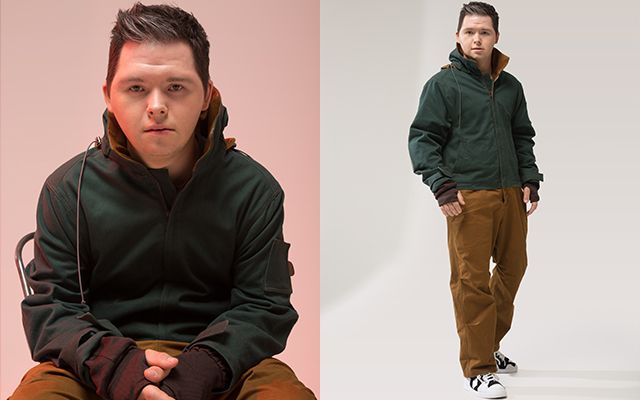
The curators offered us an experiment - making clothes for specific living people, with interesting features. At first, we did not understand at all what it was, and how to work with them, but we began to try and rushed. I made a jumpsuit for a boy with Down syndrome.
It is very interesting to do useful and functional clothes. You are faced with the task that your clothes are not only beautiful, and sit well, but also be comfortable and easier. This is a new trend in fashion, which is not yet promoted, it is doubly interesting to do this, because it is great to be a pioneer.
Before starting work, we had a meeting with models. Everyone talked about their problems. Dad told about Dima. In particular, he said that people have a poorly developed small motility in people, so it is difficult for them to cope with small fasteners. They need large lightning, large buttons, or even better than Velcro. My jumpsuit looks like trousers and a jacket for early autumn, it is made as simple as possible, it can be fastened with one movement. It seems to me that Dima is convenient in it. Even Dimin Papa told the story of how Dima went to Germany, and there he was lost, and could not explain where he needed to get. To prevent this from repeating, we placed an information insert on the overalls with contacts and an address that is not visible in a normal situation, but when necessary, it can be opened and showed.
The guys with Down syndrome have a complex figure: narrow shoulders, wide hips and neck, so the pattern had to be done individually. At the same time, their physique is more or less the same, so in the future, it will be possible to make a dimensional grid and put their clothes into production. For Dima, we planted overalls in the figure, and with its help they leveled it a little - it became more trapezoidal, like standard men.
Before this work, I have never encountered such people. She opened a new world for me. People with Down syndrome are very kind, positive, do not hold evil. It was very interesting to work with Dima.
Olga Senina
Mom Dima, models with Down syndrome
Dima is an actor of the Odrokyudny Theater. Choosing clothes for people like Dima can be very difficult. They have a very peculiar figure - small growth, a tall waist, sloping shoulders. The pants either fall off or do not fit, the sleeves are long, always finished clothes have to be either lined or somehow finalized. Dima does not tie laces, so you have to look for not just comfortable shoes, but always without laces. We are not always next to him, he must be able to undress himself, hang his clothes, get a ticket in the subway, put a phone somewhere.
Dima loves to dress beautifully, leaving the house looks in the mirror, although he is not fixated on this. He himself chooses what he likes before buying something, we always ask him if he will wear it. And for me, of course, it is important that he looks good, I want his clothes to decorate him.
Anastasia Abroskina
Model with cerebral palsy
I started a modeling career in 2009, I then studied on medical and secretly from my parents registered on the site for models, put my photos there and began to go to castings along with healthy models - I did not indicate its disability anywhere. Someone scolded me-said why you came, you spend our time, but someone perceived, on the contrary, well, we worked together. My disease in the photographs is not visible - I have two arms, two legs, but the poses differ. I have been participating in this project since 2011, and now I have been invited to work in it, I will be engaged in crowdfunding, finding funds to launch the production of this clothing. Young designers worked on the clothes for this show. And this is a very good decision. They are more open, they have no desire to just take and remake their old collection for the needs of the disabled, they are ready to develop clothes from scratch.
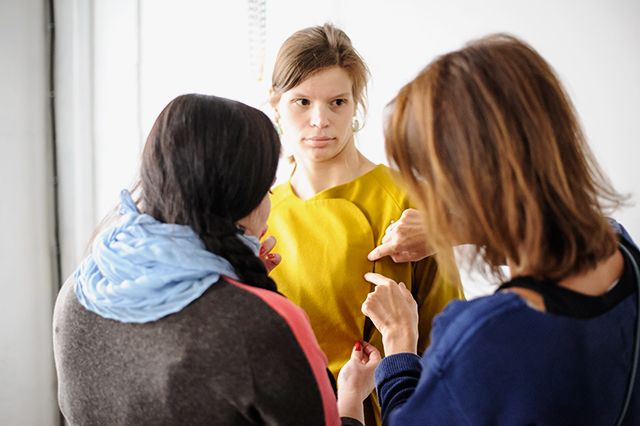
We met with designers, and I told them what I want and why. I talked about postmers that can be integrated into clothes, and this will change the landing of the product itself. There will be such a dress at the show. We constantly went to try on, we were in close contact all the time, we were looking for options for how to make clothes more convenient. It is difficult for me with my disease to fasten my clothes, therefore, both a jacket and trousers are fastened to Velcro, which are located on the side, everything can be fastened with one hand. In this project, we sought to unify. Such clothes will be relevant for people with a stroke and for people with fractures. And the clothes made for people with amputation are suitable for people with gypsum, clothes for strollers, in general, are suitable for everyone who leads a constant sedentary lifestyle.
I have an innate disease, and I do not know how to be different. I can more than many healthy people. I entered the medical, my husband, a five -year -old child, I was engaged in athletics, I am the champion of Moscow, Russia and international equestrian sports competitions. Many healthy people do not have this. But I can’t get dressed myself. Recently, I had to go to shoot and decided to put on a dress. It hung for a long time, but there was no reason. And then there was a reason. This is an ordinary dress with a secret lightning on the left side. I put it on, and I understand that I can’t fasten it. I understand that I was left alone in an empty apartment with this dress, from which I can’t get out, nor fasten it. And I'm late for the shoot. I had to go to the neighbors - to ask to fasten the dress. For a very long time I had to explain to the person what I want from him.
Tatyana Zarubina
Moscow