
Translated material
What do doctors do in the war?
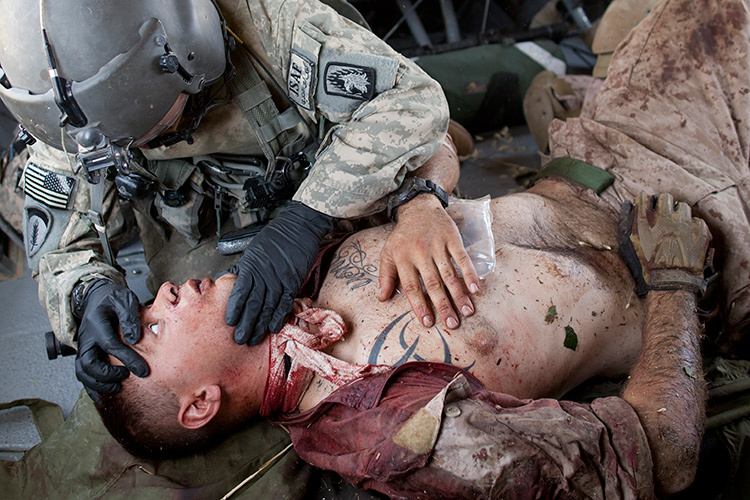
In the Lecture of the Polytechnic Lecture , the editor of the scientific Internet publication N+1 Vasily Sychev gave the lecture “Military Medicine in the conditions of the zombie-apocalypse”-about painkillers, dry plasma, smart armor and fasteners for wounds, which will appear in army pharmacies in the very near future.
Despite the name of the lecture-“Military medicine in the conditions of the zombie apocalypse”-there will be no zombies in my story. You need to immediately decide on the terms: a zombie apocalypse is a concept that military and doctors use to model various situations. Doctors on the example of a zombie apocalypse simulate the spread of diseases; The military under the zombies implies poorly organized or not organized groups of opponents, which are poorly armed and some principles of warfare are simulated on them. But what about military medicine?
Today, military medicine consists of several disciplines, but for our topic today, the most important is military field therapy. Roughly speaking, these are fighters with medical education, who provide assistance to the wounded soldiers directly on the battlefield. Military field therapy as a hope for survival. The main in military field therapy are paramedic (the Western term is a paramedic, that is, a person who has received an incomplete medical education, who is able to provide primitive basic medical care), field surgeons. Roughly speaking, treating a runny nose-yes, and treating a complication with a runny nose-some purulent sinusitis is no longer to him, but to a professional.
What do military doctors do on the battlefield? Provide primitive treatment of wounds, give some medications, carry out basic amputations (if the leg does not come up to the end during the explosion, for example), and then transfer the fighters to special evacuation services. The wounded fighter is transported to the field hospital, where some expanded operations are performed-for example, they will add that the medic on the battlefield is undergoing, conventionally speaking, they pour blood, administer all the necessary medicines and after transferring to the already stationary, real hospital, where professional medical care will be provided to the wounded.
Doctors in the war have to face a variety of wounds, but they can still be classified. The most common are the wounds of the lower extremities and abdomen - they account for 80% of the wounds received on the battlefield. Not because the soldiers actively substitute their lower parts of the body - no one likes to stick out of the trench. It’s just that the fighting today is for the most part not active shootings with the enemy, but stripping the territory and moving around the area, which is often mined. That is, the wounds of the lower extremities are mainly subverses on mines, abdomen - shootings. 15-17% falls on the wounds of the upper belt of the limbs and head. These are, as a rule, already active shootings or active sniper fire under which the fighters fall. The greatest danger during the wound is irreversible damage to vital organs-for example, entering the chest, into the liver, in the kidneys, if some important arteries are tuned or open wounds are infected. However, in fact, military doctors usually have to deal with the most dangerous complication of wounds - with a traumatic shock.
What is it? Violation of the compensatory functions of the body, when the body is not able to cope with damage, with pain, infection, with blood loss. With the development of traumatic shock, the so -called two vicious circles can occur - vasomotor and cardiological. With a vasomotor circle, blood pressure drops, the blood and vasomotor center, which is responsible for blood vessels, stops responding to nervous impulses - as a rule, they contract - which leads to poor blood supply to the peripheral organs, and in the future the blood pressure is even more supplied to the brain, and the brain is even more affected. A vasomotor center and so on along a closed chain, in a circle. Cardiological vicious circle with shock is about the same as a vasomotor circle, the heart only suffers. The drop in pressure, the deterioration of the heart - it decreases worse, the blood flows worse, the pressure falls even more, the blood pushes even worse, the heart is even worse and so on, the same thing, in a circle.
Shock is divided into four main phases. The first is compensated when a fighter can still be helped. The first phase is customary to be divided into two spells. Moreover, there is either one or the other. The first is erectile, when a wounded fighter screams, rides in pain, rushes, ceases to react to the teams of doctors. Thorpid is, on the contrary, inhibition. A person lies, does not want to do anything, but at the same time retains complete clarity of consciousness, can give expanded answers to the doctor’s questions. The second phase of shock is a subcompensated phase. After the erectile period (if it was he), a person calms down, his consciousness is slightly clouding, he gives monosyllabic answers to questions, while he turns pale, his pressure drops and the heart rate increases. The third phase of shock - and it poses the greatest danger to the health of the wounded fighter - is characterized by the fact that a person is already practically losing consciousness, he already had a lot of blood loss and irreversible disorders in the body begin. If a person has not yet been provided with medical assistance, he smoothly moves to the fourth phase of shock, already terminal, when it is impossible to help him: consciousness is absent, superficial, rapid breathing, heart beats more slowly and slower, and in the end the person dies. I repeat: military doctors have to fight with a shock. All possible wounds, blood loss, damage, burns - anything - roughly speaking, is the symptoms of shock, its root cause that needs to be eliminated, smooth out to eliminate the shock itself.
There are many different sets to combat wounds. For example, an individual first -aid kit of a soldier. There is the most basic set of drugs. Anesthetic: physiological solution of morphine, promedol, ketorol, narcotic drugs. In Russian military medicine, Promedol and a solution of morphine are not used - they are prohibited by the Ministry of Health; There is only a physiological solution of ketorol, which acts slowly, not for long, but at least somehow. Even in the first -aid kit there are all kinds of means from poisoning with various chemicals, including phosphororganic compounds. In the event that suddenly, in addition to the zombie apocalypse, an atomic war occurred, there are various radio protection products, but they, by the way, are of a preventive nature, that is, they need to be taken twenty to thirty minutes before they get into radioactive conditions. And if a person is already under the influence of radiation, all these funds are ineffective. A wide spectrum antibiotics are used in increasing temperature, with intestinal infections, with extensive burns, when the wound infection is possible. Plus a standard set: anti -war, bandages, buns, notebook, pencil (the latter for making a preliminary diagnosis before transferring the wounded to evacuation).
In addition to individual first -aid kits, there are medical military paramedic and medical bags. There are much more drugs: there are tablets from pressure and - pay attention! - A garden knife. It would seem a strange subject for a doctor. In fact, in the field, it is indispensable. If you need to build a tire for a broken hand - I took a knife, cut a branch, screwed it up, and everything seems to be in order. If the fighter underestimated the leg with an explosion and it needs to be cut off, again the knife helps out. By the way, a garden knife is an exclusively Russian feature. He is not included in the medical military sets of other countries.
The rule of the "golden hour". It was formulated in the First World War with French doctors. Its principle can be stated as follows: the most effective medical care to the wounded can be provided in the first sixty minutes after receiving a wound. According to statistics, if help was given conditionally in the first sixty minutes - why will I say conditionally, later - then up to 90% of the wounded survives. If help comes later than two hours after the wound, only 10%survive. In fact, the rule of the “golden hour” was actively formulated and used by doctors in the 1960-1970s, but later they abandoned it. It is believed that there is no scientific and evidence, that assistance will be more effective in the first sixty minutes. But doctors still agree that with any disease - not necessarily a wound - medical care should be provided as early as possible after the onset of symptoms. This significantly increases the chances of a person for survival.
Now let's move on to those promising developments that will use or are already using doctors to combat the consequences of wounds. The most common device (or not even a device, but a tool), already included in all medical sets in all countries, is a hemostatic turnstile. Previously, rubber burners were used, which wrapped, for example, around the hand, and then tightened with some kind of special stick. But today they are almost not used, because they could very much pull the wounded limb. Too much. And prevent any blood in general. And this is wrong. The blood flow of at least some should remain-otherwise, murder of tissues may begin. Therefore, they came up with such a turnstile. In the database, these are wide strips of elastic fabric with special mounts, made in such a way that the wounded fighter is able to apply them independently with one hand. Puff, bandage - all this takes very little time. Troops today are already starting to receive turnstiles of an even simpler structure. They are ordinary cuffs, similar to those that have the appliances for measuring blood pressure - only a special handle is installed on them, which is easy to rotate with two fingers. And after five to seven years, the troops awaiting a special equipment for soldiers with built-in tans in all important places: in the axillary region, on the elbow, in the groin, under the knees. On the first samples of the tourniquets, these will need to be tightened yourself - you pull the special strap, the tourniquet will drag on, the blood stops. Subsequently, as they say, sensors will be integrated into soldier equipment that will work automatically and use drives that tighten the tugs for overlapping bleeding on their own.
Another drug that is already used by the military was the first to test the Americans in 2012. It is called Celax , produced from chitosan. Chitosan is the main substance that is part of the chitin shells of all kinds of insects, small crustaceans and so on. Actually, the peculiarity of this substance is that, unlike cotton wool, it absorbs blood perfectly. Having mixed with blood, the drug instantly forms a thick viscous substance, which then hardens and forms a crust, a securely closing the wound. Initially, Celax was produced in the form of powder, which sprinkled burns, wounds and open fractures to stop bleeding. But then they refused the powder for one simple reason - blowing off in the wind. With strong gusts of wind, the powder wakes up by, and almost nothing gets to the wound. They began to make bandages impregnated with chitosan, and the so -called aerosol plasters (a spray can, from which the chitosan spray onto the wound and forms a crust). In expanded medicine - ordinary, civilian - chitosan is also used: surgical self -absorbing threads are made from it. The chitosan is now very active with chitosan. Doctors develop special chitosan mixtures with antibiotics and healing substances. Such drugs will begin to be delivered to the troops in the next three to four years-after all clinical trials are completed.
A garden knife is an exclusively Russian feature. He is not included in the medical military sets of other countries.
Anesthetic candies is a special drug. So far, only the United States and Israel are used. Moreover, the first were the Israelis, which is not surprising, since it is an actively fighting country and military medicine is developing more actively there than anywhere else. Anesthetic candies include fentinel, the narcotic substance of the opioid series. It is much stronger than morphine used by the military in ordinary practice, and acts much faster. Why was he made in the form of candies? Yes, because when absorbing under the tongue, the substance very quickly falls into the bloodstream and begins to act. The duration of the action is the least for an hour, but, the most interesting, analgesic effect of fentanil is the same as Morphine is very weak. Anesthetic candies do not remove pain, they change the attitude towards it. It is difficult to convey this with words, but I will try: a person begins to perceive the pain as if separately from himself, she ceases to cause anxiety, he ceases to worry about her. Accordingly, the reaction of the central nervous system to pain changes. After all, what is the first reaction of our nervous system to severe pain? An increase in blood pressure, an increase in the frequency of the heartbeat, that is, the development of the very shock state that I already spoke of.
"Flasp" for wounds. Exclusively Israeli invention. It is made of bioinertic plastic, hypoallergenic and not causing rejection. This plastic can be imposed on wounds for an arbitrarily long time until healing. It is made on the principle of fastener: two halves are located along the edges of the wound, with the help of special hooks cling to the skin, then a plastic screed is brought, which simply pulls the wound, blocking the bleeding, reducing the area of the open wound and the probability of infection. The fighters are transferred to the evacuation, and they arrive in the hospital, where the “fastener”, if the wound is not particularly serious and does not require special processing, are not removed, but left until completely healing.
Holy hemostal foam made of polymeric materials is a very promising development. It is even unknown when she goes to the troops. The Americans are developing it, and in the base it is a liquid in a spray can with a thick needle. Having determined internal bleeding, doctors simply pierce the abdominal cavity and inject the liquid into the fighter. There it already turns into a foam, slowly hardens, squeezes the internal organs, blocking the bleeding. The fighter in such a situation greatly increases the chances of survival. The peculiarity of this foam is that it is very easy to extract during the abdominal operation, and even if the surgeon forgets some separate particles, they will not cause inflammation, and slowly will resolve over time.
To determine internal bleeding in the field, portable apparatus of ultrasonic diagnostics is already beginning to use, but so far only in Israel. In other countries, they are still experiencing them. The case is inhibited by strict requirements for the stability of the technology for falls, for temperature scatters, again, the ultrasonic diagnostic devices located in the military should not require the use of gel. In ordinary medical institutions, as you know, a gel is applied to the skin, which improves the conductivity of ultrasound waves and so on. So in the field, the gel should not be used, because: a) you will not always find it; b) If the doctor took him with himself, he will quickly consume him on the wounded fighters.
Gibernation is a secret project, which is known only to the most general information. Scientists are looking for chemical compounds, drugs that allow you to slow down absolutely all the life functions of the body. This is not the same as the immersion in whom, when there is no consciousness, the normal functioning of the body is preserved, but there is an inhibition of absolutely all the processes of life, including, as expected, aging. This is done in order to stretch the same “golden hour” and win the death of time. Because not always evacuation machines, helicopters, robots manage to fly up to the fighter in the first sixty minutes after the wound and cannot always provide full assistance. So they come up with a way to stretch the condition of the wounded fighter for as many time as possible-up to two to three hours. They say that the protein from nature has something similar-I just don’t know how proteins we are. It is clear that if they come up with an apparatus capable of immersing a person in the hibernation regime, an antidote will immediately be invented, which will derive a person from this regime. How? It is incomprehensible. Everything is classified - and the first results will be only in 2018.
More recently, the British presented “smart armor” - a body armor with a mass of integrated sensors. Там и пульсометр, и прибор для измерения артериального давления, и прибор для измерения сатурации крови (то есть насыщенности ее кислородом), и анализатор пота (например, если человек сильно устал, у него меняется химический состав пота, а физического переутомления бойцов допускать никак нельзя, потому что могут быть серьезные физиологические последствия — вплоть до отказа почек). Датчики «умной брони» призваны мониторить состояние бойцов и передавать данные командиру и военному медику, которые все это отслеживают. При ранении одного из солдат они могут быстро до него добраться, так как в «броню» помимо прочего входят еще и датчики, передающие информацию о местоположении бойца. Используется в том числе инерциальная навигация, то есть, грубо говоря, магнитные датчики записывают, как перемещался боец из исходной точки, и по этим записям его можно найти. «Умная броня» опять же работает на правило того самого «золотого часа», который как будто отменили, но военные медики продолжают утверждать, что правило такое существует. Израильтяне даже пытаются этот час сократить: среднее время оказания медицинской помощи раненому бойцу израильской армии — 43 минуты. И это меньше, чем в армии США: у них 58 минут. По российской армии таких данных нет, потому что в последний раз мы воевали очень давно, а то, что сейчас, и войной-то сложно назвать — никто не контактирует с врагом напрямую.
Я сегодня много говорю об Израиле, но, повторюсь, это страна, которая воюет активно и постоянно уже долгие-долгие годы, и поэтому военная медицина активнее всего развивается именно там. И именно там помимо прочего разрабатывается такой вот замечательный аппарат, как AirMule . Это беспилотный аппарат вертикального взлета, способный самостоятельно лететь по заданному маршруту или под управлением оператора на скорости 180 км/ч и перевозить грузы массой до 655 кг. Его самое очевидное использование — доставка провизии. Однако разработчики говорят, что он будет использоваться и для вывоза раненых. То есть после того, как военные медики оказали солдату помощь — обработали раны, набрызгали хитозана, дали пососать леденец с фентанилом, — AirMule подхватил его и унес в безопасное место. Похожие разработки существуют и в США — там у них создается колесный робот SMSS , который может действовать в трех режимах: быть полностью управляемым оператором (солдат идет за ним с пультом и командует, куда ехать и что делать), в режиме следования (когда робот самостоятельно следует за бойцом, невзирая ни на какие преграды) и в автономном режиме, когда робот двигается сам по заданному маршруту. SMSS также создается для эвакуации раненых и подвоза провизии. Однако наиболее любопытная разработка в этой области ведется в интересах нашего Министерства обороны при участии Ковровского завода, который производит пулеметы Дегтярева и всякое авиационное оружие. На заводе не так давно открылся робототехнический центр, где прямо сейчас создают робота, который будет самостоятельно находить на поля боя раненых бойцов, оказывать им первичную медицинскую помощь, проводить диагностику и вызывать машину для эвакуации. Каким образом это будет реализовано, пока трудно представить. Возможно, будет использована так называемая телемедицина, когда врач сидит где-нибудь в полевом госпитале и, дистанционно управляя роботом, обследует раненого бойца.
И — наконец — сухая плазма крови. Довольно перспективная разработка. Ее уже используют натовцы и американцы, но она требует еще доработок. Боец потерял много крови — ему необходимо вливание. Во многих войсках — кроме уже перечисленных — для пополнения жидкости в кровеносных сосудах используется, как правило, физиологический раствор. Он дает какое-то время на выживание, но не представляет полноценной замены крови. Плазма — это более естественная замена. Причем она хороша еще тем, что в сухом виде ее можно брать с собой при любых температурных условиях — и в мороз, и в жару, она долго не портится. Помимо пакетика с сухой плазмой крови необходим бутылек с физраствором. Содержимое бутылька и пакета смешивается, и прямо на поле боя можно бойцу начать делать вливание. Слабое место этого процесса в том, что в момент смешивания в раствор могут попадать бактерии, что повышает риск заражения. Сейчас разрабатываются контейнеры, которые бы содержали в одном отсеке сухую плазму крови, в другом отсеке — физиологический раствор. Чтобы, сломав преграду между отсеками, военный медик мог смешать оба вещества, сохранив стерильность. Если такой контейнер будет изобретен в ближайшее время, военная медицина шагнет далеко вперед.
Вообще военным медикам на поле боя приходится выполнять очень много нехарактерных для себя функций. Бывали случаи, когда медики прибывали к раненым бойцам в подразделение, в которое попал танковый снаряд. Пострадали командиры — командовать солдатами некому. И медики берут командование на себя — помимо помощи раненым. Или вот, пожалуй, вспомню один случай — он очень примечательный и как раз очень хорошо проиллюстрирует то, насколько важна медицинская помощь раненым бойцам, как можно раньше оказанная. Году в 2009-м в Израиле, в Газе, солдату пуля попала в горло. Она не затронула важные артерии, но разворотила трахею и задела пищевод. Солдат захлебывался кровью, не мог полноценно дышать, у него была сильная кровопотеря. По счастью, медик прибыл к нему через две с половиной минуты после получения сигнала о ранении: быстро откачал из легких кровь, вставил трубку, обеспечивающую дыхание (это называется трахеостомией, когда протыкают трахею и вставляют трубку под челюстью, чтобы человек мог дышать). После этой операции бойца передали на эвакуацию; медики не верили, что он выживет, потому что ранение было очень серьезным. Но он выжил и впоследствии даже смог более или менее разговаривать.
Напоследок хочу сказать, что у военных свои требования к медицинскому оборудованию. Гражданская медицина от военной отличается, грубо говоря, большей «ванильностью». Под «ванильностью» я вот что имею в виду. Например, человек заболел. В мирной жизни его тут же перевезут в хорошо стерилизованное помещение, где специалисты немедленно проведут тщательное обследование, проверят возможные реакции организма на анестезию, на закись азота или какой-нибудь калипсол, который используют при наркозе. В общем, заболевшего на гражданке человека лечат в условиях, где все хорошо. Военным медикам приходится оказывать врачебную помощь в условиях оперативности, когда чего-то всегда не хватает: или это забыли подвезти, или корабль с медикаментами потерялся, или самолет с хирургическими нитками летел и упал в пустыне, а бойцу нужно прямо сейчас ампутировать ногу или останавливать кровотечение. Поэтому военной медициной из всех разработок, ведущихся в мире, забираются только те технологии, которые позволяют проводить медицинские операции как можно быстрее, как можно точнее и в самых примитивных условиях. Грубо говоря, оперировать в палатке посреди пустыни во время песчаной бури. И так, чтобы человек при этом выжил. Вообще я это все к тому, что — ну, не знаю — давайте, что ли, не воевать. Давайте жить мирно.
Записала Наталья Кострова