
Translated material
The discoverer of darkness
Memory of Yuri Mamleev
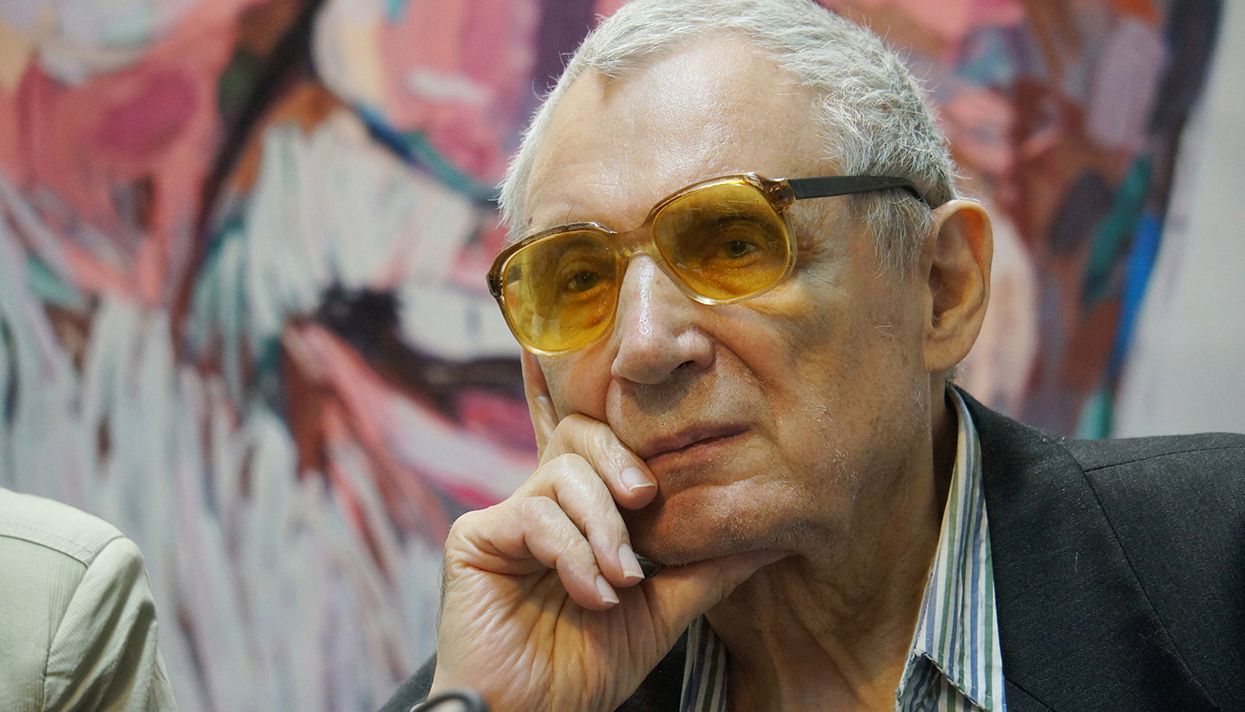
In Moscow, in the 84th year of his life, the Russian writer, playwright and philosopher Yuri Mamleev died, one of the key figures of the “unofficial culture” of the 1960s. In the mid-1970s, due to the inability to publish Mamleev emigrated in the United States, but even there his main novel of Shatuna, who influenced several generations of Russian prose writers, published only in an abbreviated form-the Mamleevsky world was so ominous. At the request of Medusa, the literary critic Galina Yuzefovich tells about the writer.
The death of Yuri Vitalievich Mamleev - of those events that can already have little change on the cultural map: it is difficult to name another writer whose place in Russian literature would be so firmly and unshakable, recorded by so many imitators, followers and students. Mamleev had a rare and honorary fate - like Pushkin (or, if you like, Brodsky), he became the fact of a language and a cultural context, which has the ability to reproduce himself in other people's texts often in addition to will - or, in any case, in addition to a conscious intention - their creators. Dmitry Bortnikov, Mikhail Elizarov, Oleg Zveznov, Viktor Polevin, Vladimir Sorokin, Dmitry Gorchev, Anna Starobinets, Yuri Buida - a list of writers, which one or another, in one way or another, who inherited his way to look at the world, can continue almost endlessly. Moreover, it is difficult to put an end to this list: authors completely free and independent of the dark, night inside out of life, discovered by Mamleev, in today's literature.
The first books of Yuri Mamleev appeared in Samizdat in the 1960s, when their author taught mathematics in evening schools. Of course, there was not a single chance to see the light in the USSR - with all the apoliticality: the gap between the officially replicated “bright Soviet everyday life” and the open mamleev world of Chaos and Judas in its foundation was too great. In order to see his books with printed, Mamleev had to emigrate - first in the USA, and after France, where he taught Russian literature and Russian for many years, with an unchanged emphasis on his beloved Dostoevsky - the author, whom Yuri Vitalievich considered his forerunner and teacher. But in an amazing way, even in the West, Mamleev’s books were perceived as too terrible: until the mid-1980s, the great “connecting rods” (without exaggeration, one of the main books of the second half of the 20th century), were abundant barely and caused quite unequivocal rejection among European and American criticism.
The situation changed in the late 1980s, when the muddy foam raised by perestroika surfaced to the surface, when the features of the world, which seemed too terrible and impossible in a situation of deceptive frozen stability of the 1970s, suddenly began to appear in reality. The infernal world described by Mamleev rose to the sun. It was then that the true recognition of Mamleev begins - and it is then that he returns to his homeland from emigration: physically and in the form of texts. In 1996, the full edition of “Shatuns” was published for the first time in Russia, and even earlier the writer’s stories and philosophical texts begin to be published. From now on, Mamleev is included in the pantheon of Russian writers and thinkers of the twentieth century.
Mamleev is not so much a writer as a visionary: for him the world of a nuthane, chthonic horror, rushing around the corner, which is rushing into the rags of normality is not a terrible dream, not a fantasy that came from the depths of the subconscious, and even more not a cunningly wrapped metaphor for our current life. Mamleev’s relationship with the reality he created is forced to recall the famous Essay of Vasily Rozanov about Gogol and Lermontov. If you believe Rozanov, the great prose writer and the great poet left so few traces in real life because they actually lived not here, but on the border of the worlds - our, ordinary, and that, whose contours are in their work. This second world - mirage, scary and exciting - was genuine for them, much more important than the one where they had to exist. Something similar can be said about Yuri Mamleev: a restrained, deliberately quiet person in famous yellow glasses, never in his entire long life, which has not become a character in a scandal or, as it is now customary to say, “public discussion”, was not so much an inventor as the discoverer of the world of chaos and darkness, not an artist, but a stalker.
The world created by him lurks somewhere in the darkness-and now that Yuri Vitalievich is no longer with us, there is no one to become our Virgil in this hell (not by chance, by the way, the American name of “connecting rods”-“sky over hell”). But thanks to Yuri Mamleev, at least we have knowledge of him - and a rather detailed card.
Galina Yuzefovich
Moscow