
Translated material
MDK on the verge of blocking
Sultan Suleimanov - about the history of the most famous public "VKontakte"
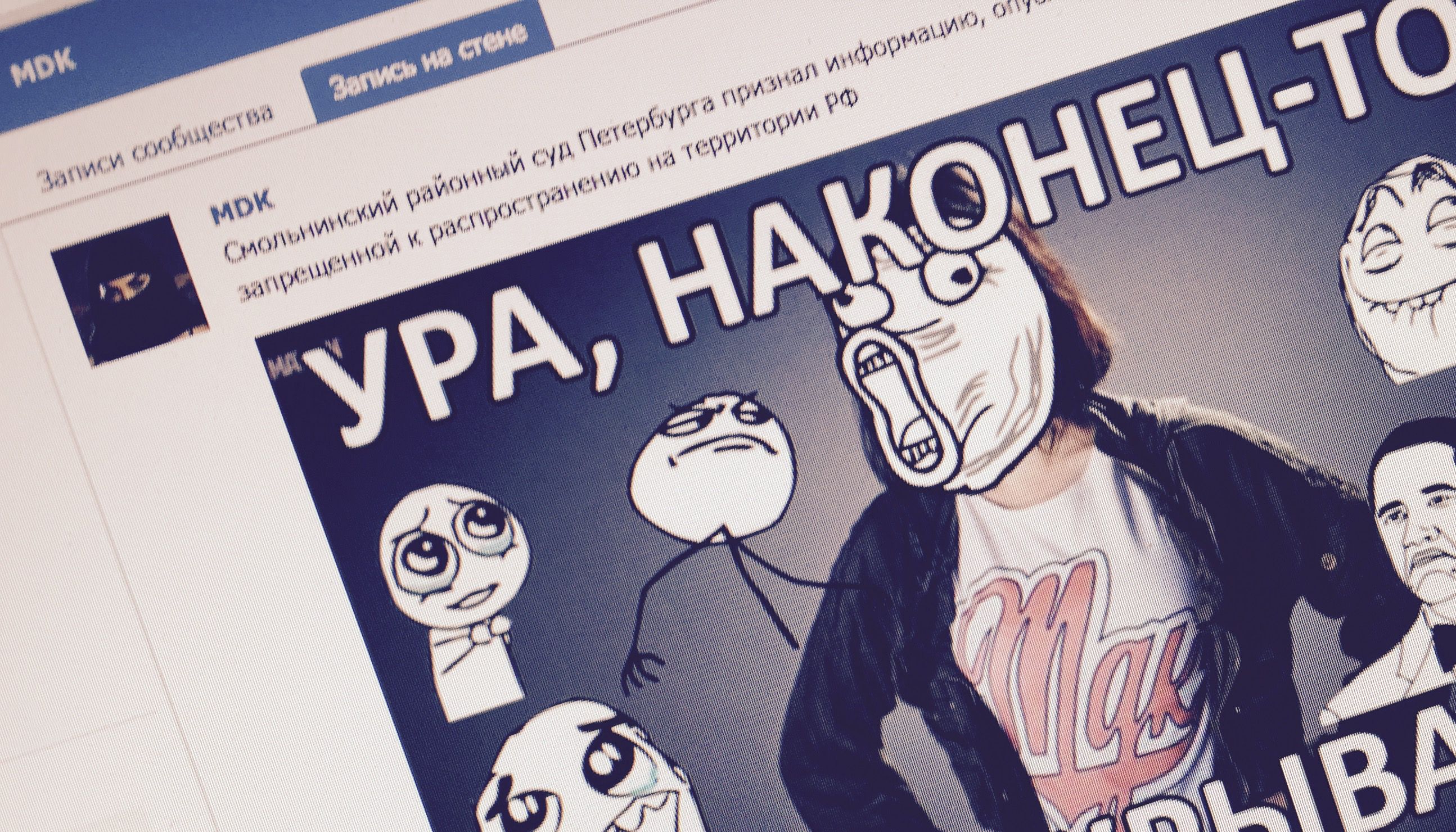
The Smolninsky District Court of St. Petersburg ordered to block access to the MDK community (six million subscribers) on the VKontakte social network. The decision was made due to publications that incite hatred on the grounds of religious and nationality. The resolution will still be appealed, and even if it comes into force, MDK administrators will probably try to find ways of bypass. Nevertheless, the verdict of the St. Petersburg Court is the first real case when the scandalous public faced the real threat of closing. Medusa journalist Sultan Suleimanov recalls how an unremarkable community with ridiculous pictures received All -Russian fame.
For M*Dacov
The MDK community appeared in the spring of 2011. Initially, it was called “for M*Dacov” and was “an ordinary subjective personal blog, where different things, phenomena were ridiculed” - this was described by the creators. From the very beginning, the page was filled with indecent photos, pictures with obscene vocabulary and rude jokes.

The community, which gathered several tens of thousands of subscribers in six months, was renamed the brief MDK. At the beginning of 2012, 60 thousand people had already read the public, by the end of February their number doubled, and by December MDK had more than a million subscribers-unprecedented growth on the VKontakte scale.
The publication
The founders of MDK - Dmitry Trachuk, Roberto Panchvidze and Dmitry Aladyshev - acted incognito for some time.
In February 2013, Panchvidze and one of his partners gave a semi -anny interview to Hopes & Fears-only their names, without surnames, were mentioned in the text. “The conspiracy, according to them, is necessary: dissatisfied users tried to reveal personal data and arrange herbs,” the article said. Another interview in which only the names were mentioned (and photographs of the heroes from the back were published) was published in the Afisha.
Finally, in July 2013, Panchvidze already from his full name gave a detailed comment on RBC and another interview with Hopes & Fears (two other MDK co -founders were declassified within a couple of months). The first material was associated with the release of MDK in Odnoklassniki, and the second - with the intention of young entrepreneurs to create their own creative agency.
The agency launched a few months later and has existed so far - in October it turned two years old. And with "classmates" did not work out. In August 2013, the community defiantly left this social network: its creators did not like the conditions under which they are divided with advertising income, as well as the general “unfriendly” of the site.
The exit of the founders of MDK from the shadow allowed them to “legalize” the marginal community in the media field. In this regard, the most successful action was the appearance of oppositionist Alexei Navalny on the avatar of the public at the end of August 2013.

Navalny then claimed the post of mayor of Moscow and actively conquered the youth audience - he looked at the Leprozoriya, gave an interview about the Games of Kanobu and the music of Rap.ru. Obviously, a partnership with a community with three million subscribers - mostly young ones - was in his own interests.
The “serious” status of MDK was fixed by the VKontakte administration: it issued the MDK “Fuck” of the official community and the short address of vk.com/mdk, which cannot be occupied independently.
At the same time, MDK regularly surfaced in the reports of the employees of the Presidential Administration, which was supposedly received by the deputy head of the domestic policy department Timur Prokopenko. The authors of the reports paid almost as much attention to community publications as the performances of Alexei Navalny and the work of the old Lenta.ru team in social networks.
Scandals
In a relatively “non -meter” state, MDK did not last long. On October 21, 2013, in Volgograd, a suicide bomber blew herself up on a bus with people. Soon, a post with the text “Help likes” and a picture with the inscription “Boys, in Volgograd is a terrorist attack. Corpses, screams to the rescue. ****** [Horror] is short. "
Social networks were indignant, but MDK continued the game: the community published a video of the explosion moment with a comment “Bombaleilo” (on the Internet this word usually means the frustration of a person who was subjected to trolling), and also joked on Twitter about the proportion of the alleged suicide bomb found at the site of the terrorist attack.
Soon, deputy Mikhail Markelov reacted to the publication: he showed a post in the State Duma, although he did not ask to close the community or punish its creators. Instead, Markelov demanded to initiate a criminal case of extremism against the founder and general director of VKontakte Pavel Durov.
Usually a laconic Durov answered the deputy with a column that only the examination can establish whether there is extremism in a scandalous publication. At the same time, the founder of VKontakte delved into the content of the post, analyzing the meaning of the word ****** [horror] and the call to put likes, not finding anything extremist in this.
A few days later, MDK representatives said that they were suing Markelov demanding that they refute their words about extremism. Subsequently, neither the deputy nor the MDK achieved anything: the Ministry of Internal Affairs refused to institute criminal proceedings, and the reciprocal lawsuit never surfaced and most likely had never been filed.
A couple of weeks after this incident, the project fell into another scandal. After the plane crash in Kazan, in which 50 people were killed, there was a record on MDK Twitter: “Was there any online crash? And then here I will get out of the popcorn. ” She outraged users, the media and State Duma deputy Valery Trapeznikov. True, the Trapeznikov did not focus only on MDK, listing several inappropriate publications on social networks and offering to send their authors to work in hospices, the houses of veterans and construction.
After this case, MDK came for a year and a half of relative silence - the community did not suit loud provocations, and no one reacted to small ones. However, in July 2014, MDK was deprived of the checkpoint of the official community. Moreover, this was done not because of some publication, but in connection with the changed rules of the verification of communities. Simply put, the VKontakte administration found that MDK was no longer required.
Zhanna Friske
On June 16, 2015, a post on the death of singer Jeanne Friske with a cynical picture appeared in MDK. Further events developed according to the already familiar scenario: mass indignation of users, a petition with thousands of votes, the speeches of deputies (this time - Mikhail Markelov and Joseph Kobzon) with the requirements to close the community. Under the pressure of users, the VKontakte administration deleted the picture, but left the community on the spot.
A source of Medusa, close to MDK, claimed that the community was asked to put the public from the administration of the President of Russia - it was supposedly necessary to distract users from the law on the “right to oblivion”, adopted in the first reading on June 16. The source also retold argumentation: instead of indignant at the law, people themselves will demand to delete information from the network that they do not like. Publicly such representatives of MDK did not declare anything like that; There were no confirmations of this information from other sources.
Be that as it may, there was no real punishment for a joke about the death of Friske. However, two months after the scandal, in August 2015, the St. Petersburg prosecutor's office demanded to block the community. But this was due to an insult to the feelings of believers and inciting hatred on the grounds of religious and nationality.
It was with this wording that the Smolninsky court of St. Petersburg agreed on October 27, ordering to block the MDK. “So far I cannot judge how justified this decision is. We will appeal, ” said Panchvidze. What will happen next is still unclear. VKontakte has experience in transferring the Children-404 community prohibited by the court, together with all its audience to the new address: since the “illegitimate” content remained at the old address, the community clone continues to operate.
Sultan Suleimanov
Riga