
Translated material
"I am a real Comic Book Nerd"
At the annual Kryakk Book Fair in Krasnoyarsk, where this year there is a huge and diverse Swiss program , with the participation of the Boimfest festival, the Swiss-comxation artists Katya Rikenbach, Christoph Shuler and Andrea Kavli showed exhibitions of their works. The author of several graphic novels, Katya Rikenbach, presented her book “The Summer of My Life”, and Kapado and Shuler are reports from trips to Kenya, India and Alpine Mountains.
- Katya, how did you start drawing comics?
Katya Rikenbach: I always drew how much I remember: in kindergarten, in school lessons, all the time. But I never thought that this would become my profession. After school, I decided for a long time what to do next. In Switzerland, you can go to the art school during the year and try different specialties: photography, graphic design, clothing design. At 20, I decided that I would become a fashion designer, but in fact my stronger side was always inventing stories -so I got to the school of illustration in Lucerne. Well, from there to the comics there was already one step.
-Where do you get stories for your stories: do you specifically come up with something or turn to everyday life?
Rikenbach: Most often these are stories from ordinary life, from what is happening around me. I am inspired by the films that I watch, and the comics themselves-I’m a real Comic Nerd , I really like classic comics about Mickey Mouse, and something more modern. For some time, between the school and the college, I even worked in the comic book store.
Farmers who graze sheep are outsiders live in the mountains in the summer, descend lower in winter, but are always outside public life.
- Do you have many colleagues in Switzerland? Can this be turned into a main profession there?
Rikenbach: Unfortunately, you can’t live alone comics in Switzerland: Zurich is a very expensive city. Probably one of the most expensive in the world along with Moscow. Or maybe Moscow is more expensive - I don't know. In general, in addition to comics, I make illustrations for commercial purposes, newspapers, organize workshops and so on. Now, for example, I am working on a cartoon dedicated to Ulrich Zwingli - the famous Reformation figure. This, of course, is much more complicated than comics-you need to somehow accommodate his whole life in fifteen minutes of screen time.
-You came to a great form, a graphic novel, starting with short stories-or something else?
Rikenbach: In fact, if I had such an opportunity, I would make exclusively books of 300 pages or more. I work intuitively: some kind of common vague idea appears, and then the plot simply develops from page to page. I never use "sterobors", storyteller.
- How did the book “The Summer of My Life” have appeared, which you represent in Krasnoyarsk?
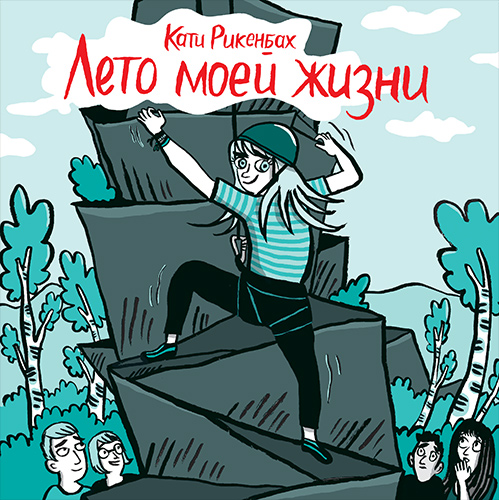
Rikenbach: This is a small book, I made it for an organization arranging campaigns for adolescents - it is not that advertising, just talks about different ways of pastime. One hero named Basty is in the south of Spain, where he hangs out the night. The second heroine goes to the tent town, travels along the mountains and so on.
 © Pro Helvetia
- And what connects you at the fair with Christoph and Andrea?
Rikenbach: We work in the same studio-I am for about 10 years, they are 25 years old, I think. This is a large studio, graphic designers, animators, writers work there - in general, a good combination of creative people of different generations. We want to make a reporting comic about what we will see in Krasnoyarsk: Andrea and I will draw, and Christophe will write a text to real-time pictures.
-In addition, there will be three more reports-comics: about India, traveling in the mountains of Switzerland and about a refugee camp from Somalia. Christoph, tell us in more detail how you were brought to Africa.
Christoph Shuler: We were invited by “doctors without borders”, which later published this book. The camp itself is in Kenya, we spent a month in it - we talked with doctors, residents. We were struck by how it is arranged: this is a real village, even a city of half a million people in the middle of a desert. There is a good infrastructure - shops, hospitals, everything you need. But the camp is absolutely isolated - you get there, and it’s already difficult to get out, the exit to Kenya is closed. Some Somalians have been living there for years, many people like it, because living here, of course, is calmer than their homeland, where the civil war continues. Young people, of course, want to get out of there somewhere-but in order to do this, you need to get an invitation to study in the States or to Europe. So the majority, unfortunately, are forced to stay there.
- What is the atmosphere in the camp, is it safe there?
Shuler: There is quite calm. Of course, many worry that they have nowhere to go from here, but this is much better than life in military conditions. Many residents built themselves at home, some even have cars - so not everything is so bad. True, adolescents are idle idle, do not know how to occupy themselves.
The camp is absolutely isolated - you get there, and it’s already difficult to get out.
- How long did it take to prepare a report?
Shuler: We collected a ton of material, but finished work already in Kenya, in the shortest possible time. The book, as I said, was published by "doctors without borders." Another report, which can be seen in Krasnoyarsk, is dedicated to a trip to New Delhi-we made it together with a famous Swiss artist named Gefe . It was an exchange program: Indian artists painted their report on Switzerland, and we - vice versa. For the third report, Andrea and I went on a trip to the Alps - we started in Slovenia, then moved to Austria, Switzerland, France, Italy. He consisted of impressions of life in the mountains - about tourists, farmers, owners of small hotels and restaurants, climbers. We made such portraits of these people: say, farmers who graze sheep are a kind of outsiders, in the summer they live in the mountains, in winter they descend lower, but are always outside public life. But they know everything about the weather, their animals. They have a very subtle understanding of nature - it was very interesting to chat with them.
-How in demand is the genre of comic book-portage? Is some development noticeable?
Schuler: Yes, more and more they appear in Switzerland - and many magazines are interested in such publications. So this story is slowly but correctly developing: more and more reports are printed in Germany, the USA, and other countries.
-How difficult to make a career in Europe, the same states?
Shuler: This is quite difficult. In Italy, Germany, other countries there are a lot of their authors. If you are very good, of course, they will print you - but the chances are small. In the States, the competition is generally extremely high - I do not know a single commander who would be published there.