
Translated material
Master of the line for the cultural public
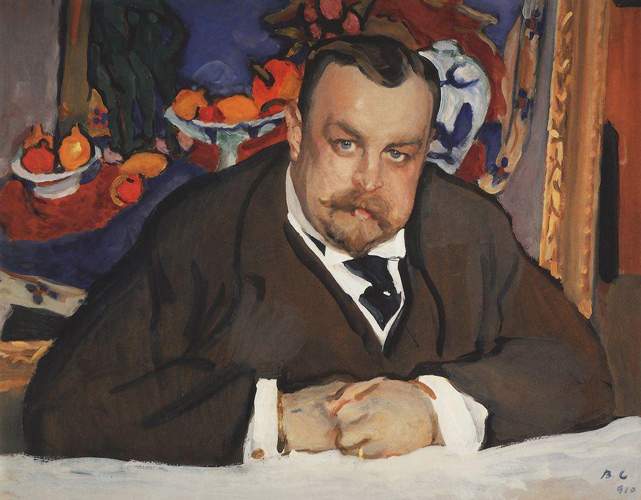
In Moscow in the Tretyakov Gallery, the Superpopular Exhibition Valentina Serova is taking place in the Crimean shaft . It opened in early October, but the stream of people does not run out there and, apparently, will not run out in the near future. As you understand, explains Alexander Novozhenov.
6000 people a day - this is what the average attendance of the retrospective of Valentin Serov. Why is the most brilliant portrait painter of the Russian aristocracy and the large philanthropic bourgeoisie on the final dramatic segment of their existence so much like the public of the Tretyakov Gallery, which has nothing to do with the Russian aristocracy in the mass of the Russian aristocracy? All these Orlovs and Yusupovs in chic chairs and sofas with sofa dogs, who, as sensible art historians like to celebrate, always parody the portrait features of the hostesses - although in this animalistic parody Soviet art and was looking for anti -bourgeois potential, to imagine Serov after the revolution is completely impossible; Who would he write when the philanthropists and representatives of the royal surname ended? Would he have entered AHRR? Or would he live in Finland, like Ilya Repin? Or, as Mikhail Nesterov, would switch to portraits of the Soviet intelligentsia and those of their heroes who remained caretakers with the estates that once belonged to them - art residences like Abramtsev? The latest, most “modernist” experiments by Serov in the coordinates of decorative modern and mythological symbolism, such as “Odysseus and Noncisy”, “The kidnapping of Europe”, dates back to 1910, and this is several years later than the Blue Rose exhibition and the death of Viktor Borisov-Musatov; This is a belated and “unsystematic” symbolism, modulation of modernity as a set of formal techniques within the realistic skill, which is unheated among Serov.
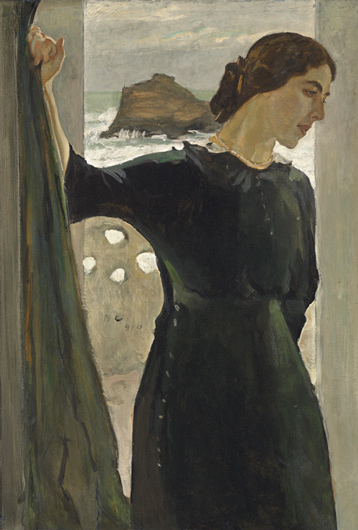 © Christie's Images Portrait of Maria Zetlina. 1910
Although Serov is considered the best painter, first of all, he is a master of the line-a recognizable stylized, fluid, virtually whirling line of modern, which even characterizes his landscapes-and has really almost multiplier observation to the characteristic manifestations of a linear gesture, in animals, in people. Hence the Serov prettyness and cuteness, which Isaac Levitan never have and which dangerously bring him closer to the kitsch manifestations of the same style in painters of the Scandinavian countries. In his impressionistic period, if the Serov to Levitan approaches, then the animalist detail always gives him out: how fluently, impressionistly and abstractly, he was “smeared”, a distant cow, so recognizably stretching the neck in order to grab a bunch of grass from a stack of the grass: the situation of Levitan is unacceptable: it is not so clever variety of details. I would violate the “Russian” despondency of horizons and verticals; The same in Serov’s landscapes with sheds, cows and horses that seem to resemble the Levitan “March” : Levitan has a horse - part of the landscape, stands quietly and dumb, like a tree; Serov has a cow or a horse - this is always exactly what a dynamic character.
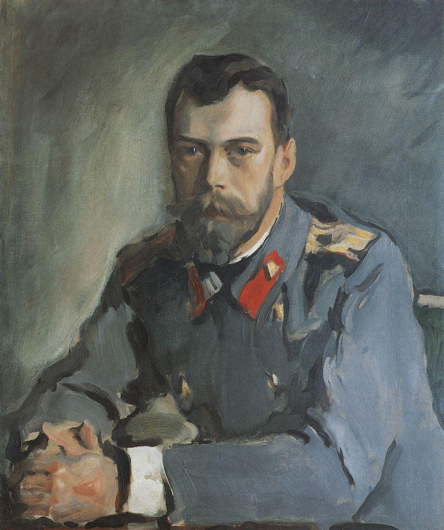 © State Tretyakov Gallery Portrait of Emperor Nicholas II. 1900
Sirstyled ladies with magnificent hairstyles, whose wave -like contours of which are always echoed by broken gestures of hands, from realism to modernity - daughters and wife of the philanthropists know a lot about the last fashion, on Serov’s portraits of aristocrats almost can not distinguish from merchant daughters and actresses: in the society of “industrial capitalism” they all begin to live in one fashion, and overlap distinces They melt in front of our eyes how smears of smell on a gray tunic in the famous portrait of Nicholas II. He, we know, showed him “almost simple” person, almost ordinary, in no way royal. The relaxation and everydayness of the king’s posture echoes the relaxation of Morozov, sitting against the backdrop of a dazzling matiss: he folded his hands in front of him as simply as the king, and dressed as simply - in the gray. So the king becomes almost like a bourgeois, equal to him in the world of a moderate, but thoughtful and solid luxury of the modern style, in no way transcendent and inconceivable, not baroque, but one that everyone can try on, albeit only in the imagination.
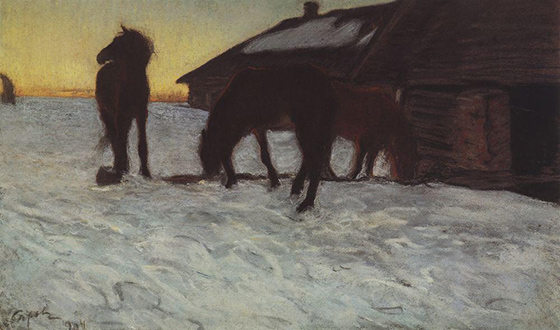 © State Tretyakov Gallery of Striguna on a Watering Power. Premotkanovo. 1904
And here is one of the keys to such an attendance of the exhibition: Serov in such a non-vulgar-sociologizing interpretation, in which he is given on his current retrospect, not only like the mass public of the “old” three-tire-he produces this audience, the public of “culture”. For which the only type of art of art is the form of a “selfless gift”, when units live in Ryabushinsky mansions, but thousands can observe this life for their pleasure-through flexible curly grates of fences and huge windows, and in exhibitions-in short, in the spaces of show specially designated for the masses. This is the secret of the pseudo -democraticity of Art Nouveau as a style and typology, this is the principle of operation of Serov as the engine of the post -Soviet discourse of the “old” Tretyakov Gallery.
But besides the aristocratic-bourgeois, Serov also has purely merchant portraits, from which more than modern, the 18th century with the dark life of the patriarchal Old Believers: such is the portrait of the old Maria Fedorovna Morozova, the director-director of the largest textile corporation “Lost Russia”, the “Partnership of the Nicholas Manufactory”, “Rich and Rich and Rich and Rich and Rich The smartest "woman-millionaire, widow and heiresses of Timofei Savvich, mother of Savva Timofeevich. Behind every philanthropist in the late XIX - early twentieth centuries is his enterprise, behind each enterprise - the history of Stocks, the largest of which, Morozovskaya , occurred just at the Orekhov manufactories of Maria Fedorovna and Savva Timofeevich. In the Russian museum system, as it exists now and how it was formed after the end of the vulgar sociology in the early 1930s, the history of strikes and revolutions and the history of philanthropy never intersect, these are two parallel stories, and the first belongs to the fading local history and historical museums, where it is buried, and the second shines with all the splendor of the picturesque skill in the central and most visited museums, Where painting reigns, passing through themselves the same six thousand visitors per day, supporting and isolation of their “culture” from everyday life.
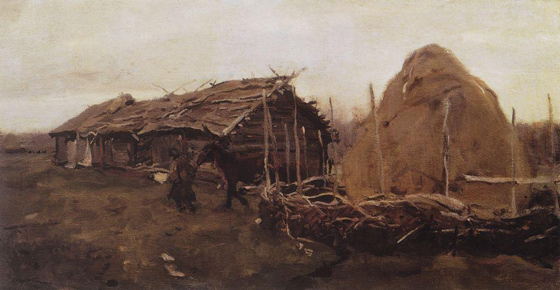 © Saratov State Art Museum named after A.N. Radishchev's haystack. 1901
Beautiful philanthropists from Serov portraits are reflected in the eyes of visitors to the “non -modern” expositions of the Tretyakov Gallery: after all, it is known who is the main consumer of “classical culture”, daily, and not an episodic visitor of the Philharmonic, Retrospective GTG, old repertoire theaters; It is known who is easiest to charm with the dream of a noble comfort, delivered from the obedient kitchen life of existence. On the shoulders of these women - women who absorb and reflect portraits of aristocrats and actresses with lush beams and blouses; women who are a string, supporting each other under their arms, go to slippery sidewalks from performances and subscription concerts to go to the subway to their apartments; Women who defend the queues on weekdays - the system of "classical art" rests. Tretyakovka is a state museum, but philanthropy as the only conceivable form of the existence of culture are the generous gifts of the richest people, the sophistication and diversity of the material culture they generated, expressed through the image of an idle woman in the interior or “illuminated by the sun” in the garden, where it is not necessary to dig the beds, compensatory longing for the times of this generosity and the displacement of its rude and material foundations, it - This is what is cultivated here.