
Translated material
Reform of useless burden
Football, to which most Russians are indifferent, are 90% subsidized by the state. What will they tell the first person on the State Council on "Sports number one"
Football, to which most Russians are indifferent, are 90% subsidized by the state. What will they tell the first person on the State Council on "Sports number one"
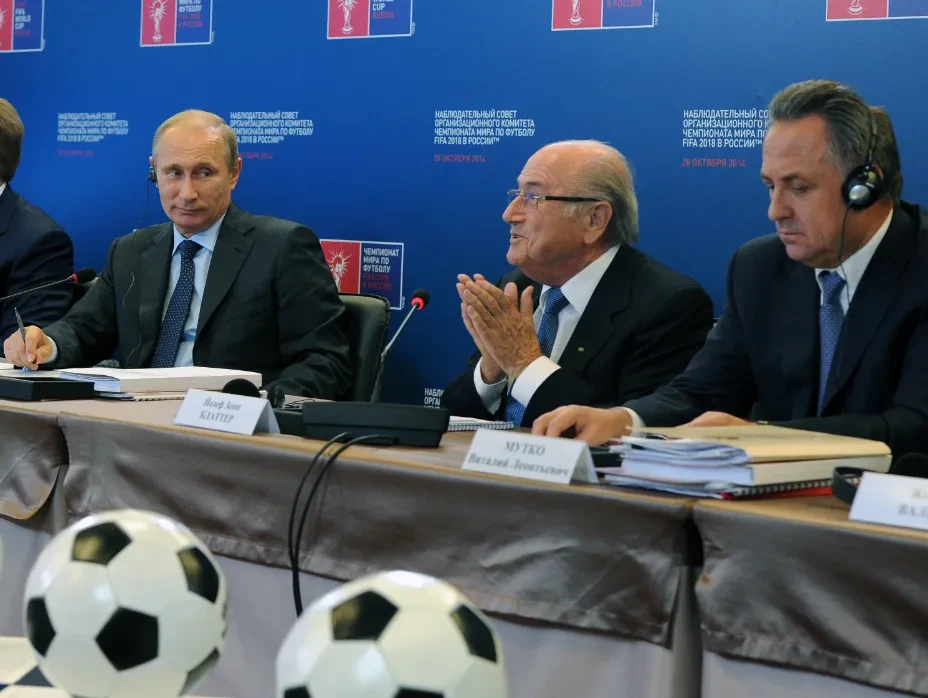
“I consider it advisable to devote the following meeting of football development” - so on June 2, 2015 Vladimir Putin actually summarized the meeting of the President for the Development of Physical Culture and Sports, hearing the reports of the participants in the working group. Then, I recall, for the first time, information was presented to the president about the volume of financing of professional football clubs by the state, as well as on the expenses of these clubs to attract foreign players and transactions with agents (including non -residents).
Based on the results of that meeting, a list of presidential assignments (No. Pr-1261 of June 25, 2015) was published, the government report on the next meeting of the Council on the topic: “On the development of football in the Russian Federation, providing sports infrastructure, taking into account preparation for the 2018 World Cup” (will be held on December 1).
At the disposal of Novaya Gazeta was a report prepared for this meeting by specialists of the Ministry of Sports. It represents aggregated information of subordinate enterprises and institutions of the department, data of international analytical agencies, a study of the Plekhanov REU and other organizations.
The report should be noted right away, does not contain any sensational facts (if not considered a sensation that 98% of children are abandoned by football for adulthood) and revolutionary decisions, but basically abundant with relevant statistical calculations and a number of curious legislative initiatives of the department Vitaly Mutko, elected by the President of the Russian Football Union (RFU).
Given the significance of this document - Vladimir Putin in November will be based first of all on information from the profile, that is, the sports ministry (although almost the entire Cabinet of Ministers, including the Foreign Ministry, was engaged in the execution of presidential assignments: Russian diplomats received the task of studying the development of football abroad), we publish its excerpts.
World Cup 2018
Almost every section of the report one way or another sends us to the upcoming home world championship in 2018. The Russian Mundial is, according to experts of the ministry, a fundamental constant, on the basis of which there is an opportunity to mobilize all subjects of football and raise public interest in internal competitions.
However, while the World Cup is in a somewhat remote perspective, the ministry intends to report to the president mainly on the rate of construction of the infrastructure planned for the championship.
In total, in preparation for the tournament, the government decree provides for the construction, reconstruction and modernization of over 600 facilities, of which 121 objects are exclusively sports (we are talking about stadiums, training bases, fields).
In total, 631.3 billion rubles were laid for the implementation of the Preparations for the World Cup in the budget, of which 200 billion should be received from extra -budgetary sources (the rest will cover the federal budget and budgets of the constituent entities of the Federation).
The costs of the World Cup will not follow - this is evidenced by the statement of the Minister of Finance Anton Siluanov at the government hour in the State Duma in September of this year.
The report notes high rates of the construction of new sports facilities: in Volgograd, Nizhny Novgorod, Rostov-on-Don, Saransk, Samara and St. Petersburg, construction and installation work are carried out in accordance with the established schedule, laying the new field at the Kazan-Arena stadium is planned for 2016, and the reconstruction of the Olympic Luzhnikov and the Luzhniki and SPULD and SPUS ahead of the deadlines.
Two problematic projects follows from the report - the construction of the stadium in Kaliningrad and the reconstruction (restoration) of the arena in Yekaterinburg. The Government of the Sverdlovsk Region concluded a state contract for construction and installation works only on September 9 this year, and in Kaliningrad, work has been carried out on engineering surveys, for which a positive conclusion of the Glavgosexpertiza of the Ministry of Construction has been received-and "Development of design and estimate documentation to clarify the final cost of the object continues."
A source close to the Ministry of Sports does not exclude that the authorities can refuse to hold the World Cup in Kaliningrad: “There is a very complex project associated not only with large costs, but also with colossal labor costs, in addition to the stadium itself (it is much more difficult than in any other participating city due to soil features), it is also necessary to equip the island. There are risks not to be put into operation on time. ”
The interlocutor also notes that due to the manifest and disputes with contractors, the ministry decided to advance work by more than 50% of the state contracts. “It was to some extent that there was blackmail from their [contractors] side: you will not raise the price-we will not go to the construction site! As a result, they agreed - they raised the price. ”
The construction of the stadiums is engaged in Crocus Group Aras Agalarov, Stroytransgaz Gennady Timchenko, the Sinara group Dmitry Pumpyansky and the PSO-Kazan.
In addition to the report on the pace of preparation for the World Cup, the Ministry of Sports intends to report to Vladimir Putin on the progress of the execution of his order to develop a bill, which would provide for the establishment of the features of regulating public relations in professional football.
The Ministry of Sports, follows from the report, developed a number of amendments to the Federal Law “On Sports” dated December 4, 2007 No. 329-FZ, which he promises to introduce to the State Duma in December 2015.
The bill, in particular, stipulates that “the activities of professional sports entities, including professional sports clubs and professional sports leagues, will be aimed at developing it as a spectacular and economically self -summed part of the sports in ensuring the assistance of the sports entities of higher achievements, including sports teams of the Russian Federation.” Despite the “common words”, in the final text of the bill, specific parameters of financing professional football clubs from the budget can be established, says a source close to the Ministry of Sports: “We are talking about clear proportions of financial assistance from state -owned companies and the budget of subjects”.
It plans to supplement No. 329-FZ and new articles, in particular Art. 19.2. (“Professional sports leagues”), which will prescribe the features of the creation, exercise, rights and obligations of leagues, as well as “the participation of foreign sports clubs in them”. The last point, according to the source in the ministry, applies primarily to the continental hockey league, where many foreign clubs take part, but "in the future it is aimed at football as a tool for inclusion in the competitions of teams from Crimea and Sevastopol, which are now on their own."
The novelty of the bill was the introduction of the concept of “sports agent” (intermediary). The norm is provided for the mandatory accreditation of agents with the corresponding All -Russian sports federation or a professional sports league. In Russian football, we recall, the agents were withdrawn from among the subjects last year - this is how the RFU intertured the decision of the FIFA Congress from 2014, based mainly on the Fatf Convention (refusing to licensing agents due to the suspicion of transactions with clubs and football players).
The current bill of the ministry implies a return to the licensing of agents, and, consequently, the outlines of their transactions to the jurisdiction of the National Federation. This decision was the result of the lobbying efforts of a small group of intermediaries, the former member of the RFU Commission on Agent Activities Vasily Grishcheak believes: “If you pay attention, there is no issue related to agents in the list of presidential instructions, although some speakers [the Presidential Council of June 2] and talked about the legal consolidation of this activity. In fact, by establishing the accreditation of agents, the Ministry of Sports transfers the RFU authority to control them. Only now, not on the basis of not just the internal regulations of the football federation, but a whole federal law. Control over the licensing of an agent is control over the market and its turnover. ”
In addition to football leagues and agents, innovations are noted in the report regarding the norm. 20.3 No. 329-ФЗ, known in everyday life as the "Law on Legionnaires." In accordance with it, we recall, for team sports, including for football, the Ministry of Sports received an exclusive right to approve restrictions on the participation of athletes who are not entitled to perform in all -Russian sports competitions.
From the current season, the formula “6+5” has been operating in Russian football, according to which more than 6 foreign players cannot at the same time. However, from the report, the president follows that “in the framework of preparation [for the Presidential Council] from the Honorary President of the RFU V.I. Koloskova and FC Spartak (Moscow) received an offer, starting from the sports season of 2016/17, introduce the formula “5+6”, which will ensure a regular game practice of an additional 76 Russian football players. ”
Vyacheslav Koloskov confirmed that he turned to the RFU with a proposal to tighten the limit to the legionnaires, in the press service of Spartak abstained from comments.
Finance and youth
Despite the “sustainable growth of the main quantitative indicators of systematically engaged in football in Russia (the number of those involved since 2006 increased by 1 million people - 2.4 million people)”, no qualitative changes in the relation to football occurred, the Ministry of Sports reports, referring to the data of the sociological survey of the VTIIME. So, as of August 2015, 73% of Russians are not interested in this sport (in 2014 - 48%).
The Ministry of Sports connects the fluctuations of public interest in football not only with the lack of success of clubs at the largest international competitions, but also with uncontrolled financing of professional clubs from the state. “The financial resources directed by the state and affiliated with it (state -owned companies) are also formed to support professional clubs that spend them, including the purchase of expensive legionnaires, paying for football agents, and the wages of players. Such investments provide individual clubs with the opportunity to “spend without looking around” and thus strengthen their own competitiveness, ”the report emphasizes.
In accordance with the estimates of The Boston Consulting Group, to which the ministry refers, up to 85–90% of the total amount of funds in one form or another enters the clubs from the state.
The report also contains a negative dynamics of participation in professional competitions of young football players: in the football National League (FNL), conducting the competition of the first division, the number of players who have been published under the age of 21 in recent years has decreased almost three times - to 59 people. “The situation is aggravated by the general opacity of the financial life of Russian football, which creates the impression of tolerance for contractual matches and the unsportsmanlike principles of players in the main team,” the report said.
To increase the number of young players in professional football, the Ministry of Sports can reform a professional football league (PFL), conducting the competition of the second division, follows from the report. The compilers of the document translate the proposal of the All -Russian Trade Union of football players, according to which it is proposed to liquidate the PFL in the 2016/17 sports season, and instead of creating a system of tournaments “up to 19 years” and “up to 21 years” with the participation of youth teams of professional clubs, assigning the responsibilities of their holding on interregional and regional federations of football.
The struggle with the hooligans
Particular attention in the report by the President is paid to measures to control the activities of the Fan associations.
“The FSB and the Ministry of Internal Affairs on an ongoing basis conducts a set of measures to collect and analyze information regarding the involvement of sports (football) fans in unlawful extremist activities that are not related to near -sports events. The objects of operational attention are persons attracting groups of fan associations and spontaneous groups of fans to extremist shares, ”the document says.
Strengthening control over fan associations, like other measures and reform described by the Ministry of Sports, is associated with the home championship of the world. “Complex operational-search and preventive measures are held, aimed at obtaining proactive information about the intentions of participants in youth destructive groups to organize mass riots during the preparation and conduct of the World Cup. Operational monitoring of the activities of youth groups and associations prone to extremist manifestations that traditionally showed protest activity in the previous years during significant political, cultural, sports and other mass events are ensured, ”follows from the report.
The Ministry of Sports, referring to the information of the FSB and the Ministry of Internal Affairs, reports that “preventive measures are being held with leaders and active participants in youth informal movements to prevent the performing illegal actions on their part and involve youth in extremist movements and organizations.” In addition, for timely response to incoming information on the preparation of extremist shares in stadiums, “monitoring of Internet resources used in the environment of football fans and participants in groups and destructive associations, as well as communications of leaders of fans of fans”.
According to the Ministry of Sports, in 2015, the total number of fans brought to administrative responsibility for committing offenses during the period of football matches with the participation of clubs of the Russian football Premier League (Premier League) amounted to 1171 people (1315 people in 2014 data).
The security forces, judging by the report of the Ministry of Sports, will require amendments to Art. 426 h. 3 of the Civil Code of the Russian Federation, which will allow not only to refuse individual fans to sell input tickets for official matches, but also tighten sanctions for violation of the rules of conduct at sports facilities (up to the introduction of criminal liability for a multiple violation of the administrative ban on attending matches).