
Translated material
Again a deuce
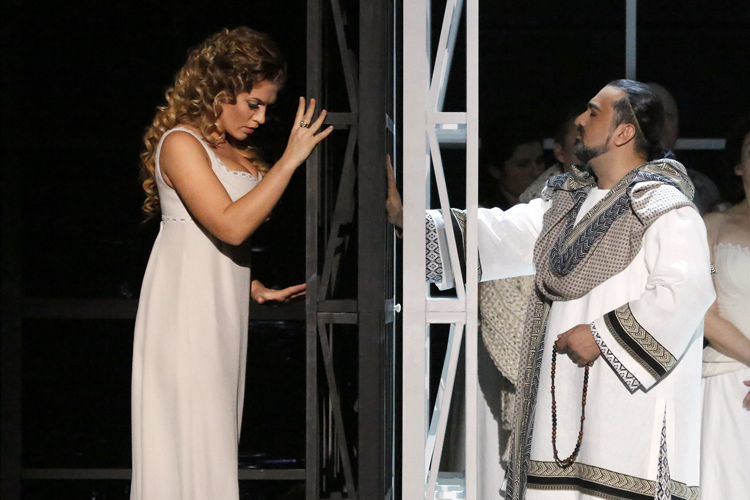
The Bolshoi Theater did not work out with dramatic directors, on whom the director of Urin took the course. The next experience after the Carmen Alexei Borodin on the main stage is “Joland” by Sergei Zhenovach, another opera debut of a respected and deserved person. And again this cannot be called success.
“Iolanta” is a small opera, so it is usually given along with something else one-act. For example, in the Madrid production of Sellars/Kurentsis, originally expected in Moscow, it was connected with Persephone Stravinsky. Tchaikovsky himself conceived it and wrote almost simultaneously with the “Nutcracker” ballet. It is such a couple that these two works will soon go to the Paris Opera in the performance of Chernyakov (he is a director and opera and ballet - with five choreographers).
The Bolshoi Theater and director Zhenovach came up with a formally similar option - “Iolante” is preceded by a symphonic suite from the “Nutcracker”, not separated by the intermission, but positioned as the beginning of the story about a blind girl. It is played by an orchestra in a pit, with an open curtain. On stage for the whole evening, the decoration of Alexander Borovsky has already been installed, not implying any discrepancies: on the left is dark, light on the right. In the darkness, among the black orchestral puppro -orchestrals established there, the purpose of which does not clarify until the end of the performance, the main character lives alone. There, without words, singing and plot, until the “Nutcracker” plunders, she needs to hold out a decent time, about half an hour. This is not easy and completely uninteresting. She wishes back and forth, sometimes wringing her hands. With each new ballet hit, the failure of the idea is found. The audience is confused. Because it is generally not clear what is happening, clap or not. It seems that the music is familiar, and the New Year is soon, but they do not dance. It should be noted that the anticipation of listener reactions and manipulation of applause - especially when it comes to superchrestomatic music, about this scene and this public - is also included in the competence of the director.
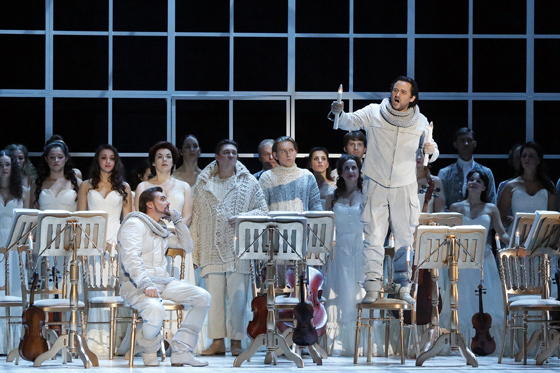 © Damir Yusupov / Bolshoi Theater
Perhaps, Vladimir Fedoseev would have created any miracle, on whom the Bolshoi Theater was bet on, but the maestro-patriarch came from a distance a week before the premiere , instead of him a remote control is a young Anton Grishanin, who has an orchestra with an intelligently, discreet, with some kind of vintage aroma, but clearly not provoking enthusiasm.
When the opera finally begins, the white half of the scene is filled not very convincing immoral: Iolanda’s friends diligently have fun, drink champagne, are on the knees of Mimans with musical instruments in their hands and demonstrate in every possible way they are tired of their dreary neighbor. Actually, the directorial activity on this is quite unexpected and ends, the playful orchestraants disappear forever, the girls settle down, the nurse of Marta, as if nothing had happened, returns to their husband Bertrand, and the performance turns into a concert with some hint of a conditional theater. There are so few further events in it that there is time to think about everyone. For example, why should the vodemone climb into a chair with two candles in his hands or where should he finally put the bottle given by Iolanta, with which he looks so funny during singing? Why are women barely dressed, and men in sweaters of rough knitting? Both love and medical stories are in almost completely contactless way. However, Vodemon nevertheless enters half of the Joland and gives her flowers. The final insight is accompanied by a white back, against which there is a piece of blackness with no -fitting remote controls. As the saying goes, everything ended well, but the sediment remained.
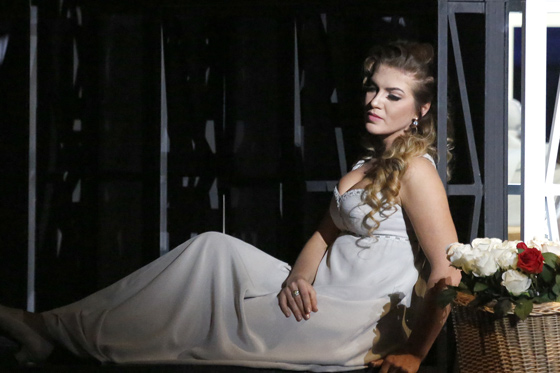 © Damir Yusupov / Bolshoi Theater
The feeling of perplexity remains in the hall to the very end, affecting the uncertain claps after the arias, although the composition of soloists (and not one) is just the strength of these products. Iolanda is good in performing the artist of the youth opera program of Ekaterina Morozova, her failed groom Robert (Igor Golovatenko) is generally a gift, the groom, the groom, Odemon (Oleg Dolgov) showed a dubious piano on the upper notes, but the rest was well done, held the old -born of the theater Vyacheslav Pocchapsky as King Rene. But the question that hung in the air remained unanswered. What, in fact, did they want to tell us? The fairy tale for the children's viewing of "Iolanta" has already ceased to be. But she never became an adult statement.