
Translated material
Mitap "Internet of things vs. Internet people ": Materials of the meeting
On October 29, with the support of Mail.ru Group, Mitap with Marina Shilina was held on the theme of “Internet of things vs. Internet people ".
Marina Shilina is a practitioner and a theoretician in the field of communications, Doctor of Philology, Associate Professor of the Department of Integrated Communications of the Faculty of Communications, Media and the Design of the Higher School of Economics (Higher School of Economics), teacher of Moscow State University and St. Petersburg State University, reads Internet communication courses in Russia and abroad. Laureate of the National Prize in the Development of Public Relations "Silver Archer", diploma of the Proba-Ipra Golden Awards.
Share this news with your friends
A little statistics
Futurologist Dave Evans in the report “Internet of things: how our whole life will change on the next round of development of the World Wide Web” quotes the following data:
“In 2003, about 6.3 billion people lived on our planet, and 500 million devices were connected to the Internet. Having divided the number of connected devices into the population of the globe, we will see that each person then had 0.08 of this device. Thus, in accordance with the definition of Cisco IBSG, in 2003 there were no Internet things yet. Smartphones at that time only appeared on the market. In 2010, as a result of the rapid spread of smartphones and tablet computers, the number of connected devices increased to 12.5 billion, while the population of the Earth amounted to 6.8 billion people. Thus, for the first time in history, each person has more than one connected device (1.84 devices per capita).
According to these data, a person loses with a significant lag in the battle between the Internet and the Internet of things. Before answering the question of where all this will lead us, we will decide on the concepts.
What are Internet humanities and Internet news?
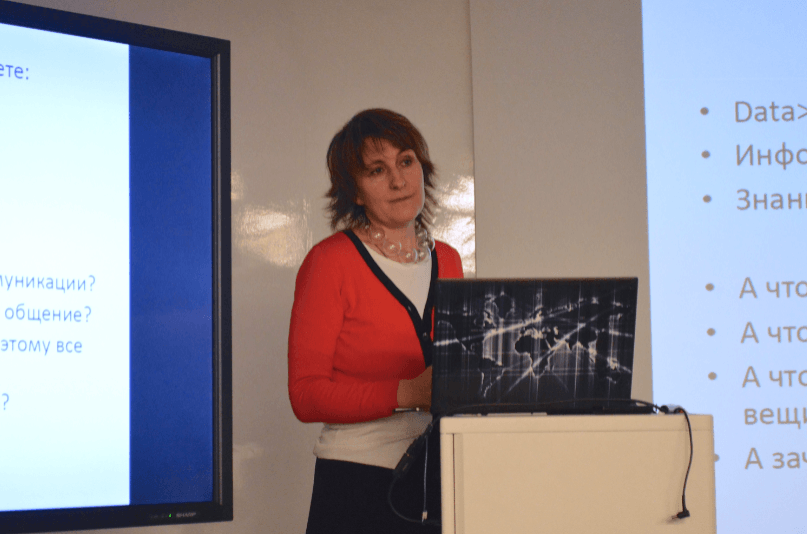
The Internet in the usual sense is a system of combined computer networks for storing and transmitting information. The Internet is a space that people created for people in order to communicate (determining Marina Shilina ).
The term “Internet of things” was first used at the Massachusetts Institute of Technology (MIT) to refer to a network of objects connected to the Internet.
On the Internet of things, each object is equipped with sensors that accumulate data. After that, the network broadcasts data to the data centers. Spheres of application of information received today are extensive: healthcare, industrial Internet of things, telecommunications, the concepts of the Smart City and Smart House.
The best projects - 2015 in the IOT field (Internet)
- The Array of Things project is a touch module, which is installed on the streets to collect information about noise, air pollution and traffic.
- The Smart Citizen Project project is a similar project for environmental monitoring (1 platform, 1203 devices, 6 thousand sensors).
- The “ThingSeeone” project is a device that allows you to collect data from things connected to it.
- Device : Hiku . As developers write, “:“ Hiku lives in the kitchen, recognizes your voice and makes a list of purchases. ”
- The WeatherCloud project is a program that collects information about weather conditions.
- The Oxford Flood Network project is a project that collects data on the water level in rivers to prevent floods near Oxford.
- The TADO AC project is a device that controls the temperature and humidity in the room.
- The SIGFOX project is a mobile operator for smart things that transfers data to the connected objects and from them with a radius of action up to 40 km in open areas.
According to forecasts, after 10 years, an industrial Internet of things will take a leading place, and health care and the Internet will take the last positions.
This means that today's developments about the drones that save a person’s life will occupy a narrow market segment and will not be able to compare with the industrial Internet of things.
On the scale of the industrial Internet of things
The key concept of the industrial Internet of things is called "Enterprise 4.0". Version 4.0 is considered as another technological breakthrough of the industrial revolution, where automation processes completely replace people.
In 2011, at the annual Hanover Fair, Germany for the first time stated that she sets itself a goal by 2030 to make all enterprises 4.0. Today, the German Siemens factory is working on this principle. Changes in the business process of the enterprise led to the emergence of a new management model, where the main object of sale is not the product, but the service.
As a result of such changes, small enterprises are forced to follow the same logic or leave the market.
And what will remain with the person?
Against the background of all technological changes, a person has not physically changed in any way. However, new devices can significantly change our lives.
David Rowe (one of the heroes of the video) draws analogies between the Internet of things and children's dreams:
“This suggests that everything that is invented now is connected with old thinking. With the new one - nothing. We realize what happened, but not what it became. The lifestyle is changing, but the person is not. Why on M technology? I cannot be in 10 dresses at the same time and live in three smart houses. The Internet of things is a continuation of economic history. We say that more information appears, but is there more knowledge? It is still unclear. "
Marina Shilina
Presentation of Marina Shilina