
Translated material
The military field budget
On November 13, the State Duma will consider the draft federal budget for 2016 in the first reading. It is unlikely that the deputies will be happy: the preparation of the document has become a difficult test for lobbyists, the state economy pie is significantly reduced. Defense expenses are growing (after Ukraine and Syria, it would be more correct to call their expenses for the attack) and government. Secret expenses are increasing. Human capital expenses fall
As it was
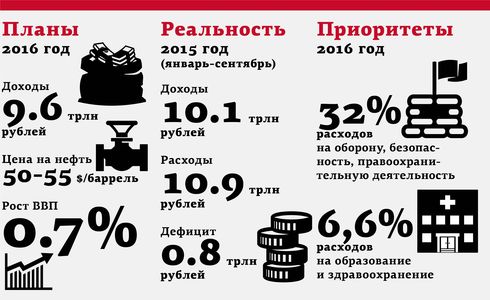
The federations and regions are becoming increasingly difficult to reduce expenses. This year, the economy, according to the Ministry of Economic Development, will fall by 3.9%. In the federal budget, the hole formed by reducing economic activity and reducing the price of a barrel is partially compensated by the ruble devaluation: 44% of its income is oil and gas. Regional budgets have no foreign exchange compensation. To understand what will happen to the budgets in 2016, you need to look at this year. For its first nine months, the income reached 10.1 trillion rubles, and the costs - 10.9 trillion. Deficiency - 0.8 trillion rubles, almost 1.5% of GDP. It could be worse. The deficit could be higher: expenses for 9 months were funded by 72% of the annual plan, and 81% of annual appointments were collected.
The main applicant for additional money, if income exceeds the planned level, is the Ministry of Internal Affairs
Incidental income-2015-a consequence of the sequestra of the budget in April of this year. Officials laid the worst scenario into the budget: despite the inflation, the budget-2015 revenues were supposed to be 2 trillion rubles in the April scenario. lower than in 2014. Of course, this did not happen. October amendments increase income level to 13.25 trillion, but in reality the budget will collect about 14 trillion.
In the structure of expenses, the main beneficiary of the budget-2015 was defense: the expenses for it over the past year increased from 3.5 % to 4.5 % of GDP. Speaks on education and medicine decreased. This course will continue in 2016.
How will it be
The income planned for 2016 below those that were (and more) were received in 2015, by about 0.5 trillion. At the same time, the government assures that the peak of the economic recession has been passed, and (in the basic version of the forecast) it will wait for oil to cost $ 50–55 per barrel, and GDP will grow by 0.7%. Of course, everything can be much worse, approximately at the level of the pessimistic forecast of the government - oil at $ 40 per barrel. Naturally, with this option, we will not see any GDP growth, and budget revenues, even in nominal terms, may be lower than in 2015.
However, the main scenario of the budget is by no means for the worst case. And in the script of the stable oil price and low GDP growth, nominal income-2016 cannot be lower than this year.
The Ministry of Finance Game in the almost annual underestimation of budget revenues is not a bait, but a brutal necessity. If you do not underestimate income for “modest” 5-10%, this money will certainly be “mastered”.
The main applicant for additional money, if the income exceeds the planned level, is the Ministry of Internal Affairs. The financing of the department was reduced by about 100 billion rubles, he will have to reduce 110 thousand employees, there are not enough gasoline for patrol trips, they stopped paying bonuses, and the line for housing subsidies stretched for a century. The reduction of the police forces many departments that need regular protection, to start their departmental security systems. In general, the amount of budget expenditures does not change due to this. If, for example, the Ministry of Culture ensures the protection of its facilities as part of the funding allocated to it, it simply finds money for security and allows less with museums.
Despite the panic declarations of officials, reserve money in reality is practically not spent. On January 1 of this year, the reserve fund was 4945 billion rubles, and 4388 billion (both funds invested in foreign exchange assets increased in ruble dimension due to devaluation) in the welfare fund (FNB). For the nine months of this year, 900 billion rubles were taken to cover the budget deficit from the reserve fund, but in ruble expression more than two thirds of this amount compensated for the devaluation, and on October 1 there were again 4670 billion rubles in the fund. Part of the FNB funds was placed in the papers of companies close to the state financing long investment projects. But the FNB funds have grown thanks to devaluation, and now it has 4879 billion rubles.
As a result, these two funds today are 216 billion rubles. More than it was in early 2015. And this is in the crisis year, when GDP is very falling, and the budget revenues in nominal terms remain at the level of last year. In other words: reserve funds, the exhaustion of which the Ministry of Finance scares annually, is still growing. Another thing is that the FNB funds invested in long infrastructure papers are actually not in it-this money cannot be disposed of in any other way. But this is not an exhaustion of funds of funds, but the result of financing projects that the state indicated. The scenario of the emission financing of the budget deficit, which Sergey Glazyev alcks, has not yet been visible on the horizon.
Priorities-2016
It is highly likely that the 2016th for the budget will not be as difficult as the current year, when the government had to go to a 10 percent sequestration of the budget. Yes, the situation compared to the bread years is quite difficult, but not critical. Revenues and expenses are almost balanced. The price of this is a reduction in expenses for human capital. In 2016, defense and safety expenses are maintained at superhumine level (at the last stage of the budget preparation, defense expenses increased by 170 billion). The oil industry will pay for these costs: at the last moment they decided not to reduce the export fee as much as it was provided for by the “tax maneuver”.
As a result, 32% of budget expenditures are spent on defense, safety and law enforcement, and 6.6% for education and healthcare. The expenses of the state’s functioning have increased: the share of these expenses, according to the Higher School of House, has increased from 6.3% to 7.1–7.2% of the budget expenditures over the past five years, although the salaries of officials and the military are frozen. Over the past five years, defense expenses have increased from 14% to 19–20% of the budget expenditures, and security has decreased slightly (due to the share of the Ministry of Internal Affairs). “Secret” and simply opaque to the analysis of the article of budget expenditures grow. In previous years, they increased due to the rapid growth of expenses on the power unit, and now - due to reserves for supporting industries, social support and humanitarian assistance to residents of other states (120 billion rubles) and “for the implementation of the decisions of the president and government” (342 billion). How these funds will be spent, the draft budget does not report. The public procurement of departments engaged in operational-search activities are also classified.
The costs of science, education and healthcare are reduced. For applied scientific research-almost half, for fundamental research-by 10.6%, for education-by 8.5%, compared with 2015, for health care-by 8%, the Higher School of Enterprise indicates. Higher education costs (in constant prices, with an adjustment for inflation) in 2016 will be 22% lower than in 2012, and for medicine-by 20%. The total expenses of education from budgets of all levels are also reduced (in permanent prices - by 14% against 2012). Another injured recipient of the federal budget-2016-regions: subsidies are reduced by 17.5%, subventions-by 11.5%, inter-budget transfers-by 2.3%.
The federal government burden the regions with all new social obligations, but deprives funds for their implementation. Regions are forced to reduce the expenses discharged on them for preschool and vocational education. In addition, they spend more and more money on duty, reaching 2.1 trillion rubles. Among the losers and pensioners - nominal indexing of pensions by 4% means that in real terms they will decrease by 3-4%. For another year, pension savings are frozen, which allows you to reduce the budget transfer to the Pension Fund. “Solving today's problems, the government increases the long -term risks of the budget system,” says the Institute of Economic Policy. Gaidara.
Budget moshna
The budget still has money for many strange things. Under Rosmolodezh, an analogue of a pioneer organization is created - the Russian movement of schoolchildren with “good -natured”, “combatants” and “volunteers”. The budget allocates 1.2 billion rubles to fulfill the provisions of the GTO law. At the same time, other Rosmolodezh organizations - the International Youth Center, the Russian Center for Civil and Patriotic Education and the Center for Assistance to Youth Entrepreneurship - are sitting without money for business trips and forums. Apparently, not effective enough. Obviously, the very existence of such organizations that continue to pay taxes and salaries proves that a truly crisis has not yet reached Russia. Despite the investigation of theft at the Vostochny cosmodrome, its financing is open - even this year 50 billion rubles will be mastered. The need for such construction was in question before the crisis (why do we need independence from Baikonur?), And now even more so. Investment projects in the Far East - mainly infrastructure - will receive 16 billion rubles.
Nominal indexation of pensions by 4% means that in real terms they will decrease by 3-4%
Taxes for small businesses are increasing. So, a single tax rate on imputed income will grow by almost 16%. During the last crisis, the default, with which this tax is established, has decreased, and now it is growing faster than inflation. Therefore, the number of entrepreneurs working on the UTII system is reduced. A trading fee in Moscow, introduced in 2015, will grow by 15.4%. But Petersburg - the capital of Russian small business - decided for another year to postpone the introduction of a trading fee.
The picture of the priorities of the state lords, which the state budget draws us, is quite clear. The growth of military expenses has stopped, but they are already on the super -high level. The government is ready to sacrifice a socialist, but only so that voters do not feel a strong decrease in income. The expenses for the future - science, education, healthcare, funded pension system went under the knife. The budget reflects a simple fact: the political elite has an extremely narrow planning horizon, and no one thinks about the medium -term future.
Photo: Shutterstock