
Translated material
Great bloody cultural
Fifty years ago, on November 10, 1965, in the Shanghai newspaper Venhway Bao, a devastating article on the playwright played by Khan was published. The newspaper review was a trigger of one of the worst tragedies of the twentieth century
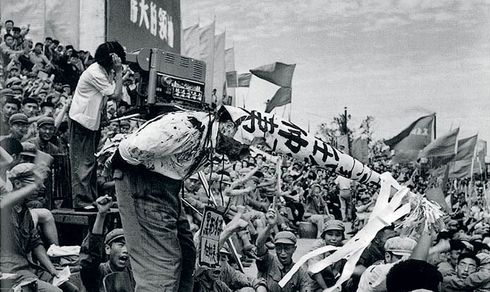
The processes over the "revisionists" were arranged in stadiums and broadcast on television, Harbin, 1966
For the Russian ear, the name of the newspaper sounds funny, like the name of the play - “High the Fighting High”. But the Chinese did not laugh. The criticized historical drama talked about an official who suffered for his honesty and kindness. Suspicious Mao Zedong, chairman of the Chinese Communist Party, decided that Han was hinting at his recent conflict with former comrade -in -arms, Marshal Pan Dahuay, who, a few years before, condemned the crazy policy of the Great Hork, carried out by the great feeder. The angry Mao unclenched and exiled the unlucky marshal.
The “big leap” of 1958-1960 was remembered by home -made blast furnaces, in which the Chinese smelted no suitable cast iron, and popular communes, where millions of peasants forcibly driven into them were killed. The comic peak of the “leap” was the victorious battle of the Chinese people with the “four pods” - sparrows, rats, mosquitoes and flies.
The fifth "bastard" was called the intelligentsia. By the mid-1960s, the line came to her.
The season of murders
Yao Wenyuan, the author of the publication, which laid the foundation for the persecution of the intelligentsia and persecution of culture, was to teach personally a great helmsman. Mao himself considered the day of the publication of the article by the beginning of the "cultural revolution." The bloody drama unfolded after careful preparation.
The extermination of morality, culture and free thought began with universities. On May 25, 1966, Datszybao, a newspaper of large hieroglyphs, or easier - a proclamation, was posted at the University of Beijing. Dazzybao came out unprecedented: not something was exposed in it, but by the University’s party committee, conducting, according to the authors, “a black counter-revolutionary line”. On the same day, the season of persecution and murders of millions of Chinese citizens accused of complication of the “black gang of revisionists”, and the movement of the Khunweibins-the Red Guardians of the Revolution was born, in fact-barbarians and rapists. The Hunweibons brought out the party leadership, Komsomol members, teachers, business executives, spat on them, beaten, beaten into clown cloaks and caps, forced them to repent in imaginary crimes.
Liu Shahoca and Dan Xiaopin had their own views on public administration, and they expressed them. This was enough to cause the hatred of Mao Zedong
The guilt of teachers, for example, consisted in the spread of “bourgeois and feudal culture”, while the students picked up the only source of knowledge about the world - and the students picked up this bright idea with enthusiasm - a small red book with citizens from Mao was supposed to be. Among the Hunweibons there were many illiterate peasant children who, with great difficulty, gave study and who would never have caught up with their peers from the city: to learn by heart the sayings of Mao and ending up education - a task where it is easier.
Khunveibin students were supported by schoolchildren: they conducted the courts over teachers, humiliated them, beat them. In one school, they even trampled a woman-director to death.
Very young children who still had the strength to beat or kill people, arranged courts over cats. Cats were called bandits walking in the bourgeois path, their heads and hung on the trees.
Fire by headquarters
However, in those vague years, not only cats went to the “bourgeois path”. When Mao nominated his famous slogan “Fire by headquarters!”, He had in mind first of all his closest comrades-communists, primarily the then chairman of the PRC Liu Shahocia and Dan Xiaopin*. He called them evil spirits and leaders who go capitalist.
In fact, they only tried to soften the economic radicalism of Mao. Private entrepreneurship was preserved in China. From the Chinese you can still hear: "We have one God - money." Even the great helmsman could not completely destroy the ministers of this god: Liu Shahocia and Dan Xiaopin had his own views on public administration, who did not always coincide with the views of Mao. Moreover, both not only openly expressed their position, but sometimes they showed Mao resistance in the implementation of his plans. This was enough to cause the hatred of Mao Zedong and to incur shaft of frank slander.
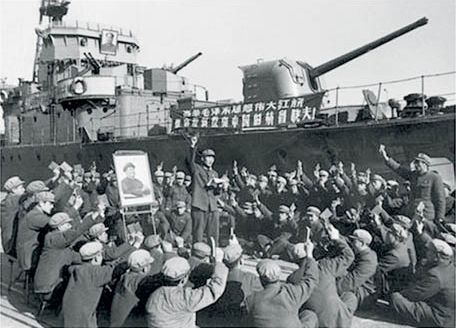
Military sailors study the "quote" Mao, China, March 1968
Sometimes they ask: why did such a cunning campaign need, because the great leader could deal with enemies and easier. But firstly, then in his hands there was still no absolute power, the opposition had a huge weight in the party, and Liu Shaiocius was completely considered the official successor of Mao, their paired portraits hung everywhere. Secondly, Mao was not enough to destroy someone specifically-he had an amazing passion for destruction in general. It is known that he dreamed of a nuclear war in which half of humanity would perish, but the survivors would be true "revolutionary". (He had a nuclear weapon, but, fortunately, there were no missile carriers.) And finally, all this had to be crank up, if possible, without dirty hands. That is why the “hybrid” path of amateur rage of masses was chosen. And for this rage, students were best ready, in which the cult of the personality of Mao was planted for more than one year. (In this context, our own news looks significant - a decree recently signed by Vladimir Putin on the creation of the Russian movement of schoolchildren.)
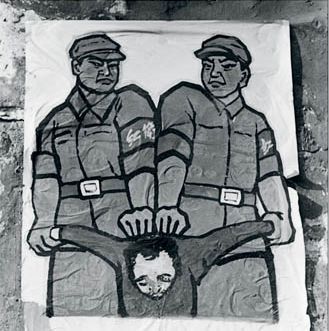
This poster shows how to do with the “enemies of the people”, Beijing, 1966
Pogrom
Gradually, the hunwebins left universities to the city. They smashed the shops of books and grampes. In old books and songs, there was not a word about Mao Zedong - it means that they were “bad”. The hairdressers also fell under the distribution - like the seedlings of a bourgeois lifestyle. It was forbidden to wear long hair, whip coca, combing the hair back, divide it into a parting. Those who had the wrong hairstyles, more precisely, those who simply had hairstyles - caught on the streets, beat, forcibly shaved half of their heads: so that it would continue to be disgraced.
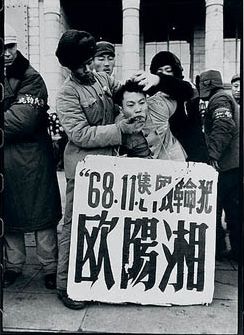
Three days after the arrest of Ouyan Xian, he will be thrown out of the third floor, Harbin, November 30, 1968
The inhabitants confiscated “extra” furniture, objects of luxury and jewelry. Houses and apartments were taken away, people were kicked out to the streets, sent to the “re-education” to the village, where the peasants themselves lived in the shoot. Oncoming streams came from the villages to the cities, the city civilized life was replaced by the archaic village.
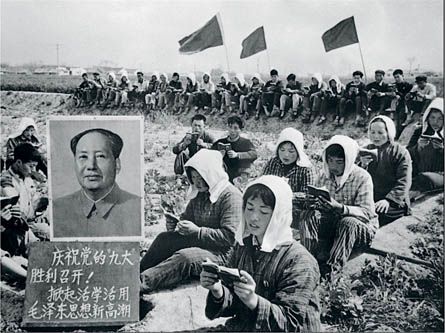
Chinese peasants read the "quote" Mao next to the portrait of the leader, County Hunchun, May 1969
The Hunweibons went home to honored cultural figures, dragged them to the streets, beat, shook, demanded repentance. Among the victims of Hunweibin was the famous Chinese writer Lao Shee. His library was burned, he himself was dragged out into the street, beaten to half to death. The old writer could not stand the bullying and drowned.
Even hairdressers fell under the distribution - like the seedlings of a bourgeois lifestyle. It was forbidden to wear long hair, whip coca, combing your hair back, divide it into a parting
In general, in those days there were a lot of suicides: in vain accused, people could not withstand fear, shame and pain. The son of Dan Xiaopin, a student Dan Pufan, also jumped out of the window, but did not die, but broke the spine and remained disabled for life.
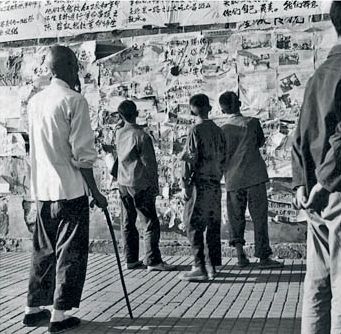
Chinese students read Datszybao with the slogans of the "Great Proletarian Cultural Revolution", Beijing, August 1966
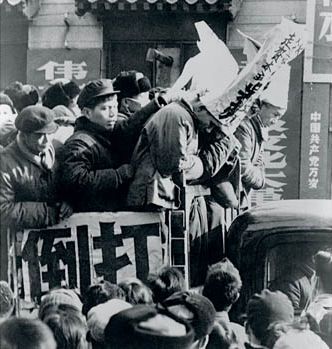
The Junwebins put the joke caps on their victims and humiliated the crowd, Beijing, the end of the 1960s
The party leadership, the opposition Mao Zedong, tried to soften the harm from the activities of the Hunweibons. The so -called working groups on the “cultural revolution” were sent to universities from the district committees. However, many hunveibins met them with hostility: they did not like the peaceful mood of working groups. They entered into a fight with them, said that they were subordinate only to the highest instructions - the words of Mao. One of them - not to suppress violence - was given to them by the army and police.
The closest assistant to MAO Marshal Lin Biao said then: “Well, they killed people in Xinjiang: they killed or by mistake - there are still not so many. They also killed other places in Nanjing and, but still, less died than dies in one battle ... ”It sounds shocking, but Mao himself in 1957 in Moscow publicly stated that to win the revolution was ready to sacrifice three hundred millions of Chinese.
Cultural workers of the revolution
From Beijing, the Hunweibons went to the province - “expose the black party committees” and “restore order”, judge and pronounce sentences to local communists and cultural workers. In some places they succeeded, in some places-no. The Communists organized workers who became defense, beat them, and sometimes killed the Hunweibons, sending their bodies on the same trains on which they arrived. So it was in the cities of Hafei, Changha, Sian and other provincial cities. The corpses of hunveibins were often brought in terrible form: with broken skulls, broken limbs, cut ears and groaned eyes. But it did not stop anyone. In many cities, chaos and anger reigned, the Junweibins detachments fought among themselves, ordinary inhabitants turned out to be between a hammer and a gravity.
Zaophani - rebels joined the hunwebbins. They were engaged in the same thing as the hunwebins, only in factories, enterprises and in offices. Every month, the situation was getting worse, the management of entire provinces was paralyzed. Finally, the army gave the order to restore order. Some of the Junweibins and Zaophane returned to universities and factories, some did not obey the decision of Mao. Intoxicated by blood and permissiveness, young people demanded the continuation of the banquet. With such a conversation was short: the army smashed their gangs, the most stubbornly publicly shot, the rest were referred to inaccessible areas.
After that, the cultural revolution did not stop, it simply entered a calmer phase. For several years, only the books of Mao came out of the printing houses, and only the performances were made personally by Jiang Qing, the wife of a great helmsman personally.
On ruins
The cultural revolution, one of the most difficult tests for China in the 20th century, ended with the death of Mao in 1976. Its results: a million dead, 100 million victims, suppression of science, the collapse of education, irreparable culture damage, and updating the worst human properties among the people. China was thrown back for decades ago and still could not recover from the blow: the so -called economic prosperity is the visible part of the iceberg, it affected mainly residents of large cities. Yes, in the villages they no longer die of hunger, but so far many people live in poverty: more than 100 million people live less than $ 1 per day. The Chinese themselves compare their economy with an elephant on a bicycle - so as not to collapse, you need to pedal very quickly. And these pedals are spinning largely due to the use of cheap manual labor in factories and factories.
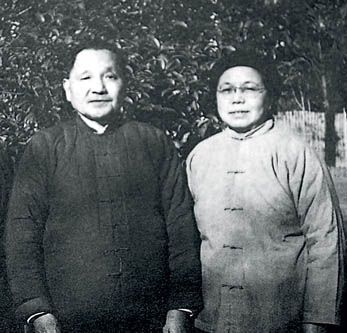
Dan Xiaopin and his wife during the Cultural Revolution sent to work at the Tractor Plant, Jiangsey Province, 1969
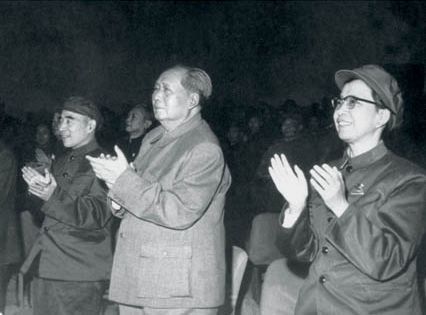
Mao Zedong (in the center) with one of the ideologists of the “Cultural Revolution” Lin Biao (left) and with her third wife Jiang Qing, who personally organized the Khunveibin units, Beijing, April 1967
The closest assistant MAO Marshal Lin Biao said then: “Well, they killed people in Xinjiang: they killed or by mistake - there are still not so many”
In Chinese society, a traditionally respectful attitude to education has replaced the dismissive, which is still felt. (Once in Beijing, a random passerby asked us with his wife what we are trading. “Nothing,” we answered. “We are teachers.” “I see, there is no talent,” the Chinese spat contemptuously. And this one was still from the enlightened, he knew the Russian language and once worked as an engineer at the Soviet factory.) The average Chinese is not only interested in the outside world, but also despises him, but also despises him, but also despises him about foreigners in foreigners in foreigners in foreigners in foreigners. The country is told by wild fables. Vera - whether it be Buddhist, Taoist or any other - now understands as a simple agreement with deities: I am to you - offerings, you are a good life to me. Even the classic concept of shame - the so -called “loss of faces” - is now interpreted completely differently. The face is not lost by the one who has done something obscene, but the one who is scolded is not important or not.
“It is very difficult to be a Chinese,” a taxi driver in Beijing once told me, sighing me. Really hard. And a “cultural revolution” played a significant role in this, undermining the worldview and civilizational foundation of the country with great ancient culture.
Alexey Vinokurov - author, writer, television center, editor -in -chief of the whole China.ru website. * Dan Xiaopin (1904–1997) - politician and reformer, leader of the Communist Party of China. Without occupying a leading state post, he actually led the PRC from the late 1970s to the early 1990s. During the cultural revolution, he was removed from all posts and sent to a simple worker at the Tractor Plant in the province of Jiangsey.
Photo: Li Zhensheng/Contact Press Images, East News/AFP; [Email Protected] , East News; Ho/AFP, Xinhua/AFP