
Translated material
Saga about Queens
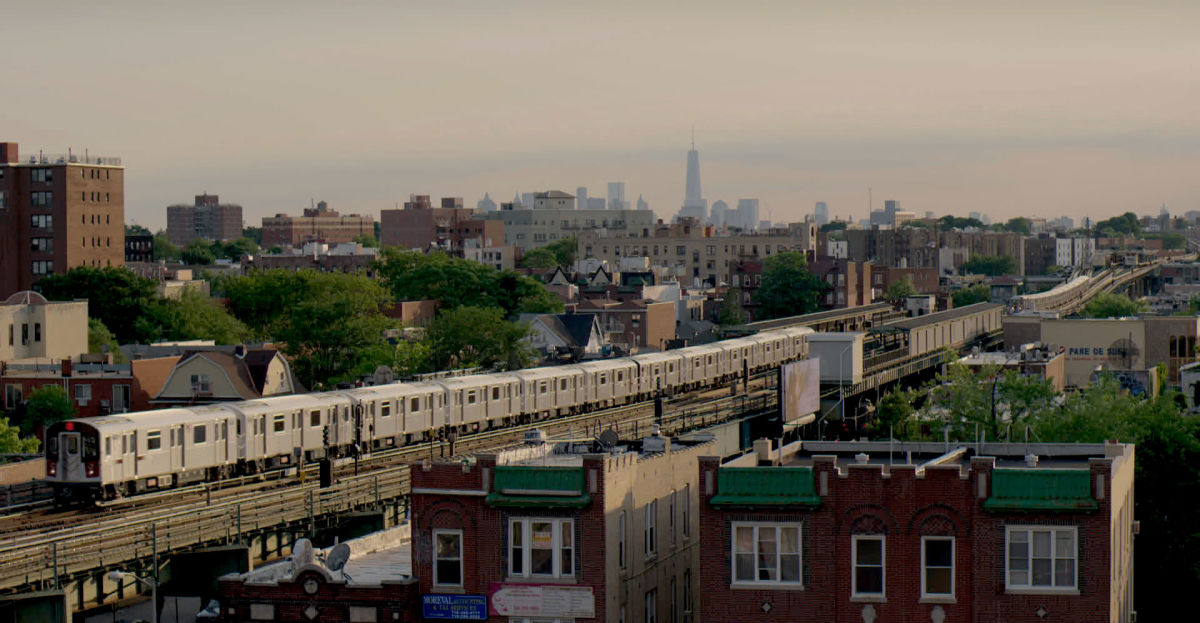
Cinema Continence with Andrei Zadansky
Alexander Genis: Today, the host of our film, Andrei Zagdansky, we are discussing the film of the classic of American documentaries Fred Vaizman, dedicated to one of the five “Boers” of New York - Quinse, the area where many of our compatriots live and which was remarkably described, who lived here Sergey Dovlatov.
Andrei Zadansky: 'In Jackson Heights' - This is the name of the film by the American classic of documentary cinema Fred Vaizman. This is the 40th Vyeman film, about his 39th film "National Gallery" we spoke no further than in March of this year. I then admitted that I envied Vaizman terribly, and I would like to do something like that - very limited in space, like a museum, and infinite in art. This is a wonderful film.
Alexander Genis: A production novel about the eternal.
Andrey Zadansky: Like Haley's Airport, only in the museum.
Alexander Genis: The contents are different.
Andrei Zadansky: It will be better, especially when it comes to the English National Gallery. Like the previous film by Vaizman, this one goes for more than three hours: 190 minutes is a matter. It seems to me that Vaizman firmly decided to refute the concept of Hitchcock, that the maximum duration of the film is determined by the comfort of the viewer’s bladder. 190 minutes will seem to many excessive, but not for the film by Vaizman. This timing is thought out and felt by the author. Your choice is either to accept such a time frame, or not to go to Vaizman's films. In this duration there is a thorough tread of the classic. At that moment, when you overcome the inevitable boredom, and this is inevitable when the film goes 190 minutes, at some point you begin to lose the thread, but after that it becomes interesting differently. He has quite large episodes, they are often more detailed, more thorough than it happens in documentary cinema, he gives more details, more words, more details, large pieces of communication between people, when you will begin to peer, listen at a different level, with some sixth sense, you begin to comprehend these people.
Alexander Genis: So what does he make us peer into?
Andrey Zadansky: We will talk about the content. The film "In Jackson Hits"-talks about the area in New York, or rather, this is part of the Queens. The remarkable, most important detail of Jackson Haits, which is widely known in New York that this is the most ethnically diverse settlement in New York.
Alexander Genis: I have numbers: in Jackson Haits they speak 167 languages. By the way, this is not a record, because Jackson-Haits is just a part of Queens, which speak more than 200 languages. Recently, linguists, experts in the rarest languages prefer not to go somewhere to Africa or Asia, but get to the metro to Queens, because there you can find a native speaker of any language in the world.
Andrey Zagdansky: And eat good.
Alexander Genis: Especially if you get into the desired ethnic pocket, as is often the case with me, because I go there to the area called Little Bombay, where they are preparing a wonderful Indian food. This is the only place in New York, where Betel is sold on the street, and there are red spit from Betel everywhere. This is a very exotic place, which, I must say, is not characteristic of the whole Quincene, because the Queens of Manhattan is the most boring area, it is very monotonous and monotonous, despite the fact that the whole planet is presented there.
Andrey Zadansky: Natives of India are secondary in this picture. In the first place in Vaizman's emigrants from Latin American countries. This is the largest and fastest growing community of Jackson-Haits community. But there are Muslims there, there is also an aging Jewish community.
Alexander Genis: There is a Russian community.
Andrey Zadansky: There is no Vaizman in the film.
Alexander Genis: And there is a Jackson-highs, I know for sure.
Andrei Zadansky: There is also a community of sexual minorities, which are given a lot of attention in the film. There is also a Colombian community, because during the filming of the film the World Cup takes place, and we look at the bar how the Colombians rejoice when their team wins.
Alexander Genis: This is a characteristic detail for Queens. There are bars of all peoples and it is customary to watch football during the World Cup in the bar of the country that plays football. I remember that during the European Championship I came there and say: where you have a Latvian bar, I will root for Latvia (she then played with Germany). They told me: go to the Brazilian bar, they are ahead of everyone.
Andrei Zadansky: We see how the Colombians celebrate victory, arrest someone, the police lead people in Columbian national T-shirts. The film has a lot of funny and a lot of serious. Vaizman removes the interweaving of many ethnic groups, showing how they are all interconnected. Thus, the fabric of life and the region and New York are formed.
One episode. A group of psychological support of sexual minorities is sitting. They meet in the Jewish community community in Jackson Haits. It is about whether to stay here or leave from here whether to continue to rent a premises from this Jewish group or not. And then one of them says to them: you know, this is an aging Jewish community, there are few of them. We count on them, they help us, and we help them. If we leave, we stop paying the rent, it will be worse and it will be worse for us, we must stay with them, we need each other. This, by the way, is a fundamental combination of fabric - people are necessary for each other, their ability to interact, help each other, cooperate in this complex big city life is the most important condition for the survival of each group separately.
Alexander Genis: You know, this is called America. I always struck me, like the peoples who, in the Old World, I can’t live with each other, the most beautifully coexist in the new one. Not far from my town there is a area where many Armenians live and many Turks live. Here they go to one store and buy the same basket. And in another town, also next to me, full of emigrants from the former Yugoslavia. Just during the terrible Yugoslav wars, they all played in the same football team.
Queens is really a symbol of the fabric that you are talking about, this is the carpet from which America is woven .. Imagine that in common between Hindu, Orthodox Jew, Russian atheist and Colombian emigrant? They all have universal needs: a safe area, affordable housing, a decent school and a lot of greenery. All of them came voluntarily to America, they all live here, because they themselves chose this path. And so they managed to create a unique community. This is the prototype of planetary civilization, collected in this seems to be boring, monotonous quincse.
Andrei Zagdansky: In this seemingly boring monotonous film, Fred Weizman connects serious, deep, tedious, I emphasize - tedious, with ridiculous. He can remove a ridiculous episode when a fluent speaker, I suppose, Arab gives a taxi driving lessons to immigrants from India. He speaks with them in English and finds insanely ridiculous advice on how to remember the card. The North is the nose, he shows them, the letter "n", and the south is shoes, shoes.
And then the director goes into the Jewish community. There is a memorial service for the victims of the Holocaust. In this synagogue, no one but the elderly, many over 70, some - for 80. The old man holds the Torah, it is very difficult for him to keep her. We understand that this is really a passing world, they disappear from here. Maybe they exist and can gather their prayer only because it is a society of sexual minorities that rents a premises for their meetings or Latin American people who rent another room where the meetings of the legal assistance group take place.
Alexander Genis: When at the beginning of the twentieth century giant emigration fell into America, there were art courses to be an American. It was believed that every emigrant must forget his native language and turn into an American. The American is a new nationality that should consist of these emigrants. I still found people of the old training who said: but a year later, two of you and your wife will speak English in English that this never happened. Everyone remembers the metaphor of the melting boiler, which, of course, was central to America. But for a long time, instead of a melting boiler, a mosaic appeared, a patchwork blanket of America, which allows you to be immediately both an American and those who you are is not necessary to abandon one for another. And in this, in my opinion, the secret of a happy quints.
Andrei Zadansky: Probably, here you need to put a large question mark. They say that in New York all ethnic groups merge, turn into something one, new-into America. Such multiculturalism in Europe, apparently, does not work very much. We see what complex friction inside different ethnic groups in Europe is a big problem, which, unfortunately, can only become more tomorrow. In America, it seems to me, it can be because I live here, people really turn into something one, remaining completely different. About this, in fact, is the picture of Fred Vaizman.