
Translated material
Holy and inviolable
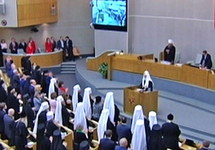
The State Duma adopted in the second and third, final, readings to amend the law on extremist activity prohibiting the search for extremism in the sacred texts of Christianity, Islam, Judaism and Buddhism. Information about the adoption of the law is contained in the document card on the website of the lower house.
The amendment was made to the State Duma on October 14 by Vladimir Putin . She says: "The Bible, the Qur'an, Tanya and Ganjur, their content and quotes from them cannot be recognized as extremist materials."
At the same time, Ganjur (more correctly Kangur) is a Tibetan Buddhist canon. It is Tibetan Buddhism, also called tantric Buddhism or Vajrayana, who is the traditional religion of the indigenous peoples of Russia - Kalmyks, Buryat and Tuvans. Meanwhile, the Pali canon (Tititaka), recognized by the direction of the Theravada, like Sanya Zan, is his Chinese translation, which is the fundamental for Mahayana Buddhism, - accepted by the correction of extremism is not guaranteed.
In the first half of September, a scandal erupted in connection with the decision of the South Sakhalin City Court on the recognition of the extremist series of the verses of the Koran. The head of Chechnya, Ramzan Kadyrov, called the judge Natalia Perechenko, who issued the relevant decision, and the prosecutor Tatyana Bilobrovets, by whose submission the decision was made, "national traitors and shaitans" and threatened them with reprisals. He later filed an appeal to the regional court to the decision of Perchenko. On November 5, this decision was canceled .
On September 30, a group of deputies of all the State Duma factions introduced a bill to the Lower Chamber, involving the transfer of proceedings on the ban on publications for extremismfrom the competence of regional courts to maintain court courts . As one of the authors of the document explained, Zhirinovets Yaroslav Nilov, the impulse to the development of the law was just a scandal around Perechenko’s decision. In order to avoid such situations, Zhirinovets noted, highly qualified experts should be involved in the proceedings, and this, according to him, "can be more optimally provided in megacities and regional centers."
Meanwhile, at the end of September, Roskomnadzor banned Russian translations of several texts of the Pali canon . The officials did not see extremism in these texts, and the cause of the ban was called the propaganda of the suicide allegedly contained in them.