
Translated material
Drivers of heavy vehicles protest against the collection for travel
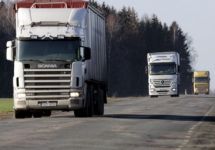
In the Belgorod region, drivers of 150 heavy vehicles partially blocked the Moscow -Crimea route, protesting against the introduction of a federal highway, TASS reports . They remained free for traffic in each line in each direction.
Truckers threaten to stop working from November 15, the day of introduction of the fee. "Our main requirement is to cancel the collection in the amount of 3.5 rubles introduced by the Government for trucks weighing 12 tons per 1 km along federal highways. Today we have gathered more than 150 Belgorod drivers, and this is only 30 percent of those who really suffer from the innovation of the government only in our region," said the coordinator of the shares in the Belgorod region Sergey Korotkov.
The Platon board of charging the board itself was not tested, Korotkov noted. At the slightest problem, drivers are threatened with huge fines by their standards. In addition, drivers have not yet been given devices by which the authorities intend to control the movement of trucks.
The action takes place in other regions. Over 300 Novosibirsk truckers occupied both roadsides on the R-254 federal highway near Novosibirsk. Cars stretched more than a kilometer. The action took place without incident. The order was ensured by the traffic police. However, the department refused to comment on the situation. In addition, truckers protested in the suburbs, Krasnoyarsk, Tomsk, Kaluga.
In most regions, the police do not interfere. However, in the Rostov region, police and riot police tried to force the participants in the action to stop it. However, drivers said they were going to discuss their problems and did not violate anything. The action, in which the drivers of 15 trucks participated, ended according to plan and without detention.
In the Chelyabinsk region, employees of the Center "E" detained the legal adviser of the action Kirill Kartashkov and the organizer of the single picket. According to Kartashkov, provocateurs joined the action, which deliberately violated the rules of picket. The detainees give explanations in the police. In addition, in the Volgograd region, police detained five participants in the action. They seized their rights and check the documents. The reasons for the detention of traffic police officers do not.
Meanwhile, Deputy Minister of Transport Yevgeny Dietrich said that fines for unpaid travel on federal highways from November 15 will be charged only in the Moscow region. "The fee is introduced throughout the country. It was decided that from the moment the system is launched, the fines for non -failure will be charged only in the Moscow Region," the deputy minister said. - On the roads of the whole of the Russian Federation, fines will be charged only from May 1, 2016. The operator of the RT-Invest system Transport Systems and the traffic police of the Moscow Region has already tested the control system. In the Moscow region, the control system is completely deployed and from November 15 it will work in combat mode. "
At the same time, on Monday, the government published a decree on a decrease in the collection of to 1.53 rubles. However, since March, the tariff for moving along federal routes for duodeners will be increased to 3.06 rubles. Since 2017, the collection will be 3.73 rubles, as planned earlier.
On November 2, the Interregional Trade Union of Professional Drivers held a warning action . From 12 to 13 o’clock, drivers - members of the organization and those who joined them, hung protest posters on their trucks and moved at a speed of 10 kilometers per hour. The chairman of the trade union, Alexander Kotov, said that on November 11, if the collection is not canceled, an unlimited action will be launched, during which at least 200 trucks will block federal highways in the Moscow region. The action will be held in other regions.
For non -payment of the collection in the Code of Administrative Offenses, fines are provided: 5 thousand rubles for drivers, 40 thousand for officials and individual entrepreneurs, 450 thousand for organizations. With repeated prosecution, fines grow up to 50 thousand rubles, respectively, for officials and individual entrepreneurs and up to 1 million for organizations.
According to Kotov, the Plato system creates insurmountable difficulties for carriers. In particular, the driver, having arrived at the destination, is obliged to return to the sending point of the same road. “And if, for example, you need to call in Krasnodar after unloading in Chelyabinsk so as not to go empty, then you must return to the starting point of the route - Moscow - and from there go to Krasnodar,” the leader of the trade union explained.