
Translated material
Sail from a falling aircraft
Parachute, catapult and other non -working ideas of inventors
After each plane crash, many people ask the same question: why in the 21st century no one has yet to come up with and has introduced a system of salvation from a falling aircraft. At the request of Medusa, Vladislav Voronin found the most common solutions to this problem and explained what prevents them from applying them.
Parachute capsule
flies through the tail of the plane
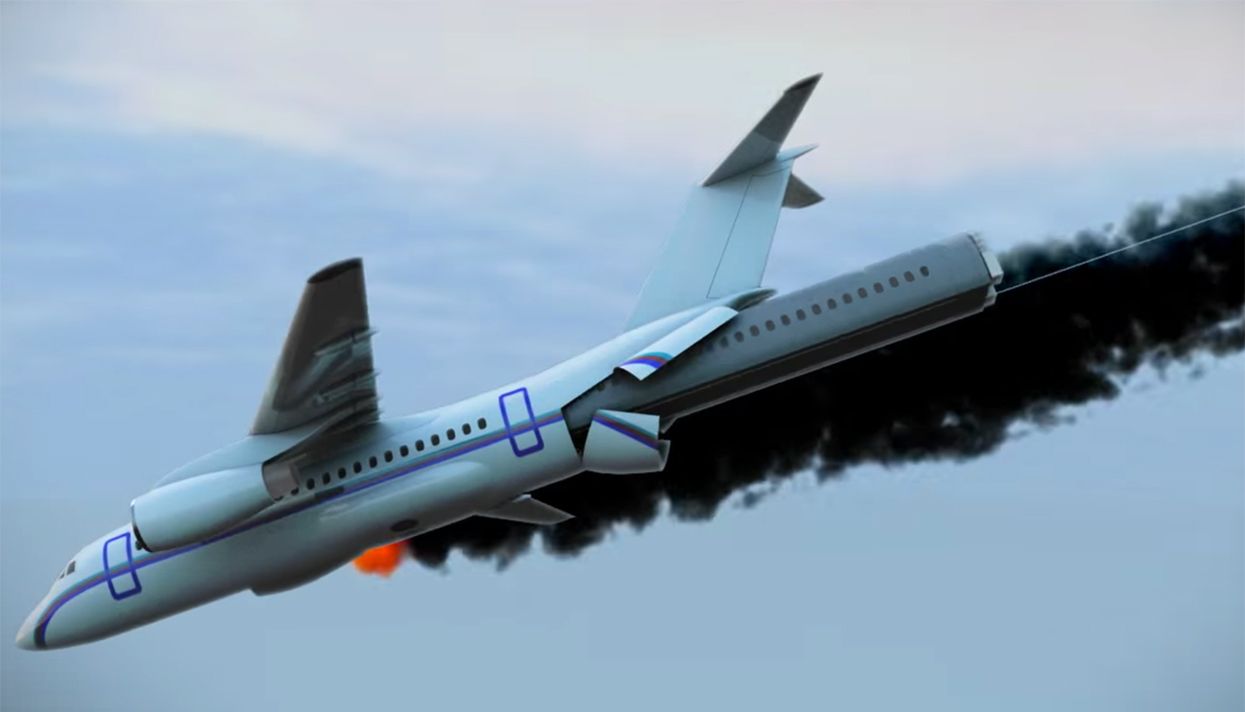
Two years ago, Kiev engineer Vladimir Tatarenko hung a video “Aircraft with a device for salvation” on Yetube. In the video, an ordinary passenger liner suddenly begins to fall due to a fire in the engine, but people do not die-they are saved by a capsule that catapult the entire interior through the tail of the aircraft and then slowly lowers to the ground on parachute. Nobody noticed the video: he did not gain a single comment and even ten thousand views. Popularity came sharply after a plane crash on the Sinai Peninsula, in which 224 people were killed. The STRET FX Motorsport & Graphics community has collected more than 18 million views.
Tatarenko patented his system back in 2010. He worked for most of his life at the Kiev Aviation Plant and was more than once in the commissions to investigate disasters. “This leaves a certain imprint, you begin to think: what is not going in the design of aircraft as we would like? All characteristics are improved, the materials are more modern and durable, some systems have four degrees of protection, but in the accident, this does not give anything, because it is fleeting. There is only one way out - to evacuate everyone, ”the inventor told Medusa.
A capsule with chairs for passengers and crew, according to Tatarenko, should be separated from the fuselage in two to three seconds. First, a special parachute flies out of the tail, which then pulls the capsule itself.
Why this system is not used
Firstly, the capsule cannot be built into existing Boeing and Airbus models that most airlines use. Ideally, for this system, you need to construct new aircraft, and this can take 10-15 years and require huge financial investments. In order for air carriers and the International Civil Aviation Organization (ICAO) to take up such a large -scale project, they must be sure of the reliability of the system. And it is impossible to prove it now.
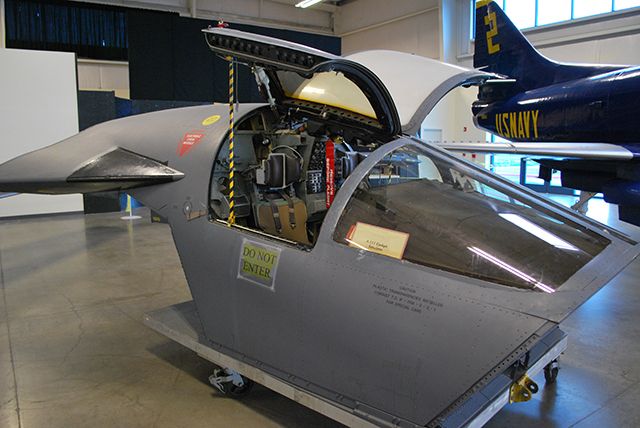
“The Americans, for example, made a similar separated cab on the F-111 military aircraft. But the probability of salvation with such methods was 50 to 50, a maximum of 65 out of 100. This is not enough, ”says Vladimir Popov, Major General and Honored Military pilot of the Russian Federation. - In particular, when installing such a system, the aircraft would become heavier than the tons of five - and how much of the thrust would be required, energy reserves so that everything works as it should? The research was completed. And now the combat aircraft has followed the unambiguous path: a means of salvation is a catapult. ”
The introduction of such a capsule will lead to the fact that the aircraft, designed for 200-300 people, will be able to transport half less, twice as much, while without a hundred percent guarantee of passenger salvation in the event of a disaster.
Parachute
For the whole plane
In 1975, in the United States, a descendant of Russian emigrants Boris Popov fell from a height of 120 meters along with a deltaplane, which suddenly failed. It was possible to survive only thanks to many years of gymnastics: the pilot was grouped in time and prepared for the impact of water.
Five years after that, Popov opened Ballistic Recovery Systems (BRS), which took up the production of parachutes for small aircraft. Already in 1982, the first parachute was released for a light sports aircraft, and a year later the system first saved the life of the pilot in the accident.
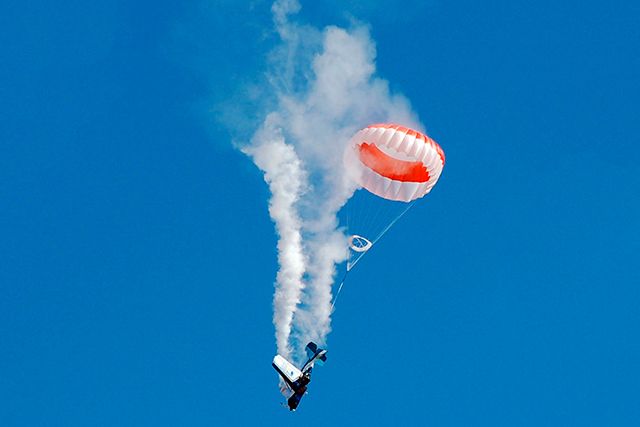
The principle of operation is simple: the system for one second reacts to the emergency of an emergency and quickly throws out a parachute, which gradually reduces the rate of falling aircraft and provides relatively soft landing.
Throughout the history of the existence, BRS sold more than 29 thousand parachute systems to Cirrus, Flight Design and Cessna light aircraft. Thanks to this, as noted in the company, it was possible to save the lives of more than 300 people.
Why this system is not used on large aircraft
Due to the imperfection of materials. Modern parachute fabrics are able to withstand only small aircraft with five to six passengers, now the development of a more strong system for 12-seater aircraft is being developed.
“In order to safely lower the plane to the ground, we must proceed from the formula“ 1 pound of weight - 1 square foot of parachute fabric ”. Suppose to lower the Boeing 747, you need half a million square feet of fabric, for Airbus A320 - about six parachutes, each of which will be the size of a football field, ” said the inventor in an interview with Engineering and Technology Magazine. In this case, either the limit values of the carrying capacity of the aircraft can be exceeded, or the capacity will have to be radically reduced, which will bring losses to airlines.
According to Popov, it is necessary to wait for a fabric that will weigh ten times less than the current ones, but it will be very strong. Then the use of parachutes for large aircraft will be both safe and economically feasible. According to the inventor, only for the creation of such fabrics it takes 5-10 years.
Sealant
Protects passengers from a blow
The most unusual system of salvation of the aircraft was invented by Moldavian Alexander Balan. Neither capsules nor parachutes are used in it - the bottom line is that when an accident and hit on the ground, the plane does not explode , and passengers do not receive serious damage.
A mixture with a classified formula is injected into the kerosene, which turns fuel into a solid substance that resembles sand in structure. Thanks to this, as the Balan says, it is possible to avoid the explosion or fire of kerosene.
The second system is a hybrid substance that is stored in special titanium capsules. Eight seconds before the alleged crash, the system automatically spray this substance, when in contact with the air, its volume increases 416 times in three seconds. As a result, foam in the form of small balls takes a stronger shape, surrounds the passenger and does not allow him to move even with a very strong push or blow. After 30 seconds, the substance again becomes liquid and frees people.
The development of the Balan security system is engaged in ABE SA, which is based in the USA and is trying to attract investments for final tests. The co-founder of the company Tim Anderson notes that when the aircraft falls, the system is able to protect passengers from overloads of 100 G (in the accident of the Formula-1 Bolid, overloads 40 g are found).
“If the plane does not collapse in the air, the system will work optimally. Even if the engines failure, the pilot has a chance to make a relatively safe landing, not with his nose in the ground. In this case, our system can save the lives of passengers and alleviate injuries, ”said Anderson.
Why this system is not used
The invention of Balan was supported by the International Civil Aviation Organization (ICAO), Medusa Anderson told Medusa, so serious experts will follow her tests.
Doubts primarily concern medical indicators - it is not clear what the passengers will breathe when the foam is covered, whether the foam of passengers will fill the foam and so on.

Just a capsule
It itself destroys the plane
Hamid Khalidov, a former adviser to the Presidium of the Dagestan Scientific Center of the Russian Academy of Sciences for invention and innovation, patented another system of capsule salvation of passengers. He came up with his method and drawn in less than two weeks. The first thought came on March 9, 2000, when, during the crash of the Yak-40 aircraft, journalist Artem Borovik died at Sheremetyevo Airport. “I was so respectful about his work that this story hit me very much, and I began to think with my son how to separate the fate of passengers from the fate of the aircraft. There was inspiration, so literally March 23 we went to submit documents for more than 10 patents on this subject, ”says the inventor.
The Khalidov system is that rescue capsules with passengers break out of the aircraft, destroying it.
In 2000, Khalidov asked the Russian government to assist in the production of capsules, but did not receive any answer. He even met with the chief designer of the Tu-334 aircraft, the serial production of which was never launched. According to the inventor, after half an hour of communication, the designer of the Tu-334, who used to be engaged in a soft landing of missile systems, recognized the necessity and usefulness of the capsule method.
Why this system is not used
According to aircraft designers, the method with the destruction of parts of the aircraft is too dangerous due to explosive substances on board, which will install a capsule for departure: detonation can accidentally occur even in case of lightning. In addition, the disadvantages described in the first paragraph (lack of technology, instability of work).
Parachute
for each passenger
This idea comes to mind to everyone who has ever thought about saving passengers from a falling aircraft.
Why this system is not used
Firstly, even to open the door at high altitude, it will take time. First you need to release all the air, depressurize the plane, and only then go to the exit. If the door is shot without depressurization, an explosive decompression will occur, which will lead to the instant death of all passengers.
Just jumping out of the plane will not work. When flying at a speed of about 900 kilometers per hour, he will break the powerful raising air flow. That is why whole rescue mechanisms are installed on military aircraft, which include not only the parachute with the catapultable armchair, but also the oxygen system with the supply of air to the light, protective helmet and individual mechanisms that are fired above the pilot to dissect the runaway air flow.
Vladislav Voronin
Moscow