
Translated material
Black burning square
Why is it pointless to run around the squares with cans
Why is it pointless to run around the squares with cans
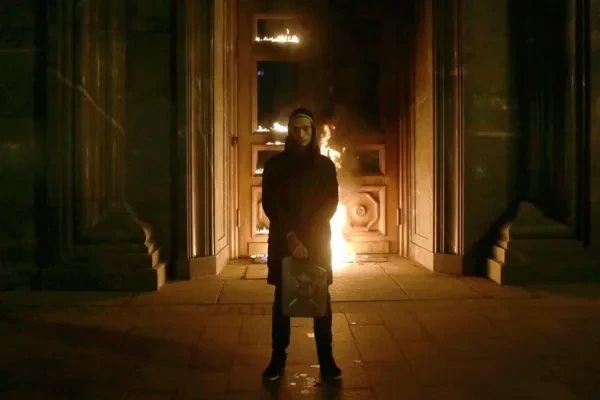
What is the difference between a black square and a black hole? In the same difference between revolutionary art and revolution. The artist of the avant -garde enters the permissible abroad - the first and the only one. Not because he is a “wheel and a screw” of party culture, but because the future speaks through it, and it turns into a speech organ. This speech may be liked, or it can cause indignation and even rage. But this is a real speech, it is impossible to pretend that you did not hear anything. Because before no one said so. And this speech cannot be repeated. Because any repetition for a radical culture is equivalent to vulgarity. A black square is created once and forever; It can be replicated, but it is impossible to come up with it. And the one who is indignantly exclaiming “I can like that too,” funny.
What is the difference between political art and politics? The fact that the first acts through the image and the symbol, turning life into the language of statement. It always looks like a demonstration and never - the instruction. "Do with us, do as us, do better than us!" - This is the name of the Soviet Komsomol program, and not a radical artistic act. And politicism looks at art as an instrument of alternative propaganda. For him, any gesture, any image, any action is important in terms of benefit: looks like a volley of Aurora? On the attack! Hooray! Not like? Why then is your art? The one who sets fire to the FSB doors to create the image of hell - makes hooliganism inseparable from the symbolic image; Anyone who just runs around the squares with a canister is only a bully and no one else.
Finally, what is the similarity between the action of Pavlensky and the famous, forever prescribed in history, by entering Red Square in 1968? The fact that the heroes and heroines of our 1968 also demonstrated: personally we are ready. But no one was called anywhere. They acted freely, they showed that another life is possible; They gave a new vector, but did not provoke anyone to repetition. They provoked to another - to reflection. It was the reflection on their act that became for many a cure for fear; Moreover, a slow -action medicine that does not kill the body, but gives it to ripen to changes. Galich sat “dare to go out to the square”, but he did not go to the square, but on the stage, until they were launched, then on the apartment, then to the microphone; He released himself from the inside. And those who sang his songs, too. Not in the square once, but in everyday life every day. So art acts, including extremely politicized.
Again. Pavlensky’s action may like, not like it, a matter of taste. But it was impossible to pretend that she was not “not warned”. His photograph (and even an incomparably weaker accompanying text to her) has already gone in history. He built such a symbolic frame that marks reality, marks it. It is impossible to jump out of this framework with angry opponents and persecutors - because he accepted all the upcoming persecution in advance; Pursuing him, they become the statists in his plot and simply confirm the symbolic diagnosis he put up by him. That is why he demands that he be recognized as a terrorist: if this happens, the symbolic trap will slam slam, hell will confirm the reputation of hell. And the only thing that the “victim” can do in order to partly destroy the calculation is to beg the judge to pardon the persecuted. But, firstly, this is impossible. Secondly, they will still be inside the plot, they will simply offer another denouement and give a different answer to the same question posed by Pavlensky: this hell, do you agree? Yes, this is hell, we agree, but we ourselves begin to extinguish it.
But it is impossible to jump out of this framework and those who sincerely sympathize with Pavlensky, not understanding what he was doing. The theology of the "liberation through the canists" is also marked with them. How? Like the heresy of the repetition of the unique. The alarm clock calls once; If he calls the second and third, it means that you have already slept. You are not with Malevich, not with the early Mayakovsky; You are with a primitive Ilyich, who looked at the art of philistine. For him, the artists are the same enemies as for the autocracy destroyed by him. Yes, they are acceptable, and even good as a good dismantling tool. But as soon as the dismantling happens, if you please, I am so to help in hell. Because you can’t live in hell and be free from him. And we will not let you set fire to this hell. And why? He is already burning for himself. There, inside. Outside the doors made of non -combustible materials.
So the action of Pavlensky is precisely an artistic statement, inside of which a political action is sewn. And not a political action wrapped in a suitable design image. The difference in the literal sense of the word is devilish; In the first case, we are talking about revolutionary art, which subordinates a policy, in the second - about a revolutionary policy that uses art as a suitable packaging material.