
Translated material
Tchaikovsky between Europe and Africa
Russian world in Malta: let the Russians go better than the Syrians
Russian world in Malta: let the Russians go better than the Syrians
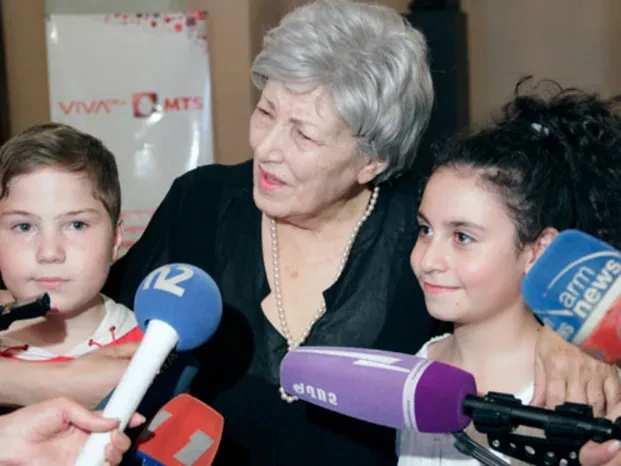
Russian and Armenian children met on an island in the Mediterranean Sea to play classics for the local population. It sounds a little absurd, but it was. We played Tchaikovsky, Prokofiev, Paganini. All of them, including the Maltese musical children, are the winners of the New Names contest, created once with the support of Gorbachev. Singers, several pianists, violin, cello, button accordion, clarinet, saxophone, Armenian brass and tiny girl Mary with a folk instrument of canon, reminiscent of gushers.
A whole international orchestra.
From the first concerts it turned out that the Russians and Armenians were prepared an order of magnitude better than the Maltese. This is explained simply: in Russia and Armenia - a strong Soviet school, and where does it come from in Malta? All this looked a little in advance: archaic and friendly. Suddenly it turned out that the Armenian duduk sounds good with button accordion, and even better with the cello. And the Maltese singer with a Russian name Raisa is quite comfortable to sing under the Armenian accompaniment. The director of the Armenian "new names" Silva Mekyanyan said at the closure: "Thank you, comrades!"
Knowing how often our musicians are served west, I asked all children the same question: "Where are you going to live when you grow up?" Here it must be taken into account that everyone has the experience of foreign tour: they were in America and traveled to Europe. Answers: In Russia, in Armenia, I don’t know, probably, in Russia, I would like to study in Armenia ... The brilliant Armenian pianist Asthik Gukasyan plans to study in Germany, but he still wants to live in Armenia. And only one boy said: “The public abroad is more grateful, and in Russia they find fault and criticize more strongly, but I like it. That's right, I need it as a musician. And I will live, maybe in Europe. ” In my opinion, he very clearly laid out everything on the shelves. It’s good there, but it’s bad, but right. So choose in your eleven years.
If you think about it, Malta is also ours, although few people know about it. On the giant sheet of the cactus is Necarato: "There was Seryozha from Engels." However, not only him. During the time of Paul, the first here stood the squadron of Admiral Ushakov, and the emperor himself was at one time the great master of the local knightly order. And if in the Mikhailovsky castle he was not tapped into the temple, it would be a Russian colony.
There is a legend that it was through Malta that he got from Rome to Jerusalem Gogol. “Once here on the same ferry,” the old Maltese told me, “one of your big writer sailed. And he was very sick. " For some reason, I immediately guessed who it was.
According to the official statistics of Russians there are about six thousand, but in reality there are much more. The main contingent is women who married local. Plus students. Plus businessmen. I ask the bartender at the hotel: “What are you you from? - Syktyvkar "
Two Russian schools. In the town of Pacheville, where the Maltese nightlife is concentrated, the Moscow club works. In supermarkets, a Russian corner is allocated - mushrooms, cucumbers, drying. Riga sprats look completely inappropriate in this series! True, they say that Russian products are brought from Germany, and not from Russia at all.
And naturally, Abramovich. Yacht, Villa, everything is as it should. I do not know a single coastal country, wherever Abramovich had a yacht and villa. In the same logic of popular myth -making in every Russian prison, there is a camera where Lenin was sitting.
University professor of chemistry, typical Maltese, dark -faced, low, friendly, tells me that he began to study Russian. Just so, I wanted. “I say badly, but I read a lot. Lermontov, Dostoevsky ... - And do you understand everything directly? - Certainly. Elementary! "
A common opinion: let Russians go to us than Libyans or Syrians. The Syrians, however, are not particularly going. But the Africans now and then catch rescue services from the sea. Surely sailed to Italy, but Malta is much closer. This is the southern outpost of Europe, already almost Africa.
It so coincided that it was these days that the EU summit on the problems of refugees took place in Malta. Meet, talked. It ended in creating another fund. On the closing day of the summit, on Friday, the 13th, Paris happened. Alan Kirkop, rector of International Institute of the Mediterranean (Malta), says:
- The Maltese are already finally waiting for specific actions from Europe, and not conversations that do not lead and do not decide anything. We are constantly faced with the problem of migrants constantly: in schools where their children come to study, in hospitals, in the streets, at construction sites. Small incidents periodically happen, but still nothing serious. We have a small country. It is not clear whether we can support those migrants who are already here, not to mention the adoption of new ones. That is why we turn to European partners for help. From my point of view, the first thing to do is legalize illegal immigrants. He arrived - no one mind, several organizations that help refugees work, the state pays benefits, the church also provides greater support. Live, but register with the authorities, pay taxes, find a job. True, not all employers are interested in this. It is more profitable for many to take illegal. The problem is precisely this. If migrants begin to contribute to the country's economy, there can be no complaints about them. Our historical experience taught us a normal attitude towards the newcomers. The main thing: stop being migrants, become the Maltese.
People come here not only because of climate and money (you won’t earn much in Malta, the average salary is lower than in Central Europe). The main reason is safety, it is really very calm here. Theft or murder - emergency. The Maltese are so careless and not frightened that at the entrance to the presidential residence no one asked what was in my bag. When one of the streets was blocked in connection with the summit, it was drawn to a historical event. And recently, for a month security reasons, they left the Schengen agreement. It sounds menacing, but in fact, this means that earlier the Euroclays went through customs without checking, and now they can be checked.
A day after Paris, an echo of a terrorist attack responded in Malta. In the nightclub, someone shouted “GAZ!”, A panic, a crush, a platform at the output broke. Everyone is alive, but many wounded, two in critical condition. For a small peaceful country with a population of 450 thousand - this is monstrous, unprecedented. They say: "We hoped that they would not notice us, that bad people simply did not know that we exist ..."
And another event there and on the same days. Biennale of Christocentric art, one of the rare attempts of dialogue between the Church and Contemporary Art. Among the participants are eight Russian artists. The works are exhibited in the cathedral of the ancient capital of Malta Mdina right among the altars (and some even in the altar are installed) and in the neighboring Palazzo. This show would probably end with a face, and then nothing, they walk, look. However, there is nothing truly shocking here, there was no initially installation on the scandal and provocation. Totem Biennale is a Maltese donkey with pacifiks on his back. A small sad animal, but very peaceful.
Muscovite Gore Chakhal, whose work is also in Mdin, says:
- In Russia, it could be the same, the conflict is far -fetched, it is deliberately incited. There is an ultra-conservative wing that wants to separate the church from the world and close it into a national-religious reserve. On the one hand, they provoke. And on the other hand, the Europoriented Artistic party uncompromisingly and aggressively opposes the church, since the church insists on cultural identity. The conflict is stimulated on both sides. My experience shows that it is easier to find a common language with church people than with an actual party. At least they listen to when you explain them, and from time to time make contact. It is more difficult with artists, they rested. But there are many sane people, and even now, when the situation is extremely acute, you can still agree. You just have to want very much. The only way is to meet and talk, without hysteria, without tearing, without hatred. Build a dialog. Although ... in 1917, too, it probably seemed that everyone understood everything and could avoid blood. ”
... And then they went on stage, these children, the Maltese, Armenian, Russians, and in chorus sang the anthem of the Malta: “Give me, Lord, we are a wise ruler, help you unite and live in the world!”
A very correct anthem.
Valletta - Moscow
We thank the European Culture Support Fund for help in organizing material