
Translated material
Moscow is offered to wait in the hallway
France President failed to convince the US president of the need to create a unified anti -terrorist coalition involving Russia, and the Turkish factor took part of Russia in this coalition even more problematic
France President failed to convince the US president of the need to create a unified anti -terrorist coalition involving Russia, and the Turkish factor took part of Russia in this coalition even more problematic
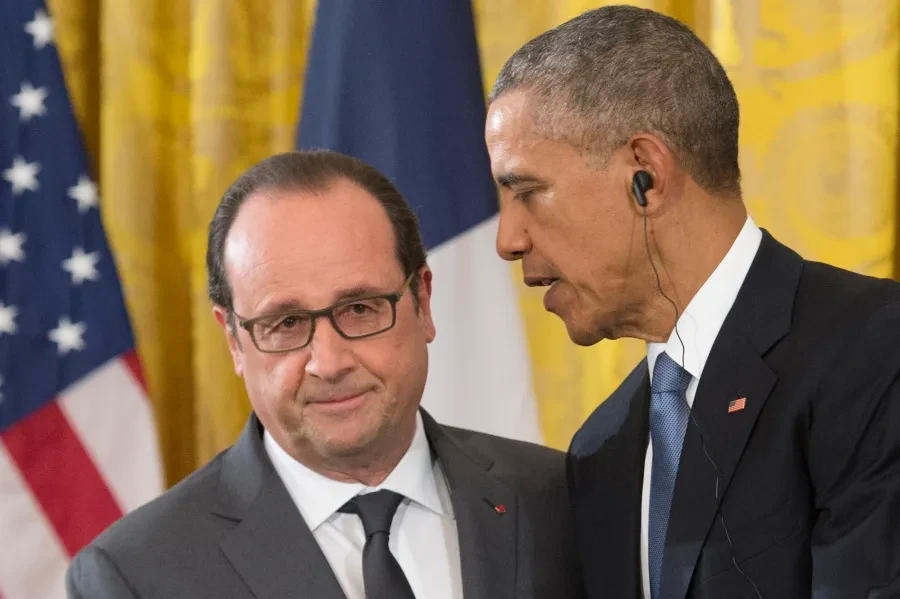
At negotiations in the White House, the presidents of the United States and France agreed to join forces in the fight against the Islamic State (this terrorist organization is prohibited in Russia). We are talking about cooperation between intelligence, intensifying air strikes, and blowing up a financial network of terrorists. The White House course regarding ISIS has not changed. Obama does not want the American army to be drawn into a military conflict in the Middle East. As it turned out, President Hollandes also does not want the French troops to land there.
"We already have a coalition"
At a press conference in the White House, according to the results of negotiations, the presidents asked journalists directly: can Russians and Americans act together under a single command? To which Obama replied: “Russia can play a more important role in the fight against the“ Islamic state ”in Syria if Moscow begins to bomb Islamists, instead of applying air strikes in the rebel groups fighting Assad’s troops.” The Frenchman’s call to create a common front against a common enemy did not find a response in Washington. “Our coalition includes 65 countries. There are only two in the coalition of Russia - she and Iran herself, two countries that support Assad, ”Obama said.
Francois Hollande on the eve of the upcoming meeting with Vladimir Putin in Moscow carefully responded about cooperation with Russia: "We do not exclude anyone."
Both presidents supported negotiations in Vienna, the speedy establishment of the ceasefire, the creation of a new government of "unity" and - as a prerequisite - the resignation of Assad. Despite the fact that the leaders of the United States and France promised to strengthen the fight against the IG, threatened with Islamists the inevitable collapse, they made it clear that neither the American nor the French infantry would land in Syria and Iraq to fight with ISIS. Parts of the Syrian opposition should fight "on Earth".
"We are all French now"
The US President uttered these words in French, thereby recalling the headlines of Parisian newspapers, which immediately after a terrorist strike on America on September 11, 2001: "We are all Americans now." Obama continued the lyrical maxims, noting that many places of France are roads to the hearts of his compatriots. After reports of terrorist attacks in Paris, "hearts were broken." France is the road and the presidential account. In the bedroom of the first persons in the White House there is a photo: the hut and Michelle kiss in the Luxembourg Garden.
The American media note that the blow to Paris rallied the French around the president. Olland's rating went up. But Obama’s rating fell - at once by five points compared to the last month. Less than half - 46% of Americans surveyed by Washington Post and ABC News approve of the president’s actions.
Moreover, 57% are not satisfied with Obama’s policy in relation to ISIS, 43% are “not satisfied” with how the president fights terrorism.
The American press notes that the two countries have now become perhaps the closest military allies. When the United States was going to invade Iraq, French President Jacques Shirak warned the White House from this mistake, and the Foreign Minister reminded the Americans: “You can win the war, but lose the world.” Then, outraged by the position of France and covered by a patriotic impulse, the Americans demanded to rename the “potato potatoes” in “Potato Freedom Potato” in the menu of the local restaurants.
And now the French president is already hiding in war drums and calls for an American colleague to more active actions against IG. France is so far the only European ally of the United States, directly participating in the hostilities against ISIS. By the way, in the Raqqi bombing - the unofficial capital of the state of the Islamic Islamic Aviation, American intelligence helped. After terrorist attacks in Paris, the Americans posted the flags of France as a sign of solidarity and sang Marcelusa. There is a stormy Renaissance in bilateral relations of the once main antagonists of the Western world.
Turkish factor
American experts are confident that the connection of Moscow to the “Unified Coalition” will become even more problematic after the attack of the Turkish fighter on the Russian bomber. Moreover, the anonymous source of Reuters in the American administration said that the Su-24 was shot down by the Turkish missile over the territory of Syria, after a short time was in the airspace of Turkey.
The data of the Americans are based on the analysis of the thermal trace of the Russian aircraft. The incident in the spirit of the Cold War hardly obscured the negotiations of Obama and Hollande. The presidents of the United States and France, going out to reporters, did not comment on reports about the downed plane. Later, Barack Obama, one might say, “showed Atlantic solidarity,” noting that Türkiye has the right to protect its airspace. “The incident showed the problem caused by the actions of Russia,” Obama said, answering questions from journalists. “Russians conduct air operations near the Turkish border, they lead them against a moderate opposition, which is supported not only by Türkiye, but also by a number of other countries.”
On Wednesday night, the presidents of the United States and Turkey held telephone conversations, agreeing that such incidents should be avoided in the future, the White House said.
Syria and Ukraine
The White House was initially skeptical of the idea of Hollande to combine the military efforts of the United States, France and Russia. Employees of the Obama administration privately expressed concern that Europe could not extend sanctions against Moscow, writes Politico. France carries serious financial losses due to these sanctions. And now - after the attacks in the Sinai and in the French capital - Moscow and Paris are united by a common enemy. In Washington, they feared that at a meeting with Hollande, President Putin would bother the events in Syria with the problem of Ukraine, and the more active hostilities of Russia against Igilovites - with the support of the EU sanctions regime supporting France.
“Early lifting of sanctions has always been our headache,” said Evelyn Farkas, who until recently was involved in the Pentagon with issues of Russia, Ukraine and Eurasia. - They (Europeans) cannot refuse sanctions. Ukraine is a separate problem from Syria. ”
“We categorically do not want to see any connection between the Ukrainian issue with the situation in Syria,” Deputy National Security Advisor Ben Rhodes told reporters. “The sanctions were imposed against Russia not because of Syria-because of Ukraine, because of Russia's constant violation of the sovereignty and the territorial integrity of this country.”
The fears of the Americans that part of the sanctions by the Europeans can be lifted, regardless of the implementation of the Minsk agreements, is “exaggerated”, believes a former Foreign Ministry employee, expert of the Washington Center for Strategic and International Research Simon de Galber: “I do not think that we will see some concessions in Ukraine in exchange for several more additional Russian aircraft (in Syria). The fate of sanctions against Russia will be resolved exclusively on the basis of an analysis of the situation in Ukraine. ”
The coalition of two
The American media drew attention to another visit - Vladimir Putin to Iran. In addition to participating in the forum of the Gaza Exporters forum, the Russian president met with the Supreme Leader of the Islamic Republic Ayatollah Ali Hameni (the Syrian and Lebanese press called this event “a meeting of the titans”). Washington and Moscow appreciate the results of these negotiations.
The newspaper Wall Street Jornel is primarily interested in experts about the strength of the Prosadov Union of Iran and Russia - the “Koalition of two”, as Obama called this bunch. According to American observers, this coalition is short -term. Tehran’s political goals in the Middle East and economic ambitions in the global energy market are largely diverged with the interests of Moscow. After international sanctions are completely lifted, Iran will inevitably become a competitor to Russia in the gas industry. Tehran wants to export energy to Europe, for which he intends to lay a pipe through Syria to the Mediterranean Sea. In general, even in Syria, both countries will begin to compete as soon as the battles end there.