
Translated material
Real Macondo: 375 years old Alzheimer
In Marquez’s novel “A Hundred Years of Loneliness”, the city of Macondo covers an epidemic of unconsciousness. “The visual idea of how the inhabitants of Macondo tried to fight with forgetfulness, gives a sign hung on the neck of the cow on the neck:“ This is a cow, it needs to be milk it every morning to get milk, and milk should be boiled to mix with coffee and get coffee with milk. ” That's how they lived in reality that constantly eliminating them, with the help of the word they managed to detain it for a short moment, but it should have inevitably and finally disappear as soon as the meaning of the letters was forgotten. ”
Marquez is a Colombian, and Macondo is a fictional Colombian city. But thanks to neurophysiologists from several American universities and one Colombian, it became clear that in Colombia there is a real prototype: this is the city of Yarumal in the province of Antiocia. As follows from a fresh publication in the medical journal Alzheimer ' S And Dementia , the problems with the memory of its inhabitants began long before Marquez printed his novel in 1967-namely about 375 years ago. And this, apparently, is to blame for this, a single Spanish conquistador.
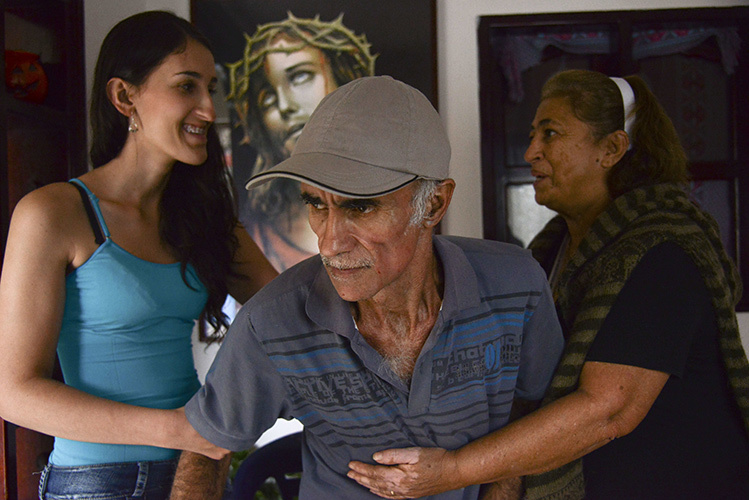
This is the case when not children, but parents often take care of patients in senile dementia.
About five thousand carriers of the gene live in Yarumal, which causes an especially early variety of Alzheimer's disease. It begins in 40-45 years, and sometimes in 32, and usually by 47 makes a person a completely helpless disabled person. This is the case when adults, senile dementia, often not children, but the parents (at the age of 70), which the disease has not touched on.
They began to write about the city outside Columbia, when the American biotechnological company Genentech decided to conduct clinical trials there at a price of $ 100 million and lasting seven years. They began in December 2013, and the results will be summed up in 2020. The drug is a krenzumab, which in theory should prevent Alzheimer's disease - not only hereditary, like the Colombians, but also its more common forms.
By the scale of the plan, this is how to find a cure for cancer. In the USA alone , 5.3 million people suffer from Alzheimer. Every third old man dies from Alzheimer (or other dementia). Also from the page of the "quick facts" of the site ALZ . Org : "The list of 10 most common causes of death in America is the only thing that cannot be prevented, cured or slow down." The cause of the disease is not a virus or a bacterium, but its own body protein, which begins to uncontrollably accumulate inside nerve cells (Colta.ru recently told how this mechanism works in detail).
If the symptoms have already manifested - to fight late, there are several others on one already destroyed brain cell, where there are already too many harmful proteins. The creators of the Krenzumab, who first considered it necessary to try their medicine for those who are already sick, were also convinced of this - and these tests ended in failure. Then they decided to go in December 2013 to experiments on still asymptomatic volunteers from Colombia-to check the statement about "cannot be warned."
Alzheimer's disease is in the list of the 10 most common causes of death in America: the only thing that cannot be prevented, cured or slow down.
The idea was this: to recruit 100 healthy people and 200 carriers of a defective gene aged 30 to 60. All of them should appear to the doctor for an injection once every two years. The participation conditions are tough: you can’t get pregnant for all five years, gain weight more than 120 or less than 45 kilograms, take a whole list of drugs for ordinary diseases. And still, those who wish were found in sufficient quantities. The completely defect is called the “dominant autosomal mutation of the E280A in the Psen1 gene”, and the word “dominant” means that if at least one of two genes transmitted by parents is defective, then you will get sick almost for sure. The unpleasant feature of the experiment is that 200 out of 300 of its participants all five years will go there and back to the placebo, a harmless injury of saline. Including - exactly half of the carriers of the mutation, which in the near future will begin to forget simple words, their age and how to use the toilet. To draw conclusions about the effectiveness of the medicine, scientists must have a control group for comparison, which does not receive medicine. At the same time, the “double blind testing” technique suggests that about the distribution of drugs by ampoules - where the medicine is, and where the dummy is not known not only by patients, but also by doctors who make an injection.
So far, GenentecH conducts its tests of medicine, another group of scientists-from the University of California in Santa Barbara-set itself a more modest task: to find out to whom or what the city owes its misfortunes. The disease affects 28 large families, inside which kinship is relatively easy to track, but the connections between families are in question. Professor Kennett Kosik, who guided the molecular and cell neurobiology laboratory at the University, recruited 102 volunteers from different families in Yarumala, took blood from them and conducted two different DNA analyzes.
200 of the 300 participants in the experiment who threatens the loss of memory, all five years will go there and back to the placebo every two weeks: scientists need a control group in which the disease develops naturally.
The first test was identified by a defective gene - it was found in 74 out of 102 people. The second according to other, less critical, mutations determined the degree of kinship between those who have a defective gene. This for geneticists is a routine mathematical task - in this way, the age of a common ancestor is calculated in related biological species (for example, people and chimpanzees) and even languages .
The Yarumal residents, who are threatened with the early Alzheimer, was found such a ancestor 15 generations ago: if we consider 25 years to the average interval between generations, it will turn out 375 years. According to a number of additional signs, scientists concluded that the ancestor was from continental Europe-and since we are talking about Columbia of the 375-year ago, that is, the beginning of the 17th century, we are talking almost certainly about the Spanish conquistador.
Markes Jose Arcadio Buendia is starting a long campaign to “come into contact with the civilized world,” and the inhabitants of Macondo, after many days, stumble on the Spanish galion of the conquistadors: “He was slightly tilted on the right side, the dirty shaggy fumbles of sails were hanging from completely decorated orchids.” No one is waiting for the Spanish conquistadors in an article on molecular biology, but, having taken up the Markes plot, even molecular biologists find themselves in a world where minor personal acts and family stories are able to influence the course of events after more than 300 years. When the captain of some galleon in Spain was gaining a crew (and took there by chance a man with an E280A mutation), he was unlikely to foresee that it may have help to find a cure for Alzheimer between 2015 and 2020.