
Translated material
Inglorious bastards
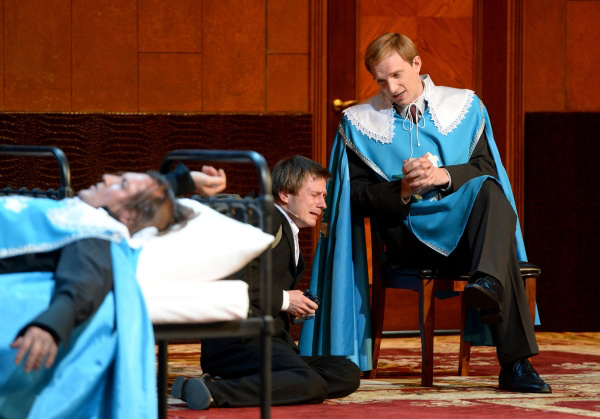
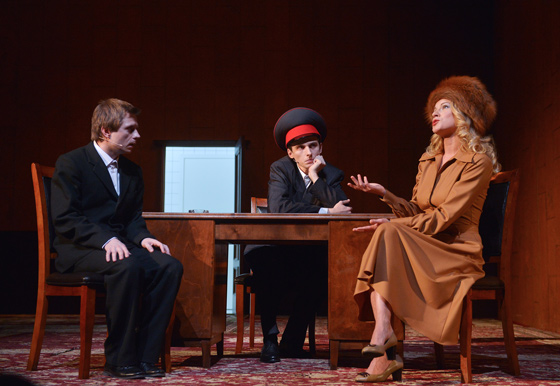
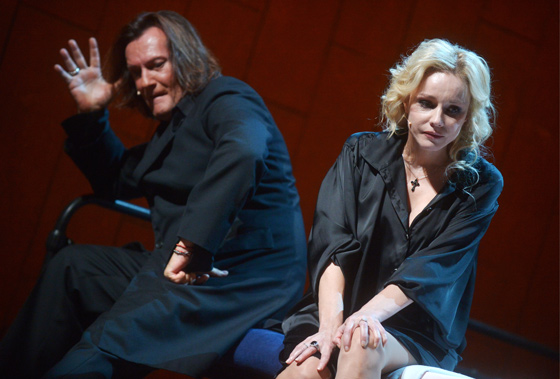
In the universe of the new “musketeers”, completely invented by the director Konstantin Bogomolov, there are two irreconcilable forces-“Love and Death, Queen and Cardinal”-and the battle between them unfolds not somewhere, but in Moscow in 2015. The noble Queen Irina Petrovna (Irina Miroshnichenko) sighs along the Canadian pop artist Justin Bieber (Pavel Tabakov), and Cardinal Uncle Vitya (Viktor Verzhbitsky) sets up the king Uncle Sasha (Alexander Semchev). The cardinal has my lady (she is played by Marina Zudina, and who she is here, you better know from the performance), the queen has a fanatically devoted to her musketeers ATOS, Portos and Aramis (respectively Igor Mirkurbanov, Andrei Burkovsky and Igor Vernik). Who are the musketeers in the performance of Bogomolov? If you believe Athos, the musketeer does the same as other people: eats, sleeps, copulations - but does it "like a musketeer." Nikolai Fedorovich Ermilov recruited by children of friends (see “Memorial Word” by Sorokin), he is de Treville, now deceased. Many years have passed since then: the heroes of the performance of Bogomolov are already “grandfathers” and themselves convey the musketeer wisdom “to the new recruit”, a naive 17-year-old guy from Krasnodar with the usual Armenian surname Artanyan; In this role, young artists Evgeny Perevalov and Danil Steklov alternately act.
The performances of Bogomolov - the response of the theater to the state, from the beginning of the tenth aggressively imposing a new identity.
All the text that sounds in the “musketeers” was written by the director in the process of rehearsals, for the playwright of Bogomolov this is almost a debut. Almost - because back in April, he set his own play in Liepae “My Blaster was discharged” , moreover, since the time of the “lira” of the staging of Bogomolov, they seriously diverge from the original source. For a long time, the directorial remark, a kind of theatrical analogue of the Internet, was displayed for a long time, the director’s signature. It would seem that with the signs of Bogomolov’s literary style the audience is as well as well as with his directing: irony, black humor, absurdity and grotesque, mixing of eras and cultures-“in Russia was 1597, and in Poland the Sopot-1979 festival took place (this is from last year’s “ Boris Godunov ” in Lenkoma). “Musketeers” allow you to see the Bogomolov-Dramator in full growth-and this, of course, is a separate, completely independent plot of the Moscow Art Theater Premiere.
His syllable suddenly turns out to be inherent in a kind of poetry: not because the characters occasionally speak rhyme, but because they are abounded in comparisons, often deployed, like an analogy between the wind of dead members and the erection of a living member. This property of the text refers us to a well-defined tradition: the allusion is not indicated as obvious as frequent in the “musketeers” links to Russian classical prose and Soviet pop culture, but it is guessed quite definitely-this, undoubtedly, Shakespeare. In Bogomolov, however, poetic techniques inherent in the Barda syllable are mainly used to achieve a comic effect: when the hero of modern drama speaks the Shakespearean syllable - this is ridiculous.
 © Alexey Bobrov / TASS
The “musketeers” represent almost the entire cultural background of the average modern Russian, and Bogomolov does not attempt to streamline the collective unconscious in a certain hierarchy: Pushkin is adjacent to him with Kirkorov, Dostoevsky’s novels with a series about Cheburashka. Hyperlinks for books, films, cartoons flash in the text in a minute: culture for the characters of Bogomolov, as well as for the heroes of his beloved Tarantino, is a way of describing the world. And this is not the only parallel between the two directors: Mr. Quentin shoots the author’s versions of genre films, the mantis takes on the basis the plot, known to most compatriots in the adaptation of 1978, - I strongly doubt that Alexander Dyum’s novel would have attracted his attention if that cult films with Mikhail Boyarsky had not been shot.
Judging by the "musketeers", the interest in the mass culture of Bogomolov is anthropological. His performances, by and large, are the response of the theater to the state, from the beginning of the tenth of the aggressively imposing a new identity. The significance of the works of Bogomolov is not so much political as social: about what “Russianness” (rather even “Sovietness”) is, no one speaks from the stage more often and rather than the author of the “ideal husband” and “Karamazovs”. As I would not understand the “rainbow tribune” - the satirical production of the young leaders of the new Polish theater Pavel Demirsky and Monica Stamka - if not for the comments of the Polish colleague and the “musketeers” of Bogomolov without outside help would not understand the foreigner.
 © Alexey Bobrov / TASS
What gives the director an analysis of domestic culture-and, in particular, pop culture? For example, he notices a claim of aristocracy in the “our man”, the desire to see himself beautifully, more noble than he really is. The life of the nouveau riche is the favorite theme of the artist Larisa Lomakina, who is involved in all his projects: for the “Karamazovs” “status” things like a nasal chain for $ 55,000 were purchased, and in the same “musketeers”, the theater pavilion is the artificial crocodile skin, traditional for the tandem of the Bogomolov-the Lomakina. Is it not the same nature - the popular love of the adventures of d'Artagnan and his friends, for the Soviet television movie in the first place? It is no accident that Bogomolov refers to him in the terrible scene of group rape, when the friends of D'Artagnan “punish” his incorrect wife Constance. Although the “concepts” replace these heroes with the Knight's Code of Honor, it is in this episode that they change into “knightly” costumes - that is, into the blue musketeering raincoats thrown into everyday clothes. In an interview with Gazeta.ru, two years ago, shortly before the premiere of the “ideal husband”, the pilgrims remarked: “Our world was built on combining the attempt to be sir, peers, lords and my lords-and primitive-appropriate essence.” This is only one of the meanings arising in the performance-but it is he who somehow particularly accurately resonates with the agenda of the Day of Modern Russia, the main characters of which at some point became role-playing and reconstructors.