
Translated material
The fleet is trapped
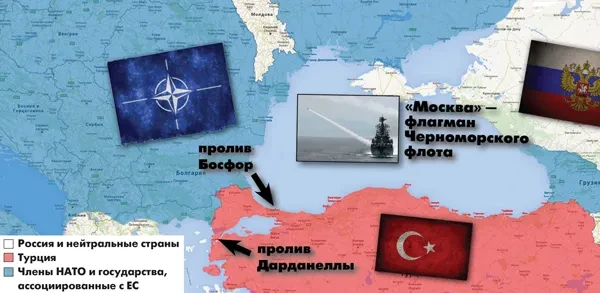
What threatens Russia if Türkiye will block Bosphorus and Dardanella?
What threatens Russia if Türkiye will block Bosphorus and Dardanella?
After the attack of Turkish fighters on Su-24 in Syria, Russia transferred the S-400 anti-aircraft missile systems to the Arab Republic. Turkish President Recep Erdogan said he would regard the use of complexes against Turkish aviation as aggression. In this case, according to him, “further measures” will be taken.
One of the measures that Türkiye can take advantage is the overlap of Bosphorus and Dardanella for Russian ships. Moreover, both military and trade. Lawyers claim that this is impossible by international law. But who and when did international law bothered?
The political scientist and geographer Dmitry Oreshkin spoke about the geostrategic and economic risks of the Black Sea blockade of Novaya Gazeta:

- Record Erdogan, long before the Syrian crisis ( in March 2014. - N. G. ) threatened Vladimir Putin to block Bosphorus. Then this was due to the referendum in the Crimea and the rights of the Crimean Tatar population, which, according to the concept of Erdogan about the “pan-Turkish world”, is under the protection of Turkey.
In international law there is a concept of open straits. These are straits connecting open waterquakes. For example, the Gibraltar Strait between the Atlantic Ocean and the Mediterranean Sea, which has access to the Black Sea. Open straits are not controlled by anyone.
Another status of closed straits, such as Bosphorus. Countries located on the shores of a closed water area want to have an advantage of control over the strait through which ships are included in this sea. For example, the Strait Ormuz, leading to the Persian Gulf. It is closed, and states located on the banks of the Persian Gulf are trying to control it all the time. The same with the Black Sea. Russia, Ukraine, Türkiye, Georgia, Romania and Bulgaria have access to it. For Russia, the geostrategic situation over the past decades has sharply worsened. Previously, Romania and Bulgaria were allies, Ukraine did not have its status at all. Now the opposite. There is Russia, and against it - Türkiye, Bulgaria, Romania (all in NATO), Georgia, Ukraine.
The 1936 Montreso Convention on the Black Sea Strait regime gives Turkey a fairly wide minimum of rights to Bosphorus and Dardanella. This is natural, because both straits are entirely on its territory. And in the event of a war or threat of war, Türkiye can generally close the passage for warships. Therefore, when Erdogan says that striking on Turkish aircraft over the territory of Syria will be perceived as aggression, this is not just “we will be offended”. This means that Turkey has the right to close the straits for countries from which a military threat comes.
All sane experts say: it is unprofitable, Türkiye feeds on transit, the closure of the straits is contrary to the interests of NATO. But we live at a time when something is performed in which I do not believe. Therefore, it makes sense to consider this incredible situation. If Türkiye blocks the strait for military vessels, Russia has problems with the supply of military bases in Syria. You can supply them through St. Petersburg and Murmansk, go on the other side, through Gibraltar, but this will take much longer ( the path will take two weeks instead of three or four days.-N. G. ). This is not fatal, does not break the back, although it complicates the life of Russia and closes it from the point of view of a military strategy within the Black Sea basin.
But in 1994, Türkiye unilaterally adopted another document - the regulation of shipping. There are many more unpleasant things, because it concerns not only warships (the Montreo Convention limits mainly them). About 25 million tons of oil and 37 million tons of oil products from Russia go through Bosphorus and Dardanella a year. This is a serious share of the sector. Based on the fact that oil production last year amounted to about 525 million tons, 25 million tons - this is about 5%. The share of oil products is probably higher, since export oil goes mainly through oil pipelines, and petroleum products are transported precisely by sea transport. Plus exports of steel, grain, building materials.
So, according to the regulations, the passage of such courts can be limited under any prepositions: environmental, sanitary or referring to repair and other work on the channels. And this will cause serious economic damage to Russia. What to do? The positions of Russia in the Black Sea basin are weakened, the Turkish Navy is stronger, so it will be difficult to excite and pushing with elbows.
In my opinion, you can only answer this by finding interaction with NATO so that the organization affects Turkey. NATO in this case the Peacemaker. They certainly definitely do not need an escalation of stress, because the tougher the situation in the region, the higher the risks of terrorist strokes in Europe and the USA. Therefore, they want Erdogan in peaceful conditions to provide protection against sealing to Turkey IG militants ( organization is prohibited in Russia. - N. G. ). That is, Russia, oddly enough, can put pressure on Turkey, perhaps only through NATO.
Of course, the main part of the grain, oil and steel exports does not go under Russian flags, but by library flags, Cyprus. Therefore, our experts believe that formally Türkiye will not be able to stop these vessels. However, in my opinion, the regulation of navigation gives many reasons for the nit -picking. The question is only in the political will. And Erdogan’s political will is very intricate. Such people act irrationally, they are unpredictable. It is important for them to show that they are strong politicians that respect them. And if Erdogan rejuvenation properly falls under the tail, he can act contrary to his long -term interests, if only they would be considered with him.