
Translated material
"War of sanctions": ambitions and reality
20 years ago, Russia, in the pace of rapprochement with the West, escaped to the leaders among the CIS countries. It took only 20 months so that all the achievements in this direction are completely reduced to naught. And go to minus
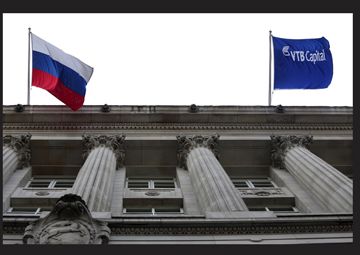
On November 26, 2015, the head of the State Bank of VTB Andrei Kostin admitted that the sanctions hit the bank, London, the 2014 VTB Capital office
The legend is still fresh: in 1994, Russia signed an unprecedented in its history agreement on partnership with the EU. Then we were invited to the "seven", which became "eight", were admitted to the Council of Europe. Ahead was membership in the WTO, then in the prestigious club of rich countries - members of the OECR. In 2014, everything turned back: de facto interrupted our participation in the Eight, and the OECR suspended negotiations on the adoption of Russia. The reasons are known. And in the degree of "proximity" with the European Union, not only Ukraine, Georgia and Moldova, but also Kazakhstan with Armenia, bypassed us.
Two glances
“Such an instrument as sanctions should generally be removed from the international economic vocabulary and communication. It should not be used in the global economy, ”President Putin said following the results of the SCO and BRICS summits in early July 2015 in Ufa. And he added that sanctions turn over the economy "upside down." You really can’t argue with the latter. But as for the seizure of sanctions from international economic communication, it would be wonderful, but we do not live in an ideal world.
In Russia, whole generations formed militarized thinking: a counterattack must be responded to a blow from the outside. In the war, this is exactly how. Decades of peaceful life have not changed our psychology
International sanctions are provided for by the UN Charter (Article 41), and during the post -war period were introduced on the basis of the UN Security Council resolution 19 times, including in relation to South Africa, Iran, Yugoslavia and others. It is clear that such sanctions can hardly be introduced: being a member of the UN Security Council, it will block them in any case. Another option for imposing sanctions is based on the verdict of the International Court in The Hague. Here are two types of sanctions that have a legal basis, and therefore, strictly speaking, they should only be called “international sanctions”. Everything else is sanctions from individual countries. They do not have the same solid legal framework, however, they are also applied, which we had to make sure 20 months ago, in March 2014, when the West introduced the first restrictions on Russian banks and people.
Do we use similar sanctions ourselves? From our point of view - no. But the look from the outside is somewhat different. IN
In 2006, Russia announced the ban on the import of wine, mineral water and fruit canned food from Georgia, this was explained by sanitary considerations. However, all over the world it was perceived as Moscow sanctions against the Saakashvili regime. A similar story was with Moldova. Now in Moscow they talk about strict economic measures regarding Turkey - what is this?
The WTO will not help
Until the very last moment, Moscow did not believe that the West would decide on sanctions against the Russian Federation, because it is economically unprofitable for the United States and the EU itself. It turned out that in high offices they do not remember the latest story very well. From the 1930s to the beginning of the Gorbachev perestroika, the West has repeatedly imposed sanctions against the USSR to the detriment of its interests-it is enough to recall the US ban on the sale of grain in 1980, when it was in abundance in America itself.
Shortly after the introduction of economic sanctions in Moscow, they started talking about violating the rules of the World Trade Organization and the intention to file a complaint with the WTO resolution of the rules of the World Trade Organization. However, no complaint has been filed to this day - they limited themselves to the distribution of an information letter among the WTO members in June
2014, in which, in fact, we stated our assessment of sanctions against Russia, noting that they are contrary to the spirit and letter of the WTO.
The sanctions introduced against Russia really contradict the WTO spirit, but with the letter it turned out to be more difficult. Violating the freedom of trade, the sanctions, without a doubt, violate the fundamental principles of the WTO aimed at opening markets and ensuring stable and predictable trade relations. However, in the Rules of the WTO there is a loophole in the form of a link to the protection of "national security". The loophole is designed by Article XXI GATT * , in which, under the term “exceptions for security reasons” (that is, exceptions that allow the introduction of trade restrictions), the state “considers it necessary to protect the significant interests of its security”.
The question arises: when can you refer to exceptions for security reasons? The issue was widely discussed in the WTO for many years, but there is no certain answer to it. And in the absence of a clear definition, what these “essential interests of security” are, WTO members perceive the mentioned Hatt article simply as a carte blanche. After all, it allows you to violate its obligations within the WTO for non -economic reasons. In history there were cases when sanctions were called into question using the procedures for resolving disputes, but this was rather an exception from the overall picture.
Thus, the EU with the United States with its sanctions against the Russian Federation, and Russia with its counter-sanctions-all in its actions rely on the same article of the XXI GATT. Of course, everyone interprets it in their favor. And this is almost a dead end. The way out exists, but it lies in a different area - political agreements around the Ukrainian crisis.
Get away from the principle of "Talion"
But back to Putin’s call for the seizure of sanctions from the international vocabulary. It is logical to assume that it refers to all parties involved in the sanctions war. Consequently, to us by ourselves, which applies in relation to the EU, the USA and some other countries of counter -sanctions. What is their meaning, are they justified?
In Russia, whole generations formed militarized thinking: a counterattack must be responded to a blow from the outside. In the war, this is exactly how. Decades of peaceful life have not changed our psychology. Therefore, many considered that the announcement of counter -sanctions in response to Western sanctions is something natural, for granted and does not require preliminary analysis. The principle of “eye for an eye, tooth for a tooth”, reflecting the establishment of justice in a rude form, is close and understandable to us. He formed in the family society and is known in the history of law as the “law of equal retaliation” (Lex Talionis). The primitive peoples of Talion met in various forms, but at the same time the main motive for its application was the desire to equalize the punishment with the damage caused. Are we really guided by such a primitive motive, announcing in early August last year of counter -sanction or the so -called grocery embargo * * ? What did you achieve as a result?
It turned out in a surprising way: our response measure did not give the effect on which it was designed. By the anniversary of Moscow, the European Commission has calculated the effect of the Russian ban on the announcement of food products. The conclusions were unexpected: the export of food from the European Union countries for the past period not only did not fall, but grew by 5 %. This happened due to the rapid development of new markets. Of course, individual countries and individual sectors of agricultural production in the EU, focused on deliveries to the Russian Federation, were injured, but this does not change the general result.
In August 2015 (a year after the well -known decree of the President of August 6, 2014 “On Counter Sanctions”), a report of the analytical center under the Government of the Russian Federation under the name “Food Embargoes: Import substitution and change in the structure of foreign trade” was published. It directly follows: the introduction of counter -sanctions led to food inflation in Russia, since the ban on imports negatively affects competition and leads not only to price growth, but also to reduce product quality. It turned out that with our counter -sanctions we punished ourselves, and not those against whom they were planned.
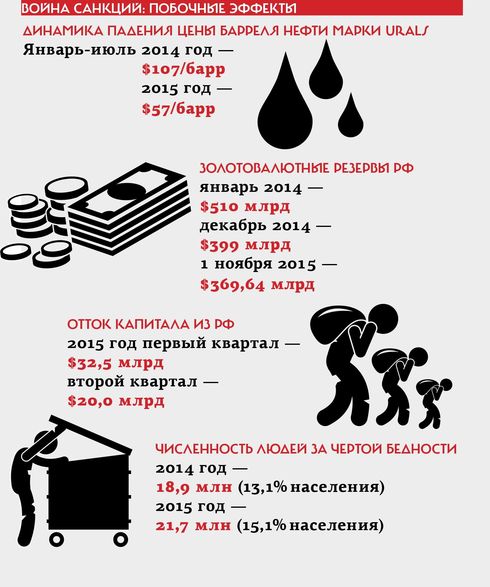
$ 160 billion - damage from Western sanctions, only according to official estimates
Self -insulation is impossible
To defeat in the sanctions war of Russia is beyond strength - and this was worth realizing from the very beginning, so as not to exhaust their economy and citizens with a primitive skirmish on the principle of “eye for an eye”. We can measure nuclear missiles with the West, but not by the economy. Let me remind you: the share of the USA and the EU in the world GDP is about 40%, and Russia has less than 3%. Is it really here out of habit counting on a miracle? If the sanctions continue, then in the coming years this can most seriously affect the production of oil and gas - high -tech equipment is critically necessary for the development of new deposits, and it is the Western (American and Norwegian).
The sanctions war is harmful to everyone, but Russia suffers more - its economy is weaker. The West, in turn, repeats about the “point” application of sanctions in the spirit of the principle of “no harm”. But this is not entirely true. Our scientists suffer who have become less at international forums in the United States, representatives of small businesses, who suddenly began to refuse visas in the EU, etc.
Food exports from the EU countries for the period of Russian counter -sanctions not only did not fall, but grew by 5 %. This happened due to the rapid development of new markets
Sanctions and counter -sanctions, as it seemed to us, created unprecedented favorable conditions for import substitution. But this is a misconception. If, for example, to set the most difficult task to produce all components for the Superjet 100 aircraft, then even in case of solving it, Russia could not export these aircraft to the European market-due to certification problems. So, the whole project would generally lose its meaning. And this example is typical. Not a single country in the world is already producing a complex product from beginning to end-the modern economy works differently.
More than 60 years ago, the father of the German economic miracle Ludwig Erhard wrote: “In other times, it was believed that in“ national ”interests to pursue a policy of nationalist self -isolation, replacing the import of his own products supported by nationalist backups and artificially high prices. Accordingly, the idea of “national self -sufficiency” in the spirit of a closed economy was widely carried out ... there was a destruction of world trade, and with it and the international foundations of mutual trust. ” We should pay attention to the arguments of the outstanding German reformer.
* Gatt - General Agreement on tariffs and trade - the main component of the legal basis of the WTO.
* * In case of imports, it is customary to use the term “ban”, and the “embargo” usually refers to export.
Photo: Chrisratcliffe/Bloomberg